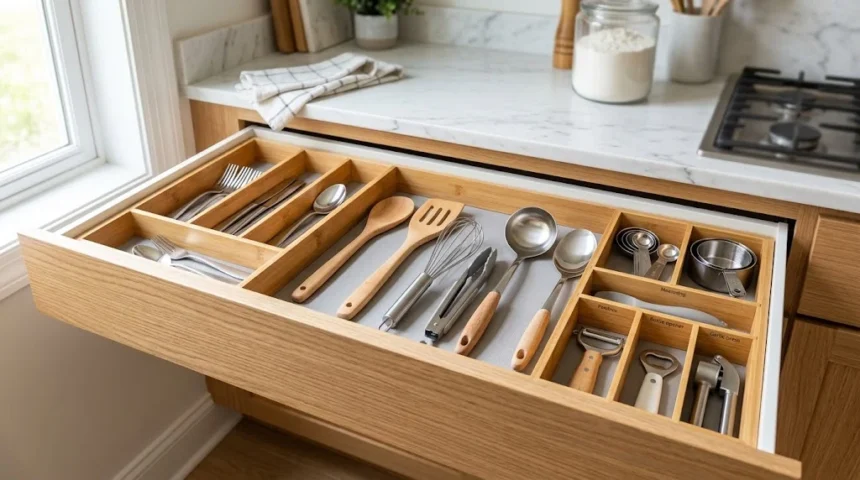
Knowing how to organize kitchen drawers can completely change how your kitchen feels and functions every day. When drawers are crowded with loose utensils, gadgets, cutlery, food storage accessories, and items you rarely use, even simple cooking tasks can become frustrating. A well-organized kitchen drawer makes everything easier to see, reach, and return to its proper place. It also helps you make better use of limited storage space without investing in expensive renovations. Whether you have a compact apartment kitchen or a large family kitchen, the same basic organization principles can create noticeable improvements. The goal is not to make every drawer look perfect, but to make each one practical and easy to maintain.
Professional kitchen organization starts with understanding how you actually use your space rather than copying a picture-perfect setup from social media. The best kitchen storage solutions are based on your cooking habits, daily routines, drawer sizes, and the items you reach for most often. Drawer dividers, cutlery trays, adjustable organizers, and containers can help, but they work best after unnecessary clutter has been removed. By giving every utensil and kitchen tool a logical home, you reduce visual mess and save valuable time. A few thoughtful changes can also prevent drawers from becoming overcrowded again. With the right approach, organizing kitchen drawers becomes a simple system that continues working long after the initial cleanup.
Why Organized Kitchen Drawers Make Everyday Life Easier
Kitchen drawer organization is about much more than making your home look neat. An organized drawer allows you to find the tool you need immediately instead of searching through piles of utensils while preparing food. When cooking becomes busy, knowing exactly where your measuring spoons, knives, peelers, or serving tools are located can make the process noticeably smoother. Organized storage also reduces the chance of buying duplicate items because you can clearly see what you already own. It makes cleaning easier because clutter does not constantly shift around inside the drawer. Over time, these small advantages create a kitchen that feels calmer, faster, and more comfortable to use.
Good kitchen storage can also make limited space feel significantly larger. Many kitchens technically have enough drawer space, but poor organization prevents homeowners from using that space efficiently. A drawer filled randomly with utensils may appear completely full even though much of its vertical and horizontal space is wasted. Drawer inserts and thoughtful categorization help you fit items together without creating a crowded appearance. When every section has a purpose, you can often create additional room without installing new cabinets. This is especially valuable in small kitchens where every inch matters. Better drawer organization therefore becomes one of the easiest ways to improve kitchen functionality without making structural changes.
Organized drawers can also protect kitchen tools from unnecessary damage. Loose utensils often slide against each other whenever a drawer opens, which may scratch surfaces, dull certain tools, or damage delicate accessories. Knives stored carelessly can become unsafe while expensive cooking tools can easily become buried beneath heavier items. Proper kitchen drawer dividers keep different categories separated and reduce unnecessary movement. Containers can protect smaller accessories that might otherwise disappear into the back of a drawer. Even simple organizers can extend the useful life of cooking tools while making them safer to handle. Good storage is therefore both an organization strategy and a practical way to protect what you own.
Another important advantage is that organized drawers encourage better daily habits. When putting something away takes only a few seconds, people are much more likely to return it to the correct location. Complicated organization systems often fail because they require too much effort after every meal or cooking session. A professional-looking kitchen does not need dozens of containers or complicated labels to remain organized. Instead, it needs simple zones that make sense to everyone using the space. When frequently used items have obvious homes, tidying becomes almost automatic. The easier your drawer organization system is to understand, the more likely your kitchen will stay organized over the long term.
Kitchen organization can also contribute to the feeling of maintaining your entire home more intentionally. Many people begin with one cluttered drawer and gradually become motivated to improve cabinets, pantry shelves, countertops, closets, and other areas. Seasonal home resets often include both indoor organization and outdoor maintenance projects. For example, while reorganizing storage spaces, homeowners may also plan garden improvements or research the best grass seed for a thick green lawn as part of improving their overall property. Breaking home maintenance into manageable projects keeps the process from becoming overwhelming. Starting with kitchen drawers is particularly effective because the results are immediate, visible, and useful every single day.
Empty and Declutter Your Kitchen Drawers First
Before adding any kitchen drawer organizers, empty each drawer completely. Trying to organize items while they are still inside usually causes you to move clutter from one corner to another rather than genuinely improving the space. Place everything on a kitchen counter, dining table, or another clean surface where you can see the full collection. You may be surprised by how many duplicate utensils, broken gadgets, old takeaway accessories, and rarely used items have accumulated. Seeing everything together makes decisions much easier because you can compare similar items directly. This first step creates a blank canvas and helps you understand exactly what needs to return to each drawer.
Once everything is removed, clean the inside of the drawer thoroughly. Crumbs, dust, spices, food packaging residue, and other debris often collect underneath drawer organizers without being noticed. Vacuum loose crumbs first, then wipe the drawer using a suitable cleaner based on the material of your cabinetry. Allow the surface to dry before returning anything because moisture trapped beneath organizers can cause unpleasant odors or damage. This is also a good opportunity to inspect drawer runners, handles, and liners for wear. Cleaning before organizing gives the entire project a fresher result. It also creates a natural moment to decide whether old drawer liners should be replaced.
The next stage is deciding what you genuinely need to keep. Begin by removing broken utensils, damaged tools, expired products, duplicate takeaway cutlery, and gadgets you have not used for years. Kitchen drawers often become crowded because people keep items simply because there is technically enough room to store them. Ask whether each object supports the way you currently cook rather than the way you imagined you might cook someday. You probably do not need four bottle openers, six wooden spoons of the same size, or several nearly identical vegetable peelers. Reducing unnecessary duplicates immediately creates more storage capacity. Decluttering should always happen before purchasing additional kitchen organization products.
Create simple categories while sorting so decisions remain manageable. You might separate everyday cutlery, cooking utensils, baking tools, food storage accessories, small gadgets, towels, and miscellaneous household items. If something does not clearly belong in the kitchen, consider moving it to another part of the home rather than forcing it into an available drawer. Batteries, paperwork, tools, medicine, cables, and random receipts often find their way into kitchens despite having better locations elsewhere. Removing unrelated items protects valuable drawer space for things used during cooking and dining. Category sorting also helps you identify which drawers will require organizers. By the end of this stage, every item should have a reasonable purpose.
Avoid becoming overly aggressive while decluttering because useful organization should support your lifestyle rather than follow rigid minimalist rules. If you use several similar utensils regularly, there is no reason to remove them simply to make a drawer look emptier. The objective is to eliminate unnecessary clutter while keeping everything that makes cooking easier. Consider frequency, condition, usefulness, and replacement cost before discarding something. Items used only during holidays or special occasions can be moved to less accessible storage instead of removed completely. Everyday drawers should primarily contain everyday tools. Once you separate essential items from occasional ones, deciding where everything should go becomes much easier.
Group Kitchen Items by Function and Frequency
After decluttering, organize what remains according to how each item is used. Professional organizers often create zones because categories are easier to maintain than random individual placements. Keep similar items together so that every drawer serves a recognizable function. One drawer might hold everyday cutlery while another contains cooking utensils such as spatulas, wooden spoons, tongs, and whisks. Baking tools can share another location, while food storage accessories can occupy their own space. Grouping items according to function reduces the number of places you need to search. It also makes it easier for other family members to understand where things belong after they have been used.
Frequency of use should influence drawer placement as much as category. Tools you reach for several times a day deserve the most convenient locations, usually drawers between waist and shoulder level near the areas where they are used. Less frequently used accessories can occupy lower drawers, deeper storage, or harder-to-reach sections. For example, everyday forks and spoons should remain easily accessible while specialty cake decorating tools can be stored farther away. This approach is sometimes called organizing according to workflow. Instead of simply finding an empty drawer, you intentionally position items based on how often you need them. The result is a kitchen that feels naturally easier to navigate.
Consider where activities happen when deciding where different categories should live. Cooking utensils work particularly well near the stove because they are frequently needed while preparing meals. Cutlery is usually most convenient near the dining area or dishwasher because this simplifies unloading and table setting. Food storage bags, foil, reusable wraps, and containers can be kept near the area where leftovers are prepared. Measuring tools and baking accessories may make more sense near the countertop where ingredients are mixed. Matching drawer contents to kitchen zones reduces unnecessary movement while cooking. Even moving one frequently used category closer to where it is needed can make daily kitchen routines noticeably more efficient.
Separate items by size when a single category contains many different tools. Long cooking utensils may not fit comfortably beside small measuring spoons, clips, and bottle openers, even though they are all technically kitchen tools. Combining dramatically different sizes often creates wasted space because smaller pieces disappear underneath larger ones. Adjustable drawer dividers or individual containers can solve this problem by creating dedicated compartments within one drawer. You can also group tools according to specific tasks, such as baking, meal preparation, serving, or beverage making. Smaller categories are easier to scan quickly. Well-defined zones prevent one large collection of utensils from turning back into an untidy pile.
Keep your categories intuitive rather than overly detailed. An organization system with fifteen tiny classifications may look impressive initially but can become frustrating to maintain. Your household should be able to determine where something belongs without studying labels or remembering complicated rules. Broad categories such as cooking tools, baking supplies, food storage, and everyday cutlery usually work better than highly specific systems. If a drawer continues becoming messy, the category may be too broad and can then be divided further. Organization works best when the system evolves according to real behavior. Start simple, observe how your household uses the drawers, and adjust categories only when necessary.
Choose the Right Drawer Dividers and Organizers
Drawer organizers can transform kitchen storage, but they should solve specific problems rather than simply fill empty space. Measure the interior width, depth, and height of every drawer before purchasing organizers because drawer dimensions vary considerably. Pay attention to hardware, curved corners, and internal edges that may reduce usable space. Taking accurate measurements prevents you from buying a beautiful organizer that cannot actually fit inside the drawer. Write the measurements down or save them on your phone while shopping. If possible, measure twice before ordering fixed-size inserts. Proper sizing makes organizers look more intentional and ensures that valuable storage space is not wasted around their edges.
Adjustable drawer dividers are among the most versatile kitchen organization tools because they allow you to customize compartment sizes. They work particularly well for cooking utensils, towels, food storage accessories, and miscellaneous kitchen gadgets. Instead of forcing every item into predetermined spaces, you can create sections that match the exact size of your belongings. Some dividers expand using spring tension, while others use adjustable rails or locking mechanisms. Choose a style that remains stable when the drawer opens and closes. A divider that constantly shifts can quickly become more frustrating than having no organizer at all. Stability is especially important in drawers containing heavier kitchen tools.
Traditional cutlery trays remain one of the easiest ways to organize forks, knives, spoons, and serving utensils. Look for a tray with enough compartments to match your household’s cutlery collection without creating excessive unused sections. Expandable cutlery organizers can be helpful if drawer width allows additional storage for steak knives or smaller serving tools. Materials range from plastic and bamboo to metal, each offering different advantages in appearance and maintenance. Bamboo organizers can create a warm, built-in look, while washable plastic inserts may be easier to clean. The best choice depends on your kitchen and habits. Functionality should always come before appearance when choosing an everyday organizer.
Small containers are useful for controlling accessories that tend to scatter throughout drawers. Measuring spoons, bag clips, wine stoppers, reusable straws, corn holders, tea tools, and similar small objects can become difficult to find when mixed with larger utensils. Shallow bins create clear boundaries and prevent these pieces from sliding around every time the drawer opens. You do not necessarily need expensive containers designed specifically for kitchens. Small storage boxes you already own may work perfectly if their dimensions fit the drawer. Matching containers can create a polished appearance, but consistency is not essential. What matters most is that each container has a clear purpose and remains easy to access.
Drawer liners are another optional addition that can improve both appearance and practicality. A non-slip liner prevents utensils and containers from moving excessively when drawers are opened quickly. Liners can also protect drawer surfaces from scratches, crumbs, moisture, and staining caused by frequently used tools. Choose washable materials whenever possible because kitchen storage inevitably collects dust and food particles over time. Avoid overly thick liners if drawer height is limited because they may interfere with bulky utensils. Cut the material carefully so it sits flat against the bottom. When combined with well-sized dividers, a simple liner can make an ordinary drawer feel considerably more organized and finished.
How to Organize Different Types of Kitchen Drawers
The cutlery drawer is usually one of the busiest storage areas in any kitchen, so accessibility should be the priority. Use a dedicated cutlery tray and place everyday forks, spoons, and knives in separate compartments. Keep the utensils your household reaches for most frequently toward the front or center of the drawer. Serving spoons, specialty forks, chopsticks, and less commonly used pieces can occupy secondary sections. Avoid mixing unrelated gadgets into the cutlery tray simply because a compartment is available. Empty space does not always need to be filled. Maintaining a clear purpose for the drawer prevents everyday cutlery from becoming mixed with miscellaneous kitchen accessories.
Cooking utensil drawers require a different approach because spatulas, spoons, tongs, whisks, and ladles vary greatly in shape. Begin by laying similar tools beside each other so you can see how much space each category requires. Long adjustable dividers work especially well because they allow utensils to remain aligned rather than piled on top of one another. Keep your most frequently used cooking tools near the front of the drawer for quick access. Specialty utensils can remain toward the back if they are used only occasionally. If a drawer becomes too crowded, consider moving oversized utensils into a countertop container. A drawer should open comfortably without tools catching against the cabinet above it.
A baking drawer can save considerable time for anyone who regularly prepares cakes, bread, cookies, or desserts. Keep measuring cups, measuring spoons, pastry brushes, cookie cutters, piping accessories, and other baking tools together rather than distributing them across several drawers. Small containers work particularly well for decorating tips, clips, and tiny measuring accessories. Nesting measuring cups and similar tools can reduce the amount of horizontal space required. If you bake infrequently, this drawer can be positioned slightly farther from your main preparation area. People who bake several times a week may prefer it closer to their primary worktop. Organizing according to real habits always produces a more practical kitchen.
Food storage drawers can quickly become frustrating because bags, wraps, container lids, and reusable accessories are difficult to control. Place aluminum foil, parchment paper, reusable wraps, and storage bags together if their packaging dimensions are similar. Vertical dividers can keep boxes upright and prevent them from stacking into an unstable pile. Food container lids can be organized using narrow dividers so they remain standing rather than scattered underneath containers. If possible, store lids close to the containers they belong to. Remove damaged containers or pieces that no longer have matching partners. A simplified food storage system reduces clutter while making packing lunches and storing leftovers much faster.
Many homes also have a kitchen junk drawer, and keeping one is not necessarily a problem. The issue begins when it becomes an unrestricted storage location for anything that does not have another home. Use small compartments for practical household items such as pens, tape, scissors, spare keys, clips, and frequently needed tools. Remove outdated receipts, empty packaging, unidentified cables, and objects that belong elsewhere. Limit the junk drawer to useful items that make sense in a shared household location. Once every compartment has a purpose, random clutter becomes much easier to notice. A controlled miscellaneous drawer can be extremely useful without becoming an overflowing collection of forgotten belongings.
Organizing Deep Drawers and Small Kitchen Drawers
Deep kitchen drawers provide generous storage capacity, but they can become inefficient when everything is stacked horizontally. The extra vertical space encourages people to create layers, making items at the bottom difficult to see and access. Whenever possible, store appropriate items vertically so that you can view everything from above when the drawer opens. Food container lids, cutting boards, baking sheets, and certain cookware accessories can benefit from upright organization. Dividers keep these pieces separated and prevent them from falling against one another. Deep drawers are particularly effective when categories are clearly defined. Without dividers, the additional capacity can simply create a larger area for clutter to accumulate.
Pots and pans can also work well in deep drawers when the drawer construction is strong enough to support their weight. Nest cookware of similar sizes while keeping frequently used pieces easiest to reach. If lids create clutter, use a separate section or vertical divider to keep them upright. Avoid creating tall stacks that require removing several heavy pans every time you need the one at the bottom. Lower drawers are generally more practical for heavy cookware because lifting items from them is easier and safer. Check the manufacturer’s recommendations if you are unsure about drawer weight capacity. Practical organization should protect both your belongings and the cabinetry supporting them.
Small kitchen drawers require a more selective approach because limited space leaves little room for unnecessary items. Begin by deciding exactly what the drawer should contain before choosing any organizer. Avoid using oversized trays with compartments that do not match your collection because they can consume more space than they save. Slim dividers, narrow containers, and expandable organizers are particularly useful in compact kitchens. Store only high-priority items in the most convenient drawers and relocate occasional tools to cabinets or pantry storage. Small kitchens benefit greatly from editing possessions carefully. The fewer unnecessary gadgets competing for space, the easier it becomes to maintain an efficient drawer system.
Think vertically when organizing small drawers whenever drawer height allows it. Certain utensils, rolled kitchen towels, reusable bags, and small food storage products can fit more efficiently when folded or positioned upright rather than spread across the base. However, avoid filling drawers so tightly that removing one item disturbs everything around it. Organization should create breathing room, not maximize storage capacity at every cost. Leaving some unused space makes categories easier to see and maintain. It also provides room for future essentials without immediately creating clutter. A drawer that is approximately comfortable rather than completely packed will usually remain organized much longer.
Unused corners and narrow spaces can also be valuable in compact kitchen drawer organization. Customizable dividers allow you to create small sections beside larger tools instead of leaving awkward gaps. Narrow compartments can hold reusable straws, chopsticks, thermometers, peelers, skewers, or small baking accessories. Before adding another organizer, however, confirm that the section will hold items you genuinely use. Trying to occupy every inch can make the drawer feel visually crowded and difficult to clean. Professional organization is often about intentional empty space as much as storage. When every item has enough room to be removed and returned easily, even a very small kitchen can function efficiently.
Create a Kitchen Drawer Layout That Matches Your Workflow
A professional kitchen organization system should reflect how you move through the room while preparing meals. Think about the sequence you follow when cooking, serving, eating, cleaning, and storing leftovers. Tools needed together should generally be located near one another so you spend less time moving between different parts of the kitchen. For example, prep knives, peelers, measuring tools, and cutting accessories may belong near your primary preparation surface. Cooking spoons and tongs should be accessible near the stove, while cutlery may work best near the dishwasher or dining area. Designing storage around movement creates a kitchen that feels naturally efficient rather than simply visually organized.
Consider your dominant hand when arranging frequently used kitchen tools. If you usually stand in the same location while cooking, keeping your most-used utensil drawer on your dominant side may make access slightly easier. This detail may seem minor, but repeated movements add up when you prepare meals every day. The same principle applies to coffee stations, baking areas, and breakfast preparation zones. Store mugs, scoops, filters, or accessories close to the appliance where they are actually used. Convenience should guide placement more than traditional expectations about what belongs in each drawer. Your kitchen does not need to follow somebody else’s layout if another arrangement supports your routine better.
Households with multiple cooks should consider everyone’s habits rather than designing the kitchen around one person. Frequently used items should be placed where different family members can access them comfortably. Children can have a lower drawer for safe plates, cups, or utensils if age appropriate, allowing them to participate in simple routines. Less safe tools should remain in locations that reflect the needs of the household. Discussing where items belong can also reduce the chance of family members returning things to random drawers. A shared organization system works best when it feels intuitive to everyone. Good kitchen storage should reduce friction rather than create new rules people struggle to follow.
Cooking frequency should also influence how much drawer space each category receives. Someone who prepares most meals at home may need significantly more accessible storage for utensils, knives, and preparation tools than someone who cooks only occasionally. A passionate baker may benefit from dedicating an entire drawer to baking accessories, while another household might use that same space for food storage products. There is no universally perfect kitchen drawer arrangement because homes function differently. Analyze the activities you perform most often and allocate space accordingly. Storage should reflect priorities rather than symmetry. Giving important categories more room usually creates a more satisfying and sustainable organization system.
Test your new drawer layout for several days before making permanent decisions or purchasing custom inserts. You may discover that an organizer looks attractive but makes a frequently used utensil difficult to reach. Another drawer may initially seem logical but require unnecessary movement every time you cook. Pay attention to these small frustrations because they reveal where the system needs adjustment. Moving a category to another drawer can sometimes improve workflow more than adding another storage product. Organization is most successful when treated as an evolving system rather than a one-time decorating project. After a week of normal kitchen use, you will understand whether your layout genuinely supports your routine.
How to Keep Kitchen Drawers Organized Long Term
Creating an organized kitchen is relatively easy compared with keeping it that way, so maintenance should be built into your system from the beginning. The simplest rule is to return items to their assigned location immediately after cleaning or using them. When every category has a clear home, this usually takes only a few seconds. Problems begin when new objects are placed wherever there happens to be room. Those temporary decisions gradually create the clutter you originally removed. Encourage everyone in the household to follow the same basic zones. A simple organization system that is used consistently will remain effective far longer than a complicated arrangement that depends on constant effort.
Avoid treating newly created empty space as an invitation to purchase more kitchen gadgets. After decluttering, drawers often feel surprisingly spacious, which can make it tempting to fill them again. Before buying a new utensil or appliance accessory, consider whether you already own something that performs the same function. Also decide where the new item will be stored before bringing it into the kitchen. This simple habit prevents unnecessary duplicates from slowly rebuilding clutter. Quality often matters more than quantity when it comes to kitchen tools. A smaller collection of reliable utensils is typically easier to organize, maintain, and use than a large collection of highly specialized gadgets.
Perform a quick drawer reset every few months rather than waiting until the kitchen becomes noticeably disorganized. Remove crumbs, wipe the interior, straighten dividers, and return misplaced items to their correct locations. These small maintenance sessions usually take very little time when the original organization system is functioning properly. Seasonal resets are also useful for reviewing items that have stopped being used. If something remained untouched through several months of regular cooking, consider relocating or donating it. Small adjustments prevent clutter from becoming a major project again. Regular maintenance is one of the biggest differences between drawers that stay functional and those that gradually return to their previous condition.
Pay attention when one particular drawer repeatedly becomes messy. Instead of blaming the household for not maintaining the system, examine whether the organization itself is creating the problem. Perhaps a category has outgrown its compartment, the divider shifts too easily, or several unrelated items are competing for the same space. A drawer that constantly becomes disorganized is providing useful feedback. Adjust the layout, enlarge a section, move less-used tools elsewhere, or simplify the category. Effective organization should work with natural habits rather than constantly fighting them. When the system is easy to follow, maintaining neat kitchen drawers requires significantly less attention.
Ultimately, learning how to organize kitchen drawers like a pro is about creating practical systems rather than achieving picture-perfect storage. Start by emptying and cleaning each drawer, remove unnecessary clutter, group related items, and position them according to how frequently they are used. Add drawer dividers, cutlery trays, containers, or liners only when they solve a specific storage problem. Allow your layout to change as your cooking habits and household needs evolve. A kitchen that supports everyday routines will always be more valuable than one organized only for appearance. With a little planning and occasional maintenance, your drawers can remain clean, accessible, efficient, and enjoyable to use for years.
FAQs About Organizing Kitchen Drawers
What is the best way to organize kitchen drawers?
Start by emptying the drawer, removing unnecessary items, and grouping everything by function. Use dividers or containers to create clear categories, then place frequently used items in the easiest-to-reach sections.
How do I organize a kitchen drawer without buying organizers?
You can reuse small boxes, containers, shallow trays, or other storage pieces already available at home. Grouping similar items together and removing unnecessary clutter can improve drawer organization even without dedicated products.
What should go in a kitchen junk drawer?
Keep only practical household items you use regularly, such as pens, scissors, tape, clips, or spare keys. Small containers can prevent these miscellaneous objects from becoming an uncontrolled pile of clutter.
How do I organize deep kitchen drawers?
Use vertical storage wherever possible and divide large drawers into clear sections. Deep drawers work particularly well for cookware, lids, food containers, baking equipment, and larger kitchen accessories when items remain visible from above.
How often should kitchen drawers be reorganized?
A quick review every few months is usually enough for a well-designed system. Clean crumbs, remove unnecessary items, and adjust categories whenever you notice a particular drawer becoming difficult to maintain.