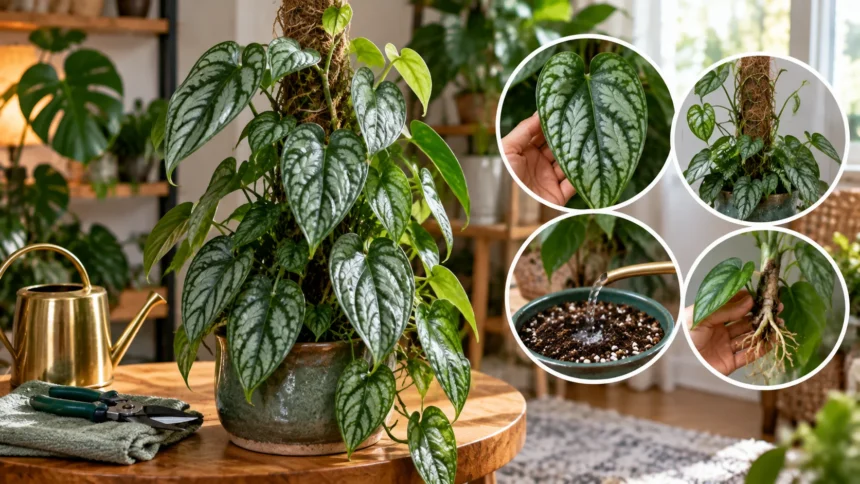
Monstera Siltepecana Care: Easy Growing Guide
Monstera siltepecana is a tropical climbing houseplant valued for its silvery juvenile leaves, dark green veins, and dramatic transformation as it matures. Often called the silver monstera, this species is smaller and more delicate-looking than the familiar Monstera deliciosa, making it an excellent choice for shelves, hanging baskets, plant cabinets, and moss poles. Although its foliage looks exotic, Monstera siltepecana care is relatively straightforward once you understand its basic needs. Bright indirect light, an airy soil mix, careful watering, warmth, and moderate humidity create the foundation for healthy growth. Giving the plant something to climb can also encourage larger mature leaves. With consistent care, it can become an impressive indoor statement plant without requiring expert-level gardening skills.
One of the most interesting things about Monstera siltepecana is how dramatically its appearance can change with age. Juvenile leaves are usually narrow, silvery green, and marked with darker veins, while mature plants can produce larger, greener leaves with fenestrations or openings. Whether that transformation occurs indoors depends heavily on light, support, root health, and overall growing conditions. Plants left trailing may remain in their juvenile form for much longer than specimens allowed to climb. This guide explains how to water, fertilize, repot, propagate, and troubleshoot Monstera siltepecana while avoiding common mistakes such as overwatering and insufficient light. The goal is simple: create stable tropical conditions that allow the plant to grow vigorously without making care unnecessarily complicated.
What Is Monstera Siltepecana and How Does It Grow?
Monstera siltepecana belongs to the aroid family and naturally grows as a climbing tropical plant rather than behaving like a compact upright houseplant. In its natural growth habit, young stems search for surfaces they can attach to before climbing toward brighter conditions. This climbing behavior explains why indoor plants often produce stronger growth when provided with a moss pole, coir pole, wooden plank, or similar support. Juvenile plants have distinctive silver-colored foliage crossed by dark green veins, giving them an appearance that can resemble some Scindapsus species. As the plant matures, silver coloration may become less pronounced while leaf size increases. Mature foliage can eventually develop fenestrations when environmental conditions support strong vertical growth.
Understanding the difference between juvenile and mature growth is important when setting realistic expectations for Monstera siltepecana. A small plant purchased from a nursery may continue producing attractive silver leaves for a long time if it trails from a pot or hanging basket. This does not necessarily mean the plant is unhealthy or failing to mature correctly. Climbing provides the plant with environmental signals that can encourage larger leaves and more mature characteristics. Strong light and healthy roots also contribute to that progression. If your goal is maintaining compact silvery foliage, allowing stems to trail can work beautifully. If you want larger leaves and eventual fenestration, vertical support should become part of your long-term care strategy.
Growth speed depends on temperature, light, nutrition, root development, and season. During warm and bright months, a healthy Monstera siltepecana can extend its vines quickly and produce new leaves at regular intervals. Growth often slows during darker winter months, especially in homes where natural daylight decreases significantly. Reduced winter growth is normal and should not automatically be treated with additional fertilizer or excessive watering. Instead, watering frequency should usually decrease as the plant consumes moisture more slowly. Providing stable conditions throughout the year allows new growth to resume naturally when light and temperatures improve. Artificial grow lights can help maintain more consistent growth in homes with limited natural sunlight.
Monstera siltepecana is often described as relatively easy to grow, but it responds poorly to extremes. Constantly saturated soil can damage roots, while prolonged drought may leave vines limp and leaf edges dry. Very dark locations can produce weak stems, smaller leaves, and wider spacing between growth nodes. Direct harsh afternoon sunlight can scorch the delicate foliage, particularly when the plant has not been gradually acclimated. The best results come from balancing moisture, airflow, warmth, and bright filtered light rather than maximizing any single factor. Consistency is especially valuable because tropical houseplants often tolerate moderate conditions better than repeated cycles of stress. Once you identify a suitable location, avoid unnecessarily moving the plant every few days.
Like many members of the Monstera genus, Monstera siltepecana contains calcium oxalate crystals that can irritate the mouth and digestive system if the plant is chewed. It should therefore be kept away from curious pets and young children who may bite the foliage. Skin contact during ordinary handling is usually not a problem for most people, but washing your hands after pruning or propagation is a sensible habit. The plant is grown primarily for ornamental foliage rather than edible use. Damaged or pruned material should not be left where pets can access it. This safety consideration does not make the plant difficult to own, but thoughtful placement is worthwhile when animals share the same indoor space.
Best Light and Placement for Monstera Siltepecana
Bright indirect light is generally the best choice for Monstera siltepecana because it supports vigorous growth without exposing leaves to intense heat and sunburn. A location near an east-facing window can provide gentle morning sun followed by bright filtered light for the rest of the day. South- or west-facing windows can also work when the plant sits farther back or receives protection from a sheer curtain. North-facing windows may provide enough light in very bright rooms, although growth can become slower in darker climates. The goal is to give the plant plenty of usable light without allowing strong midday or afternoon sunlight to bake the foliage. Healthy lighting usually produces compact growth and well-developed leaf patterns.
Insufficient light is one of the reasons Monstera siltepecana can develop long bare sections of stem between leaves. This stretched growth is called etiolation and occurs when the plant reaches toward stronger light. New leaves may also become smaller, and the silver pattern can appear less impressive when the plant is chronically shaded. A trailing specimen placed on a distant bookshelf may survive, but survival is different from vigorous growth. Moving the plant closer to a bright window can gradually improve new growth, although existing stretched stems will not shorten. If natural light is limited, a quality grow light positioned at an appropriate distance can provide supplemental illumination. Consistent daily lighting is usually more useful than occasional exposure to very strong sunlight.
Too much direct sunlight creates a different set of problems. Leaves exposed suddenly to intense afternoon sun may develop pale patches, brown scorch marks, or crispy sections that do not recover. Sunburn often appears on the side of the plant facing the window, making the cause relatively easy to recognize. Direct morning sunlight is generally gentler, but even that should be introduced gradually if the plant has previously grown in shade. Window glass can intensify heat around foliage during hot weather, so temperature should be considered alongside brightness. If leaves repeatedly scorch despite proper watering, filtering the light with a sheer curtain may solve the problem. Damaged areas can be trimmed cosmetically once the cause has been corrected.
Placement should also consider airflow and temperature stability rather than light alone. Avoid placing Monstera siltepecana directly beside heating vents, air-conditioning outlets, frequently opened exterior doors, or cold winter windows. Sudden temperature changes can stress leaves and dry the potting mix unevenly. Gentle room airflow is beneficial because it helps moisture evaporate naturally and discourages some fungal problems. Strong continuous drafts, however, can dry foliage and soil too quickly. A bright location several feet from an appropriate window often provides a comfortable compromise. Plant cabinets can also work well when lighting, ventilation, and humidity are balanced instead of creating permanently stagnant conditions.
Rotating the pot occasionally can help a free-standing Monstera siltepecana receive balanced light on different sides. Plants naturally orient leaves toward their strongest light source, which can eventually create uneven growth. A small rotation every week or two may encourage a more balanced appearance when the plant is not attached firmly to a support. Once vines are climbing a moss pole or wall-mounted support, frequent rotation becomes less practical and is not necessary. In that situation, position the climbing surface so leaves can naturally face the room or light source. Avoid constantly repositioning a healthy plant simply for symmetry. Stable lighting and proper support generally matter much more than achieving perfectly uniform growth.
How to Water Monstera Siltepecana and Maintain Humidity
Watering Monstera siltepecana correctly means allowing part of the potting mix to dry before thoroughly watering again. Instead of following a strict weekly schedule, check the soil with your finger or another moisture-checking method. When the upper inch or two feels dry while deeper soil still retains slight moisture, the plant is often ready for watering. Saturate the potting mix evenly until excess water drains through the holes at the bottom of the container. Discard standing water rather than leaving the pot submerged in a decorative saucer. This approach wets the entire root system while allowing oxygen to return as the soil begins drying. Consistently damp but never waterlogged conditions generally support healthier roots than frequent small drinks.
Overwatering is one of the most common Monstera siltepecana care problems, but the term can be misleading because quantity is not always the issue. Giving plenty of water at once is usually fine when the excess can drain away and the soil dries appropriately afterward. Problems develop when roots remain saturated for extended periods because the soil is dense, the pot lacks drainage, or watering occurs too frequently. Early signs can include yellow leaves, persistently wet soil, weak growth, and eventually soft or dark roots. Root rot becomes more likely when low light and cool temperatures slow evaporation. If your plant stays wet for many days, improving soil structure and drainage is often more useful than simply reducing the volume of each watering.
Underwatering produces a different pattern of stress. Leaves may curl inward, droop, or develop dry brown edges when the root system remains without moisture for too long. The pot may also feel unusually light, and soil can pull away from the sides of the container. Extremely dry peat-based mixes sometimes become difficult to rehydrate because water runs around the soil rather than soaking through it. In that situation, watering slowly in several passes can help moisture penetrate the root ball. Avoid repeatedly allowing severe wilting because chronic dehydration can damage fine roots and slow new growth. A slight drying period between waterings is useful, but the entire root zone should not remain bone dry for extended periods.
Monstera siltepecana appreciates moderate to relatively high humidity, although many plants adapt successfully to ordinary household conditions. Humidity around 50 to 70 percent often supports attractive foliage, especially when temperatures and airflow are also appropriate. Extremely dry air can contribute to crispy leaf edges or slower unfurling of new leaves, although watering problems and root stress can produce similar symptoms. A room humidifier is more effective than repeatedly misting leaves when indoor air is consistently dry. Grouping plants can create a small local increase in humidity, but crowded foliage should still receive adequate airflow. Humidity should support healthy growth rather than creating permanently wet leaf surfaces or stagnant conditions that encourage disease.
Water quality can sometimes influence foliage appearance, although most healthy Monstera siltepecana plants tolerate ordinary tap water reasonably well. Homes with very hard water may eventually develop mineral buildup in soil, particularly when fertilizer is also used frequently. Occasionally allowing plenty of water to flush through the pot can help reduce accumulated salts. Using filtered or rainwater is an optional choice when leaf tips repeatedly brown despite appropriate watering, humidity, and root health. Temperature also matters, as extremely cold water can create unnecessary root stress. Room-temperature water is easy and generally comfortable for tropical houseplants. More importantly, establish a watering routine based on soil conditions rather than changing water sources every time a leaf develops a minor cosmetic blemish.
Best Soil, Pot, Temperature, and Fertilizer for Healthy Growth
Monstera siltepecana grows best in an airy, moisture-retentive potting mix that drains efficiently while still holding enough water for the roots. A typical aroid mix might combine quality indoor potting soil or coco coir with orchid bark and perlite or pumice. The exact percentages are less important than the resulting structure, which should contain visible air spaces instead of becoming dense and muddy after watering. Roots need oxygen as well as moisture, making compaction a major concern in containers. Adding chunky material helps excess water escape and reduces the chance that the center of the root ball remains saturated. Avoid using heavy garden soil indoors because it can compact severely and may introduce pests.
Drainage holes are essential for making that airy soil mix work effectively. Decorative pots without holes can trap water around the roots even when watering frequency seems reasonable. A simple solution is keeping the plant in a plastic nursery pot with drainage and placing that container inside a decorative cachepot. Remove the inner pot when watering and allow it to drain before returning it to the outer container. Pot size matters as well because an oversized container holds a larger volume of wet soil around a relatively small root system. Choose a pot only slightly larger than the existing root ball when repotting. Gradual increases in container size make moisture management considerably easier.
Warm temperatures support active Monstera siltepecana growth because the species originates from tropical environments. Typical indoor temperatures between roughly 65°F and 85°F, or about 18°C to 29°C, generally work well. The plant can tolerate modest variation but should be protected from prolonged cold conditions and sudden temperature drops. Growth may slow considerably when temperatures remain below comfortable household levels. Cold combined with wet soil is especially problematic because root activity decreases while the potting mix stays damp longer. Avoid positioning the plant against freezing winter glass or directly beneath a strong air conditioner. Stable warmth is more important than trying to maintain an unusually high tropical temperature throughout the entire year.
Fertilizer supports new leaves, stems, and roots during active growth, but Monstera siltepecana does not require constant heavy feeding. A balanced liquid houseplant fertilizer diluted according to product directions can be applied periodically during spring and summer when the plant is actively producing new growth. Some growers prefer feeding at reduced strength more regularly instead of applying concentrated fertilizer occasionally. Either approach can work when the total nutrient level remains moderate. Overfertilization can burn roots, cause leaf-tip damage, or produce salt buildup in the potting mix. If growth slows dramatically during winter because natural light is reduced, fertilizer frequency should usually decrease as well. Feed the plant according to growth rather than simply following the calendar.
Organic fertilizers, controlled-release granules, and liquid synthetic fertilizers can all work when applied responsibly. The plant does not require a rare or specialized fertilizer marketed specifically for Monsteras. A complete product containing nitrogen, phosphorus, potassium, and micronutrients is usually adequate for container growth. Nitrogen contributes strongly to leafy growth, but extremely high-nitrogen feeding cannot compensate for poor light or unhealthy roots. If the plant has stopped growing because it is waterlogged, adding fertilizer may worsen stress rather than solve it. Diagnose environmental problems before assuming nutrient deficiency. Healthy roots, bright light, correct watering, and suitable temperatures form the foundation, while fertilizer simply supports the growth those conditions make possible.
Moss Poles, Pruning, Repotting, and Encouraging Bigger Leaves
Providing a climbing support is one of the most effective ways to encourage larger Monstera siltepecana leaves. In nature, this plant climbs trees and other vertical surfaces, using aerial roots to anchor itself as it grows upward. Indoors, a moss pole, coir pole, wooden plank, or textured support can imitate that climbing opportunity. Position the support when repotting so it remains stable and does not repeatedly disturb the root system. Gently attach vines using soft plant ties rather than wrapping them tightly around the stem. As the plant climbs, new growth may gradually become stronger and larger. Good light remains essential because support alone cannot produce mature foliage when the plant is growing in deep shade.
True moss poles can provide an additional advantage because aerial roots may grow into the moist moss and create a secondary rooting system along the stem. Keeping a moss pole consistently but not excessively moist takes extra maintenance, so it is not necessary for everyone. A dry coir pole still provides vertical structure even if roots do not penetrate it as readily. Wooden planks can also encourage climbing when aerial roots attach to the surface. The best support is ultimately one you can maintain consistently and securely. A neglected wet moss pole can become inconvenient, while an unstable pole can tip the entire plant. Simple, sturdy support often produces better long-term results than complicated setups that are difficult to manage.
Pruning helps control size and can encourage a fuller-looking plant when vines become excessively long or sparse. Use clean, sharp scissors or pruning shears and cut the stem just above a node when shortening the parent plant. The removed section can often be used for propagation as long as it contains at least one viable node. Pruning does not harm a healthy plant when performed moderately during active growth. Avoid removing a large percentage of foliage from a stressed or newly repotted specimen because leaves provide energy for recovery. Yellow, dead, or badly damaged leaves can be removed whenever necessary. Cleaning cutting tools before and after use reduces the chance of transferring plant diseases between specimens.
Repot Monstera siltepecana when roots become crowded, growth slows despite otherwise good conditions, or the potting mix has broken down and no longer drains properly. Roots emerging from drainage holes can suggest limited space, although a few visible roots do not always mean immediate repotting is required. Spring or early summer is often convenient because the plant can recover during active growth. Choose a container only one size larger and replace compacted soil with a fresh, airy aroid mix. Avoid aggressively removing healthy roots simply to fit the plant into a preferred decorative pot. After repotting, maintain normal light while avoiding unnecessary fertilizer until the root system has had some time to settle.
Large mature leaves and fenestrations require patience because plant age and growing conditions both influence development. Strong climbing growth, bright indirect light, healthy roots, warmth, and consistent nutrition give Monstera siltepecana the best chance of transitioning from juvenile foliage. Mature leaves can become significantly larger and greener, meaning the plant may eventually look quite different from the silver specimen you originally purchased. Not every indoor plant develops dramatic fenestrations quickly, and cutting vines repeatedly back to juvenile sections can delay maturity. Allowing a strong leader to climb continuously usually supports faster progression. Focus on plant health rather than forcing fenestration through excessive fertilizer or sunlight, since stress rarely accelerates healthy maturation.
How to Propagate Monstera Siltepecana Successfully
Stem cuttings are the easiest way to propagate Monstera siltepecana because each new plant needs a node capable of producing roots and future growth. A node is the slightly thickened area on the stem where a leaf and often an aerial root emerge. Cutting only a leaf without a node may remain attractive in water temporarily but cannot develop into a complete new vine. Select a healthy stem with at least one node and preferably one or two leaves. Use clean scissors to cut just below the node, leaving enough stem for comfortable handling. Cuttings taken from actively growing plants generally establish more readily than material removed from severely stressed vines.
Water propagation is popular because it allows you to watch new roots develop. Place the node in clean water while keeping most of the leaf above the surface. Position the container in bright indirect light and change or refresh the water periodically so it remains reasonably clean and oxygenated. Roots may begin emerging within a few weeks, although timing varies with temperature, plant condition, and season. Allow roots to develop enough length and branching before transferring the cutting into potting mix. Moving extremely tiny roots into soil can make moisture management more difficult. Once planted, keep the mix slightly more evenly moist initially while the water-grown roots adapt to their new environment.
Propagation directly in sphagnum moss, perlite, or an airy potting medium can reduce the transition required when the cutting eventually grows in soil. The node should remain in contact with lightly moist material while the leaf stays above the surface. A transparent container can make root development easier to observe without repeatedly disturbing the cutting. High humidity can speed rooting, but the propagation environment still requires airflow to prevent rot. The medium should feel damp rather than saturated. If the cutting develops a black, mushy stem, remove the rotted tissue with sterile tools and reassess moisture conditions. Healthy rooting media provide both moisture and oxygen around the developing root system.
Multiple-node cuttings can produce larger new plants more quickly, but dividing a vine into single-node sections allows one long stem to create several potential plants. “Wet stick” propagation uses node sections with little or no leaf attached, placing the node in moist moss or another suitable medium until a new growth point activates. This method can work well but generally requires more patience because the cutting has less existing foliage to support energy production. Warmth, humidity, and bright indirect light improve the chances of successful activation. Avoid burying nodes deeply where constantly wet material may encourage rot. Positioning them close to the surface makes moisture easier to control while allowing emerging shoots access to light.
After a propagated Monstera siltepecana begins producing new growth, gradually transition it toward ordinary household conditions rather than changing humidity and watering abruptly. Newly rooted cuttings have smaller root systems and can dry faster than established plants, so monitor the pot more closely during the first few weeks. At the same time, avoid keeping the soil permanently wet out of fear that the young plant will dry out. Roots still need oxygen to develop properly. Once several new leaves appear, the plant can usually be treated much like a mature specimen. Adding support early can encourage climbing from the beginning and help the young vine develop increasingly strong leaves as it establishes.
Common Monstera Siltepecana Problems, Pests, and Solutions
Yellow leaves are one of the most common concerns, but several different conditions can cause them. When multiple lower leaves turn yellow while the soil remains wet for long periods, overwatering or poor drainage should be investigated first. A single older leaf occasionally yellowing can simply reflect normal leaf aging. Yellowing combined with pale new growth may also indicate inadequate light, root problems, or nutritional issues. Instead of immediately adding fertilizer, examine soil moisture, root health, and environmental conditions. Correct the underlying cause and watch how new growth develops, since damaged yellow leaves rarely turn green again. Patterns across several leaves usually provide better diagnostic information than one isolated spot.
Brown leaf tips or crispy edges often suggest dry conditions, but low humidity is not always the only explanation. Prolonged underwatering, mineral buildup, excessive fertilizer, damaged roots, and intense sunlight can all produce brown tissue. Check whether the soil is becoming extremely dry between waterings and whether fertilizer has been applied more frequently than recommended. If the plant sits in strong direct sun, brown patches may represent scorch rather than dryness. Increasing humidity will not repair damage caused by root rot or fertilizer burn. Diagnose the entire growing environment before changing several things simultaneously. Healthy new leaves emerging without additional browning usually indicate that the adjustment is working.
Root rot can develop when Monstera siltepecana remains in poorly aerated wet soil for extended periods. Symptoms may include yellowing foliage, wilting despite moist soil, slowed growth, an unpleasant smell, and dark mushy roots. Remove the plant from its container if significant rot is suspected and inspect the root system carefully. Healthy roots are generally firm, while decayed areas become soft and may pull apart easily. Trim severely rotten tissue with sanitized tools, then repot the plant in fresh, airy potting mix and a container with adequate drainage. Watering habits should also be corrected afterward, because repotting alone will not prevent the same problem from returning if the soil remains continuously saturated.
Spider mites, thrips, mealybugs, and scale can occasionally attack Monstera siltepecana, particularly when plants are crowded or stressed. Spider mites may create fine webbing and tiny pale speckles, while thrips can leave silvery scars, distorted new growth, and dark waste spots. Mealybugs look like white cottony clusters around stems or leaf joints, whereas scale insects resemble small attached bumps. Inspect both sides of leaves regularly so infestations are noticed before they become severe. Isolate affected plants from the rest of your collection and use an appropriate treatment according to the pest involved. Repeated applications are often necessary because eggs or hidden insects can survive a single treatment.
Weak growth without obvious pests usually points back to basic growing conditions. Long stems with tiny leaves suggest insufficient light or lack of climbing support, while consistently small growth despite bright light may indicate root crowding or depleted soil. Leaves that refuse to unfurl can be associated with dryness, low humidity, or root stress. Remember that Monstera siltepecana naturally slows during darker seasons, so reduced winter growth is not automatically a problem. Avoid reacting to every temporary pause by watering or fertilizing more frequently. Stable conditions are usually the best remedy for a plant that is otherwise healthy. Regular observation helps you recognize genuine changes before they develop into larger problems.
Frequently Asked Questions About Monstera Siltepecana Care
Is Monstera siltepecana easy to care for?
Yes, Monstera siltepecana is relatively easy to grow when given bright indirect light, an airy potting mix, and careful watering. The main problems usually come from keeping the soil too wet or placing the plant in insufficient light.
How often should I water Monstera siltepecana?
Water when the upper inch or two of the potting mix has dried rather than following a fixed weekly schedule. Water thoroughly until excess drains from the bottom, then allow the soil to partially dry again before the next watering.
Does Monstera siltepecana need a moss pole?
A moss pole is not essential, but climbing support can encourage stronger stems, larger leaves, and more mature growth. Plants allowed to trail often retain their smaller, silvery juvenile foliage for longer.
Why is my Monstera siltepecana losing its silver color?
The foliage naturally becomes greener as Monstera siltepecana matures, particularly when it climbs and begins producing larger leaves. Poor light can also affect leaf appearance, so make sure the plant receives plenty of bright indirect light.
Is Monstera siltepecana toxic to pets?
Yes, Monstera siltepecana contains insoluble calcium oxalate crystals that can irritate the mouth if chewed by cats, dogs, or other pets. Keep the plant out of reach and contact a veterinarian if a pet eats it and develops significant drooling, mouth irritation, vomiting, or difficulty swallowing.