Best Weed Killer to Kill Japanese Knotweed Safely
Finding a weed killer to kill Japanese knotweed can feel urgent once thick bamboo-like stems begin appearing around a garden, fence, driveway or building. Unfortunately, this invasive plant is far more difficult to control than common garden weeds because most of its energy is stored below the ground.
Japanese knotweed develops an extensive network of underground stems known as rhizomes. Cutting down the visible canes may make the area look clearer, but it does not remove the living rhizome system. New shoots can therefore return after cutting, digging, burning or treating only part of the infestation.
A systemic weed killer containing glyphosate is generally considered the most practical chemical option for homeowners. Instead of simply burning the leaves, a systemic herbicide is absorbed by the foliage and transported through the plant towards its underground growth, where long-term control needs to occur.
Even the best Japanese knotweed weed killer is not an instant solution. Successful treatment normally requires correct identification, carefully timed applications and regular monitoring over several growing seasons. The objective is to weaken the entire plant gradually without accidentally spreading contaminated stems, crowns or soil.
What Is the Best Weed Killer to Kill Japanese Knotweed?
For most domestic situations, the best weed killer for Japanese knotweed is an approved systemic herbicide containing glyphosate. The product must be suitable for tough perennial weeds, and its label should permit use in the location where the knotweed is growing.
Glyphosate works differently from contact weed killers that damage only the sprayed leaves. Once absorbed through actively growing foliage, it moves with the plant’s internal transport system. This gives the active ingredient a better chance of reaching the crowns and underground rhizomes responsible for repeated regrowth.
Homeowners should not assume that every glyphosate product has the same strength, formulation or permitted uses. Select a regulated product from a reputable retailer, read the full label and follow the stated application rate. Never make the mixture stronger than the manufacturer recommends in an attempt to accelerate control.
The Royal Horticultural Society identifies glyphosate-based weed killer as the most effective chemical option generally available to home gardeners. It also explains that treatment often takes at least three growing seasons, which is why realistic expectations and consistent follow-up are essential.
Why Ordinary Weed Killers Often Fail
Many general garden weed killers are designed for annual weeds with shallow root systems. They may quickly brown Japanese knotweed leaves, but visible leaf damage does not necessarily mean the underground rhizomes have been killed. Fresh shoots can reappear once conditions become favourable.
Contact herbicides mainly affect the plant tissue they touch. Japanese knotweed may respond by losing its upper growth while keeping enough stored energy underground to produce replacement stems. This temporary result can mislead homeowners into believing the treatment has worked successfully.
Some selective lawn weed killers are also unsuitable because they are formulated for smaller broadleaf weeds growing among grass. Japanese knotweed is a large, vigorous perennial that requires a product, method and treatment schedule capable of addressing its extensive underground structure.
The right question is therefore not simply which weed killer makes the leaves turn brown fastest. A better question is which approved systemic herbicide can move through healthy foliage and weaken the rhizome system over time. Long-term control matters more than rapid surface damage.
How Glyphosate Controls Japanese Knotweed
Glyphosate is a non-selective systemic herbicide, meaning it can damage most green plants that absorb it. When sprayed onto Japanese knotweed leaves, the plant takes in the herbicide and gradually transports it to other actively growing parts.
This movement is particularly valuable later in the growing season. As Japanese knotweed prepares for winter, it naturally transfers energy from its leaves and stems towards the underground rhizomes. Correctly timed herbicide can move with this downward flow.
Results are rarely immediate. The treated leaves may begin yellowing or browning over the following days or weeks, but the important process is happening inside the plant. Digging up the area immediately after spraying may interrupt treatment and spread viable rhizome fragments.
Glyphosate should be treated as a powerful vegetation-management tool rather than a harmless garden spray. Wear the protective equipment specified on the label, avoid spray drift and keep people and pets away for the stated period. Never apply it to plants, soil or water where the product is not authorised.
Choosing a Suitable Japanese Knotweed Weed Killer
Start by checking the active ingredient rather than relying only on attractive claims printed on the front of the container. Look for an approved glyphosate-based product labelled for tough, deep-rooted perennial weeds or woody and invasive vegetation.
Ready-to-use weed killers are convenient for a few isolated stems because they remove the need for measuring and mixing. However, some domestic ready-to-use formulas may be less concentrated than professional products, so several carefully timed treatments may still be necessary.
Concentrated products can cover larger areas, but they must be diluted exactly as directed. Adding extra concentrate is not a shortcut and may produce poor results by damaging the leaves before enough herbicide moves towards the rhizomes. It can also increase risks to nearby plants and the environment.
Product registrations, permitted uses and label directions can change. Before applying any weed killer to kill Japanese knotweed, read the current label rather than relying on an old container or instructions found online. The product label is the controlling instruction for safe and legal use.
When Is the Best Time to Spray Japanese Knotweed?
Late summer to early autumn is generally the most effective period for foliar treatment. At this stage, the plant has produced a large leaf area and is beginning to transfer nutrients towards its underground rhizomes before its stems die back for winter.
Allow the knotweed to develop enough healthy foliage to absorb the herbicide. Treating very small shoots in early spring may stunt their growth but provide limited movement into the extensive underground system. Early damage can also reduce the leaf area available for a more effective later application.
Choose a calm, dry day when rain is not expected within the rain-free period specified on the product label. Wind can carry droplets onto lawns, flowers, shrubs and neighbouring property, while rainfall shortly after treatment may reduce absorption.
Natural Resources Wales recommends late-summer or autumn treatment after flowering and warns that earlier applications may only stunt the plant. Mature infestations commonly need repeated annual treatment because one application may not reach every active section of the rhizome network.
How to Apply Weed Killer to Japanese Knotweed
Begin by confirming the plant’s identity. Japanese knotweed commonly develops reddish-purple spring shoots, hollow bamboo-like stems, shield-shaped leaves and clusters of creamy white flowers later in the growing season. Similar plants should not be treated until identification is certain.
Create a clearly marked treatment area and protect desirable plants with a physical screen where practical. Do not cut the knotweed immediately before spraying unless your chosen management plan specifically requires regrowth. A foliar application needs enough healthy leaves to absorb the product.
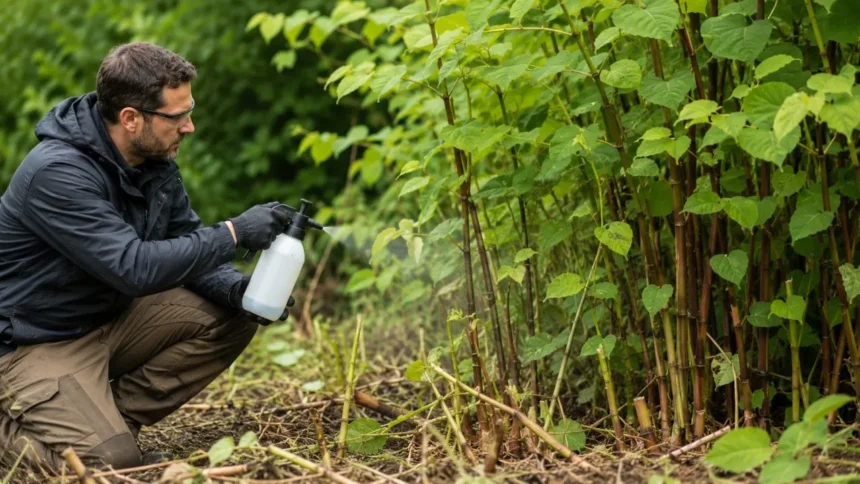
Apply the herbicide evenly to the leaf surfaces according to its instructions. The leaves should receive adequate coverage without liquid running off heavily onto the soil. Avoid walking through wet foliage because contaminated footwear can transfer herbicide to grass and ornamental plants.
After treatment, leave the stems and leaves undisturbed for the period stated on the label. Record the date, product and treated area so that future regrowth can be assessed accurately. A simple treatment record becomes especially useful when control continues for several years.
Foliar Spraying, Stem Injection and Cut-Stem Treatment
Foliar spraying is the most accessible method for many homeowners. It works well where the knotweed has enough leaf area, can be reached safely and is separated from valuable plants. Careful spot spraying reduces unnecessary herbicide use and limits damage to nearby vegetation.
Stem injection introduces a measured herbicide dose into individual hollow canes. This approach can reduce spray drift and may be useful when knotweed is growing among desirable plants. However, it requires suitable equipment, an authorised product and knowledge of the correct application method.
Cut-stem treatment involves cutting each cane and applying an appropriate herbicide to the hollow stem or freshly cut surface. Timing, product selection and disposal become more complicated because the removed material may remain capable of producing new growth.
Injection and cut-stem treatments are often better handled by qualified invasive-weed contractors. Professional-strength products and application methods may be restricted to trained users. Homeowners should never inject an ordinary garden product unless the label expressly permits that method.
How Long Does Japanese Knotweed Treatment Take?
Japanese knotweed control should be viewed as a multi-year programme rather than a weekend garden task. A strong first treatment may reduce the size and number of canes, but surviving rhizomes can produce smaller shoots during the following spring or summer.
Regrowth after glyphosate treatment may look unusual. Instead of tall bamboo-like stems, the plant may return as short, bushy growth with smaller leaves. These weakened shoots are still living Japanese knotweed and should be included in the next correctly timed treatment.
Do not stop monitoring simply because no growth appears for one season. Dormant rhizome sections can survive underground and respond when the soil is disturbed by gardening, landscaping, utility work or construction. Continue checking the affected area and its boundaries.
Current UK government guidance states that Japanese knotweed usually needs at least three years of repeated chemical treatment. It also warns that dormant rhizomes may remain in the soil for years and can regrow when contaminated ground is disturbed or moved.
Common Mistakes That Make Knotweed Harder to Control
One of the biggest mistakes is cutting, mowing, flailing or strimming Japanese knotweed without a containment plan. These activities can scatter small pieces of living plant material around the garden, onto roads or into neighbouring land.
Another mistake is repeatedly digging around the crowns. Japanese knotweed can regenerate from small rhizome fragments, so chopping the underground system into pieces may create several potential growing points. Contaminated soil can also spread the infestation to previously unaffected areas.
Some homeowners spray every new shoot as soon as it appears. Although this may keep the stems short, it can prevent the plant from developing enough foliage for an effective late-season systemic treatment. A planned application is usually more valuable than constant random spraying.
Natural Resources Wales specifically advises against strimming, flailing or mowing Japanese knotweed because these actions increase the risk of spreading it. The organisation also explains that cutting and digging established infestations are generally ineffective and create difficult waste-management problems.
Can Vinegar, Bleach or Salt Kill Japanese Knotweed?
Household vinegar may burn young leaves because of its acidity, but it is unlikely to move deeply enough through an established Japanese knotweed plant to destroy its entire rhizome system. The visible stems may decline temporarily while underground growth remains alive.
Bleach is not an approved Japanese knotweed herbicide and should not be poured onto garden soil. It may harm soil organisms, surrounding plants, pets and nearby water without providing reliable long-term knotweed control. Mixing bleach with other household chemicals can also release dangerous gases.
Heavy salt applications can damage vegetation and leave soil unsuitable for future planting. Salt can also move with water into surrounding beds, lawns or drainage systems. Destroying the wider garden while failing to eliminate every knotweed rhizome is not an effective solution.
Boiling water, diesel, waste oil and homemade chemical mixtures have similar limitations and may create additional environmental or legal problems. Use only a regulated weed killer approved for the intended purpose, or hire a qualified contractor to manage the infestation safely.
How to Prevent Herbicide Damage to Other Plants
Glyphosate does not distinguish between Japanese knotweed and valuable garden plants. Any green leaf that receives enough spray can be damaged, so keep the nozzle close to the target and use a coarse, controlled spray rather than a fine mist.
Avoid treatment on windy days, even when the knotweed appears separated from other vegetation. Small droplets can travel farther than expected and cause delayed yellowing in lawns, hedges, vegetables or ornamental plants. A temporary shield can provide additional protection.
Where individual knotweed stems are mixed closely with shrubs or flowers, wiping an authorised herbicide onto the leaves may provide more control than broad spraying. This method should only be used when the product label allows it and suitable protective gloves are worn.
Do not spray Japanese knotweed growing beside ponds, streams, drainage channels or wetlands without checking the rules for that location. In England, regulatory agreement may be required before herbicides are used in or close to a river or watercourse.
Disposing of Japanese Knotweed Safely
Treating the plant where it stands generally creates less spreading risk than digging it up and moving it. Once stems are cut, every piece must be contained carefully because living material may be capable of producing new growth under suitable conditions.
Do not place fresh knotweed stems, crowns or rhizomes in ordinary garden compost. Do not mix them with routine green waste or move contaminated soil to another part of the property. Clean tools, machinery, footwear and vehicle surfaces after working near the infestation.
Waste laws differ between countries and regions, so check the rules where the property is located. In England, Japanese knotweed and contaminated soil may be treated as controlled waste when removed from the site, requiring authorised transport and an approved disposal facility.
UK government guidance states that off-site knotweed waste must go to a suitably permitted landfill or incineration facility. It must be transported by an appropriately registered carrier, and the receiving site should be informed before contaminated material is delivered.
When Should You Hire a Knotweed Specialist?
Professional help is advisable when the infestation is extensive, has entered neighbouring land or is growing close to a building, retaining wall, drainage system or watercourse. These situations require more than choosing a bottle of weed killer from a garden centre.
A specialist can confirm identification, map the affected area and create a documented Japanese knotweed management plan. The plan may combine foliar treatment, stem injection, excavation controls, monitoring and regulated waste disposal according to site conditions.
Professional treatment is particularly important when buying, selling, mortgaging or developing a property. Lenders, insurers, buyers or solicitors may require evidence that the knotweed is being controlled through a recognised plan with appropriate documentation or a transferable guarantee.
The RHS notes that specialist invasive-weed contractors can supply management information for property transactions and may offer insurance-backed guarantees. It also explains that such guarantees are generally unavailable when homeowners carry out treatment without a professional company.
How to Tell Whether the Treatment Is Working
A successful first treatment often produces weaker growth during the next growing season. Canes may become thinner, shorter or less numerous, while leaves may appear small and distorted. These changes indicate suppression but do not prove complete eradication.
Mark the outer edge of the infestation before treatment and photograph it from the same position each season. Comparing stem density, height and spread provides more useful evidence than relying on memory. Include nearby fences, paths and fixed objects for scale.
Continue inspecting the treatment area during spring, summer and early autumn. Look beyond the original patch because rhizomes may extend underground and send shoots up at the edges. Inform the contractor promptly if growth appears outside the mapped zone.
The absence of visible stems is encouraging, but the ground should still be treated cautiously. Avoid major excavation or soil movement until the agreed monitoring period is complete. Disturbance can expose dormant material and restart growth that was not previously visible.
Final Verdict on Weed Killer for Japanese Knotweed
The most suitable weed killer to kill Japanese knotweed is usually an approved systemic glyphosate product applied to healthy foliage at the correct stage of growth. It offers better long-term control than contact sprays, homemade mixtures or repeated cutting.
Late-summer or early-autumn treatment normally gives the herbicide the best opportunity to move towards the underground rhizomes. Application must follow the product label, protect surrounding vegetation and comply with additional restrictions near water or protected land.
Expect repeat treatment rather than immediate eradication. Monitor every new shoot, maintain clear records and avoid digging, mowing or moving contaminated soil. These steps help prevent a manageable infestation from becoming a wider and more expensive problem.
DIY treatment may suit a small, isolated garden patch where property and environmental risks are limited. For large infestations, property transactions, boundary disputes or sensitive sites, a qualified Japanese knotweed specialist is the safer and more dependable choice.
Frequently Asked Questions
What weed killer permanently kills Japanese knotweed?
An approved glyphosate-based systemic weed killer is commonly used for long-term Japanese knotweed control. Permanent eradication normally requires repeated, correctly timed treatment and several years of monitoring.
Can Roundup kill Japanese knotweed?
Some Roundup products contain glyphosate and may suppress Japanese knotweed when their labels permit the intended use. Product formulations vary, so check the active ingredient, approved uses and current label instructions before application.
Will one application of weed killer kill Japanese knotweed?
One application may weaken the plant but is unlikely to eliminate an established infestation. Surviving rhizomes can produce new shoots, making annual treatment and continued monitoring necessary.
Should I cut Japanese knotweed before spraying it?
Do not cut it immediately before a standard foliar application because the leaves are needed to absorb herbicide. Some planned programmes use cutting followed by regrowth, but this requires careful timing and secure disposal.
Can Japanese knotweed grow back after glyphosate treatment?
Yes, weakened or dormant rhizomes can produce new growth after treatment. Any returning shoots should be recorded and treated according to the ongoing management plan rather than being ignored or dug up.