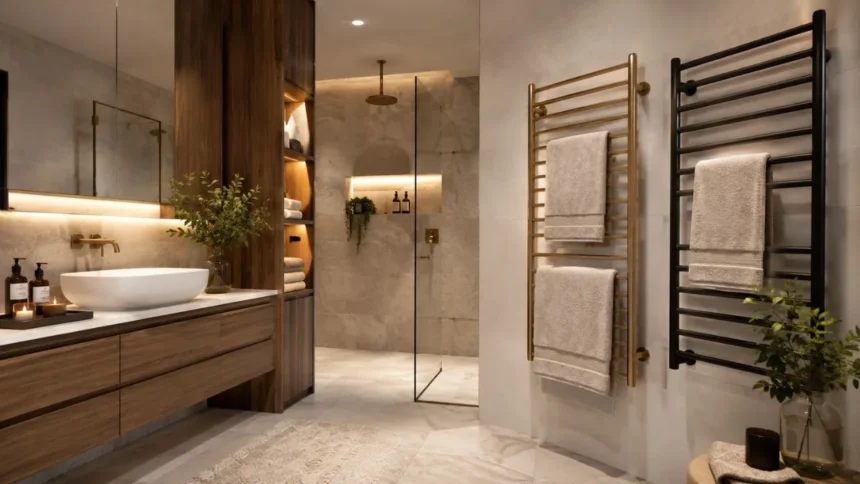
A towel rail may look like a small bathroom detail, but the right design can influence the comfort, appearance and practicality of the entire space. It gives wet towels a dedicated place to hang, keeps the room organised and can introduce a stylish finish that connects with your taps, shower fittings and bathroom accessories.
Modern towel rails are available in far more designs than the traditional chrome ladder. Homeowners can choose from a slim electric towel rail, a high-output towel rail radiator, a curved ladder design, a bold black towel rail or a decorative model in brushed brass, bronze, white or a custom colour.
The best option depends on more than appearance. You need to consider the size of the bathroom, the number of towels used each day, the available wall space and whether the rail must heat the whole room. Its power source, heat output and installation position will also affect everyday performance.
This guide explores stylish towel rail ideas for modern, traditional, small and family bathrooms. It also explains how to choose between electric, central-heating and dual-fuel models, calculate the required heat output, coordinate finishes and avoid common planning mistakes.
Quick Answer: Which Towel Rail Should You Choose?
Choose a heated towel rail when you want warm towels and a practical bathroom feature that can contribute to room heating. A standard ladder model works well in many spaces because its horizontal bars provide several hanging points while maintaining a simple, familiar appearance.
An electric towel rail is useful when the bathroom is not connected conveniently to the central-heating system. It can operate independently, allowing you to warm and dry towels during warmer months when the household heating is switched off.
A towel rail radiator connected to the central-heating system is suitable when the unit must help heat the bathroom throughout winter. Its output should be matched to the room’s calculated heat loss rather than chosen only according to height, colour or price.
For a contemporary scheme, a black towel rail creates a strong contrast against pale tiles and neutral walls. Brushed nickel, brass and bronze designs bring warmth, while white and chrome finishes offer a quieter look that can blend into most bathroom interiors.
Understanding the Main Types of Towel Rail
A non-heated towel rail is simply a fixed bar or rack designed to hold towels. It is affordable, requires no electrical or plumbing work and can be installed in many convenient positions. However, it will not actively warm the towels or contribute heat to the bathroom.
A central-heating towel rail radiator connects to the same wet heating system as the other radiators in the home. Hot water flows through its tubes when the central heating is operating, allowing it to warm towels and release heat into the room.
An electric towel rail contains a heating element and works independently of the central-heating system. Depending on the model, it may include a basic on-and-off control, an adjustable thermostat, a timer or a programmable smart control.
A dual-fuel heated towel rail combines a central-heating connection with an electric element. It can operate with the household heating during winter and switch to electric power during summer, offering greater flexibility throughout the year.
Ten Stylish Towel Rail Ideas for Modern Bathrooms
A successful towel rail should feel like part of the bathroom design rather than an item added after every other decision has been made. Its finish, scale and shape should relate to nearby fittings, tiles, furniture and the overall character of the room.
Before choosing a style, consider how many towels need to hang at the same time. A couple using an en-suite may need only a slim rail, while a family bathroom requires more spacing, height or additional hooks to manage several damp towels.
The available wall shape also matters. A narrow space beside a shower may suit a tall vertical rail, whereas a long empty wall could accommodate a wider ladder design. Awkward corners may benefit from a compact electric model or several individual heated bars.
The following ideas combine practical bathroom heating with current interior styles. They include dark statement finishes, warm metallics, traditional shapes, space-saving layouts and flexible heating options for bathrooms of different sizes.
1. Make a Statement With a Black Towel Rail
A black towel rail creates immediate contrast in a pale or neutral bathroom. It looks particularly effective against white metro tiles, light stone, soft grey walls or warm beige surfaces because the darker outline gives the feature greater definition.
Matte black is a natural choice for contemporary and industrial bathrooms. It can coordinate with black shower frames, taps, cabinet handles, mirrors and light fittings, helping separate fixtures appear connected across the room.
The design does not have to be visually heavy. A slim black ladder rail can introduce contrast without dominating a small bathroom, while a wide flat-panel model can become a stronger focal point in a larger space.
Black finishes can show dust, water marks or fibres from pale towels, so regular gentle cleaning is useful. Choose a quality finish designed for humid bathroom conditions and avoid abrasive products that could scratch or polish uneven areas.
2. Add Warmth With a Brushed Brass Towel Rail
A brushed brass towel rail brings warmth and subtle luxury to a bathroom. Its soft golden tone works well with marble-effect tiles, warm white walls, dark green cabinetry, natural stone and timber-look bathroom furniture.
Brushed surfaces are generally less reflective than polished brass, creating a calmer appearance that suits spa-inspired interiors. They can also feel more forgiving in everyday use because small fingerprints may be less noticeable than on highly polished metal.
For a coordinated scheme, repeat the brass tone through taps, shower controls, handles and mirror details. The finishes do not need to match perfectly, but their undertones should be close enough to avoid an accidental mixture of yellow, orange and pink metals.
Avoid overusing the finish in a compact room. A brass heated towel rail can serve as the main metallic feature while supporting accessories remain simple, allowing the design to feel refined rather than overly decorative.
3. Choose a Slim Electric Towel Rail for an En-Suite
A slim electric towel rail is a practical option for an en-suite, cloakroom or converted space where connecting a new radiator to existing pipework would be difficult. Its narrow shape uses limited wall space while still providing a warm place for one or two towels.
Because an electric model works independently, it can be used only when needed. A timer or programmable control allows the rail to warm before a morning shower and switch off automatically afterwards, helping avoid unnecessary operation.
Vertical models suit the narrow wall beside a vanity, shower enclosure or doorway. Check that the towels will hang without touching the floor, blocking furniture or covering the control, thermostat or heated sections too heavily.
Electrical work in a bathroom requires careful planning because water increases electrical risk. Choose a model suitable for its intended bathroom position and have the installation completed by an appropriately qualified electrician.
4. Use a White Towel Rail for a Seamless Look
A white towel rail is ideal when you want the heating feature to blend into the room rather than become a focal point. It can sit quietly against a white or pale wall, helping a small bathroom feel less visually crowded.
This approach works particularly well in minimalist, Scandinavian and family bathrooms. The soft finish coordinates easily with white sanitaryware and allows patterned tiles, coloured cabinetry or decorative lighting to receive more attention.
White models are available in both traditional ladder designs and flat contemporary profiles. A simple straight rail feels clean and modern, while a curved version creates slightly more space for hanging thick towels away from the wall.
Consider the exact shade before purchasing. A warm white rail may look noticeably different beside cool white tiles, so comparing finish samples can help create a more intentional and consistent result.
5. Install a Dual-Fuel Heated Towel Rail
A dual-fuel heated towel rail provides year-round flexibility. During colder months, it can operate as part of the central-heating system, while the electric element allows it to warm towels independently when the rest of the heating is not required.
This design is particularly useful in homes where damp towels remain a problem during spring or summer. Instead of heating the entire property, you can operate only the bathroom rail for a limited period.
Dual-fuel models are available in chrome, white, black and decorative finishes, so practical performance does not require sacrificing style. A straight ladder design offers a versatile option that can suit both modern and transitional bathrooms.
Installation is more involved because the unit requires both plumbing and electrical connections. Plan the valves, element position, cable route and controls before tiling or decorating so the finished installation appears clean and accessible.
6. Select a Traditional Towel Rail Radiator
A traditional towel rail radiator suits period homes, classic bathrooms and interiors influenced by heritage design. These models often combine a column-style radiator with an outer rail, creating a feature that provides room heat while holding towels.
Polished chrome, antique brass and nickel finishes work well with roll-top baths, crosshead taps, pedestal basins and patterned floor tiles. The curved outer bar gives the rail a furniture-like quality that feels more decorative than a standard ladder.
Traditional designs can require more floor or wall space than slim modern rails. Measure the full projection carefully, including valves and towel clearance, to ensure it will not restrict the walkway or interfere with a door.
Because appearance can make these models look smaller or larger than their output suggests, check their heat rating carefully. A beautiful design still needs sufficient performance if it will serve as the main bathroom radiator.
7. Use an Oversized Rail in a Family Bathroom
A family bathroom usually needs enough space for several bath sheets, hand towels and children’s towels. An oversized heated towel rail can reduce crowding and give each item more opportunity to dry between uses.
Look for a design with generous gaps between selected bars. Closely spaced tubes may produce an attractive continuous pattern, but they can be awkward when several thick towels need to be inserted and removed every day.
A wide towel rail radiator may also provide greater room-heating potential, depending on its construction and output. However, covering most of its surface with wet towels can reduce the amount of heat released directly into the bathroom.
Position the rail where family members can reach it without crossing a wet floor unnecessarily. The design should remain clear of swinging doors, shower screens, toilet access and frequently used storage drawers.
8. Try Individual Heated Towel Bars
Individual heated bars create a clean architectural alternative to a complete ladder rail. Several horizontal bars can be arranged with deliberate spacing, allowing each towel to hang separately and giving the wall a less conventional appearance.
This design works well in luxury and minimalist bathrooms where the fittings are intended to feel integrated with the architecture. The bars can align with tile joints, vanity edges or other horizontal details for a carefully planned finish.
Spacing must be considered early because the electrical connections may be concealed behind the wall. The design should provide enough room for towels without placing every bar so far apart that the arrangement consumes unnecessary space.
Individual bars may prioritise towel warming over whole-room heating. Confirm their combined output and intended purpose before depending on them as the bathroom’s only source of warmth.
9. Choose a Towel Rail With a Built-In Shelf
A heated towel rail with a top shelf provides useful storage in a small bathroom. Folded towels can sit above the heated section while damp towels hang on the bars below, making better use of vertical wall space.
The shelf can also provide a hotel-inspired appearance when towels are folded neatly and kept in a limited colour palette. Timber-look, metal and matching tubular shelves offer different ways to coordinate with the wider bathroom style.
Avoid overloading the top section with toiletries, candles or decorative objects that are unsuitable near heat. Follow the manufacturer’s guidance regarding weight, clearance and the types of items that can be stored safely.
This idea works best when the shelf remains reachable without stretching over the bath or toilet. It should support everyday convenience rather than becoming a high display area that is difficult to clean.
10. Add Colour With a Painted Towel Rail
A coloured towel rail can bring personality to a bathroom without requiring bold tiles across every surface. Deep green, navy blue, terracotta, blush pink and muted grey can turn a functional radiator into a carefully chosen design feature.
Match the colour to the vanity for a coordinated scheme, or use a contrasting tone against neutral walls. A dark rail against pale tiles creates definition, while a tonal design can produce a softer and more layered effect.
Painted finishes are especially useful when black feels too strong and chrome feels too conventional. They allow the heating element to connect with current bathroom trends centred on richer colour, texture and personal expression.
Choose a factory-applied finish intended for heated bathroom products. Ordinary wall paint is not an appropriate substitute because it may not tolerate heat, moisture or expansion in the same way.
How to Choose the Right Towel Rail Size
Start by measuring the usable wall area rather than the entire wall. Allow space for valves, electrical controls, door movement, skirting, furniture and enough clearance to place towels on the rail comfortably.
Height determines how many bars and hanging positions the rail can provide. A tall model is useful in a narrow bathroom, while a wider rail may be easier for spreading out large towels and can suit a long wall above a bath or beside a vanity.
Consider the users as well as the room. Controls and frequently used bars should be reachable, but the unit must not obstruct access or create a hazard for children, older people or anyone with reduced mobility.
Use masking tape to mark the proposed outline on the wall before ordering. Hang a towel within the marked area to check whether the rail’s position, height and width will work in everyday use.
Calculate the Required Heat Output
A towel rail selected only by appearance may not release enough heat to warm the bathroom. Room size, ceiling height, window area, insulation, external walls and the desired indoor temperature all influence the output required.
Heat output is usually presented in British Thermal Units per hour or watts. Use a reliable heat-loss calculator or ask a heating professional to calculate the requirement, especially when the towel rail will be the room’s main heat source.
Remember that towels placed over the bars can reduce the amount of heat reaching the surrounding air. A rail that performs adequately when uncovered may warm the room less effectively when several thick towels cover most of its surface.
Large, poorly insulated or frequently ventilated bathrooms may need a high-output towel rail radiator or an additional heating source. Underfloor heating, a separate radiator or improved insulation can support comfort without requiring an excessively large rail.
Find the Best Position for a Towel Rail
The ideal position is convenient after bathing or showering without placing the rail where it interferes with safe movement. A nearby wall allows users to reach a towel easily and reduces the amount of water carried across the floor.
Do not position the rail behind a fully opening door or in a narrow walkway. Repeated impact from a door can damage the finish, loosen fixings and make it difficult to hang or remove towels.
Avoid squeezing the unit tightly between furniture and sanitaryware. Warm air needs space to circulate, and the valves, heating element or control should remain accessible for adjustment, maintenance and future repair.
For an electric towel rail, the chosen location must also suit bathroom electrical zones, product protection ratings and wiring requirements. A qualified electrician should confirm the safe position before final plumbing, tiling or decorating begins.
Electric Towel Rail vs Heated Towel Rail vs Towel Rail Radiator
The phrase heated towel rail is a broad term for any rail that produces heat. It may run from electricity, the central-heating system or a combination of both, so always check the product specification rather than relying only on the name.
An electric towel rail provides independent operation and is useful for extensions, en-suites and summer towel drying. Its running cost depends on the element’s wattage, how long it operates and the electricity tariff.
A towel rail radiator normally refers to a water-filled model connected to the central-heating system. It operates alongside other radiators and can be efficient when the boiler or heat source is already heating the property.
A dual-fuel model provides the greatest flexibility but usually costs more to purchase and install. Choose it when you expect to use the rail frequently outside the normal central-heating season.
Bathroom Electrical Safety and Installation
Bathrooms present a higher electrical risk because wet skin conducts electricity more easily. An electric or dual-fuel towel rail therefore needs to be suitable for its exact location and installed according to current electrical requirements.
The product’s IP rating helps indicate its protection against moisture and water. However, an IP rating should not be interpreted without considering the bathroom zone, wiring method, manufacturer instructions and the wider electrical installation.
Bathroom circuits require appropriate protection, including residual current protection where required. In England, electrical installation work must also comply with the relevant requirements of Building Regulations Part P.
Do not power a bathroom rail through an extension lead or ordinary portable connection. Use a registered electrician who can assess the existing circuit, earthing, bonding, control position and safe cable route before completing and testing the work.
Match the Towel Rail to Your Bathroom Finishes
A towel rail does not need to match every metal fitting exactly, but the overall scheme should look deliberate. Repeating one dominant finish usually creates a calmer and more cohesive bathroom.
Chrome is versatile and works with a wide range of sanitaryware and accessories. Black provides stronger contrast, while brushed brass, bronze and nickel bring warmth or softness to neutral and natural materials.
Mixed metals can work when they are balanced. For example, a black towel rail may coordinate with the shower frame while brushed brass taps connect with handles and lighting, giving each finish a clear role.
Pay attention to the undertones of tiles and furniture. Warm stone, cream and timber often suit brass or bronze, while cool greys and blue-based whites can pair effectively with chrome, nickel or black.
Improve Energy Efficiency With Better Controls
A heated towel rail does not need to operate continuously to be useful. Timers and programmable controls can warm towels before they are required and switch the unit off after a set period.
Thermostatic controls help prevent unnecessary overheating by maintaining a selected temperature. Some electric towel rails include several heat settings, while more advanced models may support weekly schedules or smart-home controls.
Do not assume that choosing the smallest rail will always reduce energy use. An undersized unit may need to operate for longer while still failing to make the room comfortable, particularly during cold weather.
Insulation, draught control and effective ventilation also influence bathroom heating. Improving the room itself can reduce heat loss and help the chosen towel rail perform more effectively.
How to Clean and Maintain a Towel Rail
Allow the rail to cool before cleaning it. Use a soft microfibre cloth and a mild product suitable for the finish, following the manufacturer’s instructions for painted, chrome, brass or black surfaces.
Avoid abrasive pads, harsh chemicals and rough brushes. These can scratch protective coatings, create dull patches and make the surface more difficult to keep clean in the future.
Central-heating models may occasionally require bleeding if air becomes trapped and the upper section remains cooler than the lower section. Persistent cold areas, leaks or pressure problems should be investigated rather than repeatedly ignored.
Electric rails should be checked when controls stop responding, breakers trip or the unit heats unevenly. Do not open or repair the electrical components yourself; arrange inspection by a qualified professional.
Common Towel Rail Mistakes to Avoid
One common mistake is buying a rail that looks attractive but has insufficient heat output. Confirm whether the unit is intended mainly to warm towels or whether it can meet the calculated heating requirement of the room.
Another mistake is choosing a rail that is too small for the household. Several thick towels placed on a narrow ladder can overlap heavily, remain damp and reduce the heat released into the bathroom.
Poor placement can also create daily frustration. A rail hidden behind a door, positioned too far from the shower or installed above awkward furniture may be visually acceptable but inconvenient to use.
Finally, do not treat electrical and plumbing details as decisions that can be made after the room is finished. Plan the cable, pipes, valves, control, wall support and maintenance access before tiling begins.
Final Thoughts on Choosing a Towel Rail
The best towel rail ideas balance style, heating performance and everyday practicality. A beautiful finish will not compensate for inadequate output, inconvenient placement or insufficient space for the household’s towels.
A black towel rail suits bold modern interiors, while brass and nickel bring warmth to spa-inspired schemes. White rails create a seamless look, and traditional radiator designs complement classic bathrooms.
Choose an electric towel rail for independent operation, a central-heating towel rail radiator for integration with the home’s heating system or a dual-fuel model for year-round flexibility.
Measure carefully, calculate the room’s heat requirement and involve qualified installers where plumbing or electrical work is needed. Thoughtful planning will give you a towel rail that looks intentional and performs reliably for years.
Is a heated towel rail enough to heat a bathroom?
It can heat a small or well-insulated bathroom when its output meets the room’s calculated heat loss. Larger or colder bathrooms may require an additional radiator or underfloor heating.
Is an electric towel rail expensive to run?
Running cost depends on its wattage, operating time and your electricity tariff. A timer and thermostat can reduce waste by operating it only when warmth is needed.
Are black towel rails difficult to keep clean?
A black towel rail can show pale dust, fibres and dried water marks. Regular wiping with a soft cloth and a finish-safe cleaner usually keeps it looking tidy.
Can a towel rail be installed above a bath?
Its suitability depends on the exact position, bathroom electrical zones, product rating and manufacturer instructions. Ask a qualified installer to confirm the safe placement before installation.
What size towel rail is best for a family bathroom?
Choose a rail with enough width, height and spacing for several towels, plus sufficient heat output for the room. A larger ladder or high-output towel rail radiator is often more practical.