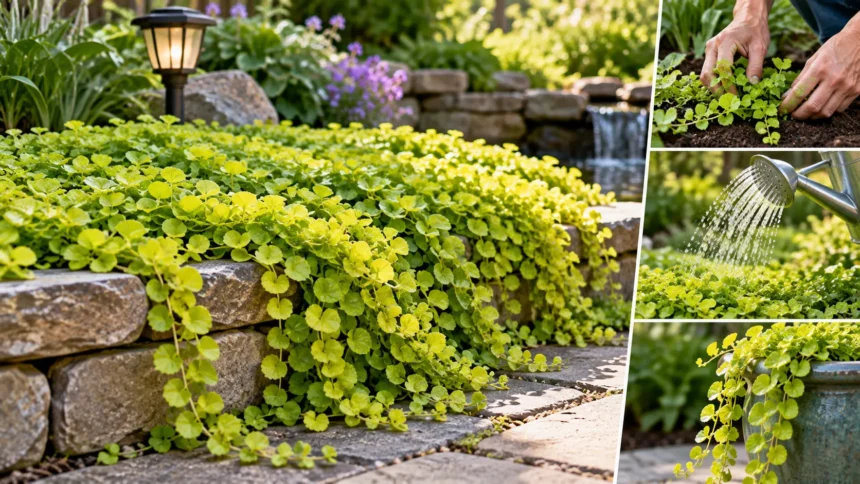
Creeping Jenny Care: Ground Cover Growing Guide
Creeping Jenny is a fast-spreading perennial ground cover valued for its low growth, rounded leaves, trailing stems, and ability to soften garden edges. Botanically known as Lysimachia nummularia, it is also commonly called moneywort because its small leaves resemble coins. Gardeners often grow it between stepping stones, beside ponds, along borders, in hanging baskets, and as a trailing accent in mixed containers. The golden cultivar is especially popular because its bright yellow-green foliage adds color even when the plant is not flowering. Creeping Jenny is generally easy to grow when moisture, light, and space are managed correctly. Its vigorous nature, however, means gardeners should understand how quickly it can spread before planting it directly in the ground.
Good Creeping Jenny care depends more on managing growth than on providing complicated maintenance. The plant prefers consistently moist soil, tolerates a range of light conditions, and usually responds well to trimming when stems become too long. Its shallow, spreading stems can root where they touch suitable soil, allowing a small planting to form a dense mat relatively quickly. That same ability can make the plant difficult to contain in favorable climates, and it may be considered invasive or problematic in some locations. Containers are therefore a useful option when gardeners want the appearance without unrestricted spread. This guide explains how to plant, water, fertilize, prune, propagate, overwinter, and troubleshoot Creeping Jenny successfully.
What Is Creeping Jenny?
Creeping Jenny is a low-growing herbaceous perennial belonging to the primrose family and known for its creeping growth habit. Its scientific name is Lysimachia nummularia, while common names include moneywort and creeping Charlie in some local usage, although that second name can also refer to a completely different plant. The stems spread horizontally across the soil and can form roots at their nodes when conditions are moist. Small rounded leaves grow closely along those stems and create a dense carpet of foliage. Mature plants usually remain relatively short while spreading much farther horizontally than vertically. This growth habit makes Creeping Jenny particularly useful where gardeners want living ground coverage rather than upright structure.
One of the plant’s most recognizable forms is golden Creeping Jenny, often grown for chartreuse or yellow-green foliage. Brighter light usually encourages stronger golden color, while plants growing in deeper shade often become greener. The standard green form has a softer, more natural woodland appearance and blends easily with other ground covers. Small yellow flowers may appear during the growing season, although the foliage is usually the main ornamental feature. Flowering can vary depending on climate, light, moisture, and cultivar. Because the stems trail attractively over edges, both green and golden forms are frequently used in containers and hanging baskets.
Creeping Jenny is often chosen for damp areas where some traditional ground covers struggle. It can perform well near ponds, rain gardens, moist borders, and low areas where the soil remains consistently damp but is not permanently stagnant. The plant can also tolerate ordinary garden soil when watering is adequate. Once established, its stems may grow across stones, mulch, and nearby open ground in search of new rooting points. This creates a soft, flowing appearance that works well in informal and cottage-style gardens. However, gardeners should account for its spreading habit rather than treating it like a compact clumping perennial.
Its ability to spread quickly is both an advantage and a potential problem. In a controlled border, Creeping Jenny can fill bare soil, reduce the visual impact of hard edges, and create attractive contrast around taller plants. In an unrestricted moist garden, the same plant may move farther than intended and compete with neighboring vegetation. It can be especially difficult to remove once many stem nodes have rooted into the soil. Gardeners should therefore check local guidance before planting it in natural areas or near waterways. Where invasiveness is a concern, containers provide a safer and more manageable way to enjoy the plant.
Creeping Jenny should not be confused with plants that simply look similar because care requirements can differ. Its rounded opposite leaves, thin trailing stems, and mat-forming habit are useful identifying characteristics. Garden centers may sell it in perennial sections, aquatic plant areas, or mixed-container displays depending on how it is being marketed. The same plant can therefore appear in very different garden contexts. Understanding its natural behavior helps explain why it succeeds in hanging baskets as well as moist ground-cover plantings. Creeping Jenny is ultimately a flexible ornamental plant whose success depends on matching its vigorous growth with an appropriate location.
Best Light, Soil and Location for Creeping Jenny
Creeping Jenny can grow in full sun, partial shade, and relatively shaded conditions, which makes it adaptable to many garden locations. Light level influences both growth and leaf color, especially in golden varieties. Plants receiving several hours of direct sunlight often develop brighter yellow or chartreuse foliage, while those in heavier shade may appear greener. In hot climates, strong afternoon sun can cause stress if the soil dries quickly. Partial shade can therefore be especially useful where summers are intense. The ideal position provides enough light for good color while protecting the plant from prolonged heat and drought.
Moisture availability is closely connected to the best planting location. Creeping Jenny naturally performs well where soil remains evenly moist, so sites that dry rapidly may require frequent irrigation. Areas near water features, downspouts, shaded pathways, and damp garden beds can suit the plant well when drainage is still reasonable. It can tolerate wet conditions better than many common bedding plants, but continuously stagnant soil may still create problems. Soil that holds moisture without becoming severely oxygen-deprived is generally preferable. Observing how quickly a site dries after watering or rainfall can help determine whether it will support healthy growth.
The plant is not particularly demanding about soil type, but rich, moisture-retentive soil generally produces the strongest growth. Loamy soil containing organic matter can hold water while still allowing excess moisture to drain. Sandy soil may dry too quickly unless compost or other organic material is added. Heavy clay can support Creeping Jenny when water does not remain trapped around the roots for long periods. A slightly acidic to neutral soil is usually suitable, although the plant tolerates a broader range. Improving soil structure is often more important than trying to achieve an exact pH number.
When using Creeping Jenny as ground cover, gardeners should consider what surrounds the planting area. It works well along path edges, beneath taller perennials, between larger stones, and around ornamental containers. However, placing it beside small or slow-growing plants can create competition because the creeping stems may spread over them. Physical boundaries such as paving, raised beds, or container walls make maintenance easier. A site that can be inspected regularly is also easier to control than an inaccessible corner. Thoughtful placement prevents a useful ground cover from becoming a recurring maintenance problem.
Container growing offers the greatest control over location and spread. Creeping Jenny can be planted around the edge of pots, window boxes, hanging baskets, and raised planters so the stems cascade downward. Containers also allow gardeners to move the plant if sunlight becomes too intense or if seasonal conditions change. A drainage hole is still important because even moisture-loving plants need oxygen around their roots. Potting mix should retain some moisture without staying waterlogged indefinitely. Container culture is especially practical in areas where planting Creeping Jenny directly into the landscape is discouraged.
How to Plant Creeping Jenny Successfully
Creeping Jenny can be planted during mild weather when the soil is workable and temperatures are not excessively hot. Spring is often convenient because new growth establishes before summer, while early autumn can also work in climates with enough time before hard freezing. The planting area should be cleared of aggressive weeds because Creeping Jenny spreads best when it does not compete heavily during establishment. Loosening compacted soil and incorporating organic matter can improve moisture retention and root development. The root ball should be planted at approximately the same depth it was growing in its original container. Planting too deeply can bury stems unnecessarily and increase the chance of rot.
Spacing depends on how quickly a gardener wants the area to fill and how much maintenance is acceptable. Because the stems spread outward, small plants do not need to be positioned extremely close together. Wider spacing reduces initial cost and gives each plant room to expand naturally. Closer spacing creates faster coverage but can also make the planting dense very quickly. After setting each plant, soil should be firmed gently around the roots and watered thoroughly. Consistent moisture during the first several weeks helps new roots move into the surrounding soil.
Mulch can be useful around newly planted Creeping Jenny, but it should be applied thoughtfully. A light organic mulch can reduce moisture loss and suppress weeds while the ground cover becomes established. Thick mulch directly over the creeping stems may interfere with rooting or hold excessive moisture against tender growth. Once Creeping Jenny forms a dense mat, less mulch is usually necessary because the foliage begins covering the soil itself. Gardeners should also watch whether stems are rooting outside the intended area. Early correction is much easier than removing a large established patch later.
Planting between stepping stones requires slightly different planning. Creeping Jenny can soften the spaces between pavers, but the gaps should contain enough soil for the stems to root. Areas receiving constant heavy foot traffic may not be suitable because repeated crushing can damage the foliage and stems. Light occasional contact is generally more manageable than daily concentrated traffic. Moisture may also evaporate quickly around stone surfaces, particularly in sunny locations. Regular watering may therefore be necessary until the plant creates enough coverage to shade the soil.
In containers, Creeping Jenny works well as the trailing component of mixed arrangements. It can be paired with upright flowers, foliage plants, ornamental grasses, or seasonal annuals that prefer similar moisture conditions. The plant should be positioned near the outer edge so stems can spill naturally over the rim. Because it grows vigorously, occasional trimming may be required to prevent it from overwhelming slower container companions. A quality potting mix and reliable drainage help balance moisture retention with root health. Container plants also need more frequent watering than those established directly in moist garden soil.
Watering and Feeding Creeping Jenny
Water is one of the most important parts of Creeping Jenny care because the plant performs best when its roots do not remain dry for long periods. Newly planted specimens should be watered regularly while they establish their root systems. The goal is to keep the surrounding soil evenly moist rather than repeatedly allowing it to become completely dry. In cool or shaded gardens, natural rainfall may provide much of the moisture required. Sunny locations usually dry more quickly and may need supplemental irrigation. Checking the soil with a finger is more reliable than watering according to a rigid calendar.
Established Creeping Jenny can tolerate short periods of less-than-ideal moisture, but prolonged drought often reduces its appearance and growth. Leaves may lose their fresh color, stems can become less vigorous, and the edges of the plant may begin to dry. Golden cultivars growing in containers are especially vulnerable because potting mix can dry quickly during warm weather. Thorough watering is generally better than repeatedly wetting only the surface. Water should reach the root zone and then excess moisture should be allowed to drain. A consistent moisture pattern encourages stronger roots and more uniform ground coverage.
Overwatering can still cause trouble even though Creeping Jenny enjoys damp conditions. Roots need oxygen, and soil that remains completely saturated for long periods may encourage decline. Container plants are at greater risk when pots lack drainage holes or sit continuously in water-filled saucers. Yellowing leaves combined with soft stems or unpleasant-smelling soil can indicate excessively wet conditions. Improving drainage may be more effective than simply reducing watering frequency if the soil itself holds too much water. Moist and waterlogged are not the same growing condition.
Creeping Jenny usually does not require heavy fertilization. In reasonably fertile garden soil, organic matter and normal soil nutrients may support healthy growth without additional feeding. Excessive fertilizer can encourage very rapid, soft growth that becomes harder to control. If foliage appears weak or growth is poor despite adequate light and moisture, a modest application of balanced fertilizer may help. Container plants may need nutrients more regularly because repeated watering gradually removes minerals from the potting mix. Following label rates conservatively is preferable to applying large amounts.
Organic matter can often provide a gentler approach to feeding landscape plants. A thin layer of compost incorporated around the planting area can improve soil structure while supplying nutrients gradually. This approach is particularly useful in sandy or compacted soil where moisture management is also a concern. Gardeners should avoid piling compost or fertilizer directly over thick mats of stems. Applying materials around active rooting areas allows nutrients to reach the soil without smothering foliage. Healthy Creeping Jenny usually grows so readily that encouraging more growth is rarely the biggest challenge.
Pruning and Controlling Creeping Jenny
Regular trimming is the simplest way to keep Creeping Jenny within an intended area. Its trailing stems can extend quickly during warm, moist growing conditions, especially when soil is fertile. Gardeners can cut back runners whenever they cross pathways, cover neighboring plants, or move beyond bed edges. The plant generally responds well to pruning and often produces fresh growth afterward. Clean garden shears or scissors are sufficient for small plantings. Larger ground-cover patches may require more frequent edging during the active growing season.
Pruning can also improve the appearance of container-grown Creeping Jenny. Long stems may become uneven or begin touching the ground below hanging baskets and window boxes. Cutting them back encourages a more balanced shape and can help prevent the plant from overwhelming companion plants. Yellow, damaged, or dried stems can be removed at the same time. Gardeners do not need to follow an exact pruning schedule because growth rate changes with temperature, moisture, and light. Trimming whenever the plant looks untidy is usually enough.
Preventing unwanted rooting is important when controlling spread. Creeping Jenny stems can form roots where nodes remain in contact with moist soil. A stem that appears to be only lying across the surface may therefore become attached in several places over time. Pulling up young runners before they root extensively is much easier than removing a mature colony. Gardeners should check bed edges, cracks, and nearby moist areas regularly. Discarded stem pieces should also be handled carefully because viable sections may root under favorable conditions.
Physical barriers can help, although no barrier should be considered completely maintenance-free. Containers, paved edges, raised beds, and hard landscape boundaries reduce the number of places stems can establish. Planting Creeping Jenny in a pot and positioning the pot within a larger arrangement is another way to enjoy the foliage while limiting root spread. Even then, stems that touch surrounding soil can sometimes root outside the container. Occasional inspection remains necessary. Combining physical containment with trimming provides more reliable control than either approach alone.
Where Creeping Jenny is considered invasive locally, landscape planting may not be appropriate at all. The plant’s ability to spread through rooted stems makes escape into damp natural areas a legitimate concern in some regions. Gardeners should follow local invasive-plant guidance and avoid allowing garden material to enter waterways or unmanaged land. A noninvasive native or locally recommended ground cover may be a better choice in sensitive landscapes. If Creeping Jenny is already established where it is unwanted, repeated removal may be necessary. Early action is considerably easier than attempting to remove a large mature patch.
How to Propagate Creeping Jenny
Creeping Jenny is easy to propagate because its stems naturally produce roots where they contact moist soil. One of the simplest methods is division. A healthy established plant can be lifted carefully and separated into smaller rooted sections. Each division should contain several stems and a reasonable amount of roots. The pieces can then be replanted at the same depth and watered thoroughly. Mild weather is preferable because divisions establish more easily when they are not immediately exposed to intense heat or drought.
Stem cuttings are another practical propagation method. Gardeners can cut healthy trailing stems into sections containing several nodes and remove leaves from the portion that will contact the growing medium. The cuttings can be inserted into moist potting mix or laid gently across the surface with one or more nodes touching the soil. Keeping the medium consistently moist encourages root formation. Bright indirect light is generally suitable while the cuttings establish. Once roots and new growth are obvious, the young plants can be transplanted.
Layering requires almost no separation from the parent plant during the rooting process. A long Creeping Jenny stem can be positioned across moist soil and held in place so one or more nodes maintain contact with the surface. Small roots often develop naturally at those points. Once a section has developed a stable root system, the connecting stem can be cut and the new plant moved elsewhere. This technique creates less stress than taking an unrooted cutting. In fact, Creeping Jenny frequently layers itself without any help from the gardener.
Propagation from seed is possible but is generally less convenient than vegetative methods. Seed-grown plants take longer to produce the immediate ground-cover effect that most gardeners want. Named cultivars may also fail to reproduce exactly from seed because seedlings can show different traits from the parent plant. Divisions and cuttings preserve the characteristics of the original plant more reliably. For golden Creeping Jenny, vegetative propagation is therefore especially useful when maintaining consistent foliage color. Seed propagation is usually more relevant to experimentation than routine garden expansion.
Before propagating large quantities, gardeners should consider whether additional plants are actually needed. Creeping Jenny can spread so easily that intentional propagation may soon create more material than expected. Sharing rooted divisions with other gardeners can be convenient where the plant is appropriate, but local invasive regulations should always be respected. Plant material should never be discarded into natural areas, streams, or wetlands. Excess growth can usually be composted only if local guidance considers that safe. Responsible propagation is part of managing an aggressive ground cover successfully.
Creeping Jenny in Pots, Hanging Baskets and Water Gardens
Creeping Jenny is particularly effective in containers because its flexible stems spill naturally over pot edges. The golden form creates bright contrast beside darker foliage, purple flowers, ornamental grasses, and upright annuals. In mixed containers, it often serves as the trailing element in the familiar thriller, filler, and spiller design approach. Because the plant grows rapidly, only a small starting plant may be necessary. Its stems can eventually cascade well below the container rim. Regular trimming keeps the arrangement proportionate and prevents Creeping Jenny from hiding neighboring plants.
Container-grown plants need closer attention to watering than those planted in consistently moist ground. Potting mix is exposed to air on several sides and can dry rapidly during sunny or windy weather. Hanging baskets often dry even faster because they contain relatively little soil. Creeping Jenny may wilt or lose foliage quality when repeatedly allowed to become very dry. Checking containers daily during hot periods can prevent stress. Self-watering containers may also be useful where frequent irrigation is difficult.
Drainage remains essential even when moisture is important. A pot should contain at least one effective drainage opening so excess water can escape after irrigation or heavy rain. Gardeners sometimes assume that moisture-loving plants should sit permanently in water, but container roots can decline when oxygen disappears from saturated soil. A quality potting mix generally provides better drainage than dense garden soil placed directly into a pot. Containers located in shade will dry more slowly than those in full sun. Watering frequency should therefore reflect conditions rather than a fixed routine.
Creeping Jenny is also used around ponds and water features because it enjoys moist environments. Stems can trail over rocks and soften the hard edges of pond liners or constructed water gardens. Some gardeners position it where the roots remain in damp soil while the foliage grows across nearby stones. Its bright leaves can create attractive contrast with darker aquatic plants. However, unrestricted growth near natural waterways should be approached very cautiously because escaping stems may establish beyond the garden. Local ecological guidance should take priority over ornamental use.
Overwintering container plants depends strongly on climate. In areas where Creeping Jenny is reliably winter-hardy, plants in the ground may return each spring even if top growth declines. Containers are more exposed to cold because roots receive less insulation than they would in garden soil. Gardeners in colder regions may move pots to a protected area, place them against a sheltered structure, or treat container plants as seasonal ornamentals. Indoor overwintering is possible in some situations if adequate light and moderate temperatures are available. The best strategy depends on local winter severity and container size.
Common Creeping Jenny Problems and How to Fix Them
Brown or crispy leaves most commonly indicate that the plant has become too dry, especially in hot sun or containers. Creeping Jenny prefers reliable moisture and may respond quickly when potting mix or soil dries deeply. The first step is to check moisture several centimeters below the surface rather than assuming that visible dryness tells the whole story. Thorough watering may restore plants that have only recently become stressed. Repeated drought can cause more permanent stem damage. Moving container plants away from harsh afternoon sun can also reduce water loss.
Yellowing leaves can have several causes, making soil inspection important. Naturally golden cultivars should not be mistaken for plants experiencing nutrient deficiency simply because their foliage is yellow-green. However, leaves that become unusually pale, soft, or accompanied by declining stems may suggest excessive moisture or poor root aeration. Waterlogged containers should be allowed to drain and may need improved potting mix. Dense garden soil may require organic matter or better site drainage. Fertilizer should not be the first solution unless other growing conditions are already suitable.
Poor golden color often occurs when golden Creeping Jenny receives too little light. Plants growing in heavy shade frequently develop greener foliage because less intense light changes pigmentation. Moving a container to a brighter position or carefully increasing sun exposure may improve color. Sudden transfer from deep shade to intense full sun can scorch leaves, so gradual adjustment is preferable. Very hot climates may still require afternoon protection despite the desire for stronger color. The best appearance often comes from bright light combined with steady soil moisture.
Creeping Jenny is generally resilient, but pests can occasionally appear. Aphids, slugs, snails, or other common garden pests may feed on tender foliage depending on local conditions. Small infestations can often be managed by removing damaged material, encouraging beneficial insects, or physically removing pests. Dense, constantly wet growth can also create conditions favorable for some fungal problems. Improving airflow and avoiding unnecessary overhead watering late in the day can help. Severe or recurring problems should be identified correctly before any pesticide or treatment is used.
The most serious problem for many gardeners is simply excessive spread. Healthy Creeping Jenny can move beyond its assigned space faster than expected, particularly in moist soil. Once runners root repeatedly, pulling only the visible stems may leave rooted sections behind. Regular edging and removal of unwanted runners prevents the problem from becoming overwhelming. Gardeners who cannot provide that maintenance should consider growing the plant only in containers. Where local environmental authorities classify it as invasive, replacement with a better-behaved ground cover is the more responsible solution.
Seasonal Care for Creeping Jenny
Spring is a useful time to inspect Creeping Jenny and remove winter-damaged foliage. As temperatures rise, established roots usually begin producing fresh stems and leaves. Dead material can be trimmed away to improve appearance and make room for new growth. Gardeners can also divide crowded plants before the most vigorous part of the season begins. A light layer of compost may be added where soil needs improvement. Spring is also a convenient time to redirect runners before rapid summer growth starts.
During summer, moisture management becomes the main priority. Plants in full sun or containers may require frequent watering, particularly during extended heat. Growth can also become very vigorous, making regular trimming useful around pathways and neighboring plants. Golden varieties may develop their brightest foliage in strong light if adequate moisture is available. However, leaf scorching can occur when intense heat combines with dry soil. Watching the plant’s appearance often gives an early warning that conditions need adjustment.
Autumn can be used for cleanup, division, and preparation for colder weather. In mild climates, Creeping Jenny may continue growing well into the season, while colder regions experience slower growth as temperatures fall. Excess runners can be removed before fallen leaves and winter weather make them harder to see. Divisions planted early enough in autumn may establish before the ground freezes. Gardeners should avoid applying large amounts of nitrogen fertilizer late in the season because soft new growth may be vulnerable to cold. Natural seasonal slowing is normal.
Winter appearance varies substantially with climate. In relatively mild regions, some foliage may remain attractive throughout much of winter. Colder temperatures can cause leaves and stems to brown or die back while underground or protected portions survive. This does not necessarily mean the plant has been lost. Dead top growth can be left temporarily for some protection and cleaned up before spring growth becomes active. Excess winter watering is rarely necessary when natural precipitation keeps the soil moist.
Container plants require more winter attention because exposed roots can experience colder temperatures than roots planted in the landscape. Small pots cool especially quickly during freezing weather. Moving containers into a sheltered location can reduce exposure to drying winds and severe temperature swings. Gardeners should still prevent the potting mix from remaining completely waterlogged during dormancy. Indoor storage should provide enough light if the plant remains actively growing. Seasonal care is ultimately simplest when the growing method matches local climate.
Frequently Asked Questions About Creeping Jenny
What is Creeping Jenny?
Creeping Jenny is a low-growing perennial ground cover botanically known as Lysimachia nummularia. It spreads through trailing stems that can root when they touch moist soil.
Is Creeping Jenny the same as moneywort?
Yes. Moneywort is one of the common names used for Lysimachia nummularia because its rounded leaves resemble small coins.
Does Creeping Jenny prefer sun or shade?
Creeping Jenny can grow in full sun or partial shade. Golden varieties usually develop brighter color with more light, although afternoon shade can be helpful in very hot climates.
How often should I water Creeping Jenny?
Water often enough to keep the soil consistently moist without leaving the roots permanently waterlogged. Containers and plants in sunny locations usually require more frequent watering.
Does Creeping Jenny spread quickly?
Yes. Its trailing stems can root at the nodes and form a dense mat relatively quickly when moisture and growing conditions are favorable.
Is Creeping Jenny invasive?
It can be invasive or environmentally problematic in some regions because of its vigorous spreading habit. Check local invasive-plant guidance before planting it directly in the landscape.
Can Creeping Jenny grow in pots?
Yes. Pots, hanging baskets, and window boxes are excellent places to grow Creeping Jenny because containers help control its spread while allowing stems to trail attractively.
Can Creeping Jenny grow indoors?
It can be grown indoors temporarily or under suitable conditions, but it generally performs best with bright light and consistently moist soil. Indoor plants may become weak or stretched when light is insufficient.
Why is my golden Creeping Jenny turning green?
Insufficient light is a common reason golden foliage becomes greener. Gradually moving the plant into brighter light may improve its golden coloration.
Why is my Creeping Jenny turning brown?
Brown or crispy foliage often results from dry soil, strong heat, or excessive sun combined with insufficient moisture. Check the soil and adjust watering before adding fertilizer.
Can you walk on Creeping Jenny?
It can tolerate occasional light contact but is not ideal for areas receiving heavy daily foot traffic. Repeated trampling can damage stems and foliage.
How do you propagate Creeping Jenny?
Creeping Jenny can be propagated easily through division, stem cuttings, or layering. Rooted stem sections can usually be separated and replanted successfully.
Should Creeping Jenny be cut back?
Yes, trimming is useful whenever the plant becomes too long, untidy, or spreads outside its intended area. It generally responds well to cutting back.
Does Creeping Jenny come back every year?
In climates where it is winter-hardy, Creeping Jenny is perennial and can return each year even if cold weather damages the top growth. Winter survival is less reliable in exposed containers.
What plants grow well with Creeping Jenny?
It pairs visually with upright flowers, ornamental grasses, dark-leaved foliage plants, and moisture-loving perennials. Companion plants should have similar moisture requirements and enough vigor to avoid being overwhelmed by its spreading stems.