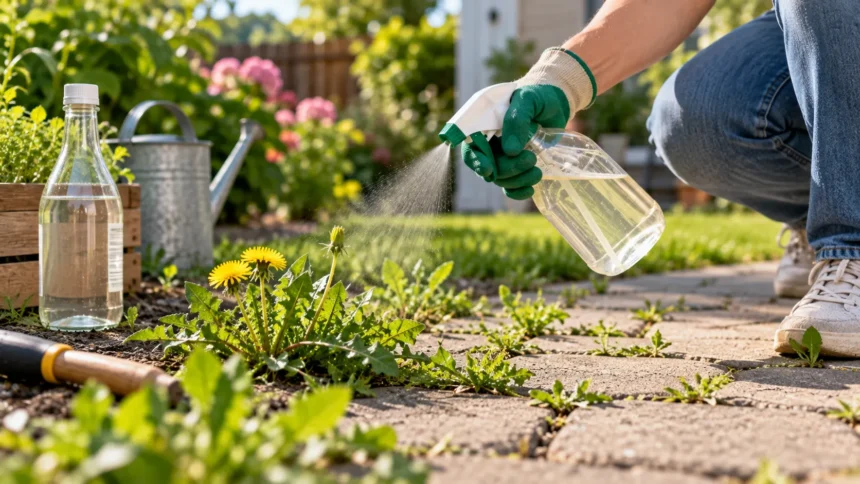
Kill Weeds With Vinegar: Simple DIY Weed Control
Killing weeds with vinegar is a popular DIY garden idea because vinegar is inexpensive, familiar, and easy to find in many homes. The acetic acid in vinegar can damage plant tissue, causing exposed leaves to dry, brown, and wilt after direct contact. However, vinegar weed control is not as simple as spraying every unwanted plant and expecting it to disappear permanently. Household vinegar works best on small, young annual weeds, while established perennial weeds often recover because their roots remain alive underground. Vinegar is also non-selective, meaning it can damage flowers, vegetables, lawn grass, and other desirable plants it touches. Understanding these limits helps homeowners use vinegar more realistically and safely.
The internet is filled with homemade weed killer recipes combining vinegar with dish soap, salt, or other household ingredients, but not every popular mixture is a good idea. Salt, in particular, can accumulate in soil and make it difficult for desirable plants to grow later, so routinely adding it to garden weed sprays can create more problems than it solves. Strong horticultural vinegar is also very different from ordinary kitchen vinegar and can cause serious skin or eye injury if mishandled. For many small weeds growing through driveway cracks or gravel, careful spot treatment may be useful. In lawns, vegetable beds, and established perennial weeds, other approaches are often more effective. This guide explains how vinegar affects weeds, where it works best, its limitations, and safer ways to improve long-term weed control.
Does Vinegar Really Kill Weeds?
Vinegar can kill or severely damage certain weeds because it contains acetic acid, a substance that disrupts plant cells when it contacts foliage. Once sprayed onto a susceptible weed, the acid damages cell membranes and causes water to escape from the exposed tissue. Leaves may begin looking dull, wilted, or brown relatively quickly, especially under warm and dry conditions. This rapid visual effect makes vinegar seem extremely powerful when compared with slower weed-control methods. However, visible leaf injury does not always mean the entire plant has died. The most important question is whether the weed can regenerate from roots, underground stems, crowns, or new seeds after the treated foliage dries.
Household white vinegar commonly contains about 5% acetic acid, which is strong enough to injure tender plant tissue but relatively weak compared with horticultural herbicide products. Young annual seedlings with only a small amount of foliage may be severely damaged after thorough contact with household vinegar. Larger weeds are more difficult because they contain greater energy reserves and more protected growing tissue. Mature leaves may burn while the lower stem or root remains alive. Within days or weeks, fresh green growth may appear from the surviving plant. This explains why vinegar can appear successful immediately while failing to provide lasting weed control later.
Vinegar behaves mainly as a contact treatment rather than a systemic weed killer. A systemic herbicide is absorbed by plant tissue and moves internally toward growing points and roots, whereas vinegar primarily damages the surfaces it directly wets. If half the weed escapes the spray, that untreated foliage may continue functioning. More importantly, deep taproots and underground rhizomes receive little benefit from a leaf-only vinegar application. Dandelions, bindweed, thistles, and many other perennial weeds are therefore capable of returning after the top growth has been burned away. Repeated removal can eventually weaken certain plants, but one application should not be expected to eliminate well-established perennial root systems.
Weather can influence how quickly vinegar appears to work. Warm, bright, dry conditions generally favor rapid drying and visible foliage injury, while rain soon after treatment can wash material away before it has produced the desired contact effect. Wind creates a different problem because spray droplets can drift onto nearby plants. Since vinegar does not distinguish a weed from a rose, tomato plant, ornamental grass, or lawn, accidental contact can cause unwanted injury. Spot application is therefore more practical than broadcasting vinegar across areas containing desirable vegetation. Choosing a calm period also improves control because more of the spray reaches the exact leaves being targeted.
Vinegar is therefore best considered one tool rather than a complete weed-management strategy. It can be convenient for scattered young weeds in places where desirable vegetation is absent, such as some gravel areas and cracks between hard surfaces. It is less useful when weeds are mature, deeply rooted, densely established, or growing throughout a lawn. Long-term weed management usually requires preventing seed production, covering bare soil, removing roots when practical, and improving conditions for desirable plants. Using vinegar only where it has a realistic advantage saves time and prevents unnecessary repeated spraying. The fastest visible weed burn is not always the same as the most effective long-term control.
Household Vinegar vs. Horticultural Vinegar
Household vinegar and horticultural vinegar may share the same active chemical, but they should not be treated as interchangeable products. Ordinary culinary vinegar usually contains approximately 5% acetic acid and is manufactured primarily as a food product. Horticultural weed-control products can contain substantially higher concentrations, often around 10% to 20% acetic acid or sometimes more. That difference dramatically changes both plant injury and human safety. A product containing four times the acid concentration of kitchen vinegar is not simply a stronger version to handle casually. Concentrated acetic acid can cause significant burns and serious eye damage, so the product label and required protective equipment matter.
The stronger concentration of horticultural vinegar can provide more rapid and extensive foliage damage than ordinary household vinegar. This can make it more effective on somewhat larger weeds, provided the leaves are thoroughly contacted. Even then, concentration does not transform acetic acid into a reliable systemic treatment for deep-rooted perennial plants. Strong vinegar may destroy the visible top of a dandelion while leaving enough root tissue underground for regrowth. This limitation is important because people sometimes assume stronger vinegar automatically means permanent control. Increasing concentration can increase immediate tissue injury, but it does not necessarily solve the fundamental problem of underground survival structures.
Safety is where the difference between household and horticultural vinegar becomes especially important. Food-grade vinegar is familiar enough that many people associate the word vinegar with something harmless, but higher concentrations can be corrosive. Spray mist can irritate the respiratory system, and splashes can damage the skin and eyes. Protective gloves, eye protection, appropriate clothing, and every precaution listed on the product label may be necessary. Children and pets should be kept away during application according to label requirements. Pouring concentrated horticultural vinegar into an unlabeled household bottle is also unsafe because someone could mistake it for ordinary cleaning or cooking vinegar.
Horticultural vinegar may also affect materials other than plants. Acid can react with certain metals and may stain, etch, discolor, or otherwise affect some outdoor surfaces and equipment. Spray bottles or applicators containing vulnerable metal components may deteriorate with repeated exposure. For that reason, equipment compatibility should be considered before filling a sprayer with concentrated acetic acid. Overspray onto fences, furniture, decorative materials, or masonry can also create unintended damage. Using more concentrated vinegar therefore requires much greater precision than pouring kitchen vinegar into a garden sprayer. The weed may be small, but the consequences of uncontrolled spray can extend well beyond the plant.
For most homeowners interested in simple DIY weed management, the better question is not “How strong can I make the vinegar?” but “Is vinegar appropriate for this weed and location?” Small annual weeds can often be pulled or treated without resorting to concentrated acid. Tough perennial weeds may be better managed by digging, repeated cutting, smothering, mulching, or a properly labeled herbicide when necessary. Horticultural vinegar can have a role when used exactly according to its pesticide label and local rules. It should not be treated as a safer substance merely because its active ingredient occurs in a familiar kitchen product.
What Types of Weeds Can Vinegar Kill?
Vinegar performs best against very young annual broadleaf weeds that have recently emerged from seed. At this stage, plants have limited root systems, small energy reserves, and tender leaves that are easily damaged by contact treatments. Chickweed, lambsquarters, mustard-type seedlings, young pigweed, and similar small annual weeds may respond more readily than mature plants. Treating them early also prevents those weeds from producing additional seeds that could create future generations. This timing advantage is one of the most important principles of vinegar weed control. Waiting until weeds are tall, flowering, and well rooted greatly reduces the chance that a simple contact treatment will provide satisfactory results.
Annual weeds complete their life cycle within one growing season, so killing their active growing tissue before they set seed can provide useful control. If an annual seedling is completely destroyed, it generally cannot regenerate from a large perennial root system because none exists. However, the surrounding soil may contain many dormant weed seeds waiting for suitable conditions. Vinegar has little meaningful residual activity for preventing those seeds from germinating later. A driveway crack that looks weed-free after spraying can therefore produce another group of seedlings within weeks. Follow-up management is required because treating existing foliage does not remove the underground weed seed bank.
Perennial weeds are more challenging because they survive for multiple growing seasons and store energy in roots, crowns, bulbs, or underground stems. Dandelions are a familiar example because their taproots can survive after the leaves have been damaged. Bindweed, Canada thistle, nutsedge, poison ivy, and other persistent weeds can also regenerate from underground tissues depending on the species. Vinegar may burn exposed foliage, producing an impressive brown appearance, while doing little to the structures responsible for long-term survival. Repeated top removal can sometimes weaken persistent weeds gradually. Nevertheless, homeowners should not confuse repeated suppression with immediate root kill.
Grassy weeds can also be difficult to manage with vinegar because many grasses possess protected growing points and can recover after their leaf blades are damaged. Young grass seedlings may be injured, but established grassy weeds frequently regrow from their crowns or underground structures. This matters in gravel paths and cracks where unwanted grasses are a common problem. Repeated contact treatments may be required, and physical removal can sometimes be faster. Vinegar is also non-selective, so spraying grassy weeds in a lawn can damage the desirable turf around them. It cannot selectively identify crabgrass, for example, while leaving neighboring lawn grass untouched.
Correct weed identification can therefore save considerable effort. Before reaching for vinegar, determine whether the unwanted plant is an annual seedling, perennial broadleaf weed, grass, sedge, woody plant, or spreading vine. Different growth habits require different strategies, and some weeds can become harder to manage if the wrong approach is repeatedly used. Pulling a young annual before seed formation may be easier than spraying it several times. Digging a taproot may provide longer control than continually burning the leaves. Vinegar is most useful when the weed’s biology matches the strengths of a fast-acting, non-selective contact treatment.
How to Use Vinegar for Weeds More Effectively
Begin by selecting an appropriate location for vinegar treatment. Areas with isolated weeds and little risk to desirable vegetation are generally the simplest places to work. Cracks in some driveways, gravel paths, edges of hardscape, and similar non-planted spaces may be more suitable than lawns or crowded flower beds. Look beyond the target leaf before spraying because desirable plant roots or foliage may be nearby even when they are not immediately obvious. Avoid treating weeds directly beside vegetables, flowers, shrubs, or young trees unless the spray can be controlled precisely. Since vinegar is non-selective, careful placement matters more than whether the neighboring plant is considered hardy.
Target weeds when they are small rather than waiting for a large infestation to develop. Young seedlings provide more leaf coverage relative to their limited energy reserves and are less capable of recovering from severe tissue loss. Examine the area every week or two during active growing periods so emerging weeds can be managed early. This approach requires less product and reduces the number of mature weeds producing seed. Removing seed heads before treatment can also be useful when weeds have already begun flowering. Preventing one mature weed from spreading hundreds or thousands of seeds can sometimes provide more long-term value than achieving perfect immediate leaf burn.
A calm, dry period provides better control over spray placement. Wind increases drift and can carry vinegar droplets beyond the weed onto flowers, lawn grass, or ornamentals. Rain shortly after application can reduce contact time, so choose conditions that allow the treated foliage to remain dry long enough for the product to act. Apply only enough liquid to wet the weed’s leaves rather than soaking the surrounding soil. Heavy soil application generally provides little additional benefit for controlling established roots and can expose nearby plant roots or soil organisms unnecessarily. Precision is a better strategy than saturation when using any non-selective contact weed treatment.
If using a commercial horticultural vinegar herbicide, follow its label rather than substituting a homemade application rate. The label explains where the product can legally and safely be used, the protective equipment required, and any restrictions involving weather, surfaces, people, pets, or reapplication. Do not increase the concentration because a previous treatment failed. Failure may simply indicate that the weed is too mature or has underground structures capable of regrowth. Adding extra acid can increase hazards without addressing the biological reason the plant survived. The correct response to regrowth is often to reconsider the weed-control method rather than continually strengthening the mixture.
Monitor treated weeds over the following days and weeks instead of judging success only by rapid browning. Young annual weeds that are truly killed will not produce fresh growth from the base. Perennials may initially look dead and then send up new leaves from surviving roots. When that happens, repeated cutting, digging, mulching, or another appropriate strategy may be more useful than endless spraying. Also watch the surrounding vegetation for signs of accidental injury. Good weed management is measured by lasting reduction in weeds without unnecessary damage to desirable plants, soil, people, pets, or property.
Should You Mix Vinegar With Dish Soap or Salt?
Many DIY weed killer recipes recommend adding dish soap to vinegar because soap can help liquid spread across waxy leaf surfaces. In simple terms, a small amount of surfactant can reduce surface tension so droplets coat foliage instead of immediately rolling off. Commercial herbicidal vinegar products may already contain ingredients designed to improve coverage. However, household dishwashing liquids are formulated for cleaning dishes, not necessarily for use as garden pesticide additives. Some contain fragrances, degreasers, antibacterial ingredients, or other chemicals that provide no weed-control benefit. When using a registered herbicide product, adding ingredients not permitted by its label can be inappropriate and should be avoided.
Salt is a much more problematic addition to homemade vinegar weed killers. Sodium chloride can damage plants by interfering with their ability to take up water, which explains why salted mixtures may appear more effective initially. The problem is that salt does not simply disappear when the visible weed dies. It can remain in soil, affect desirable plants, move with water, and make future planting difficult when enough accumulates. Repeated salt applications are particularly undesirable around gardens, trees, lawns, and areas where runoff can reach other soil. A driveway crack may look isolated, but rain can carry dissolved salts toward nearby roots or drainage areas.
Epsom salt is sometimes promoted online as a gentler alternative because it contains magnesium sulfate rather than sodium chloride. However, the fact that magnesium and sulfur are plant nutrients does not make excessive quantities beneficial. Large or unnecessary applications can disrupt the balance of nutrients in the soil and are not a scientifically reliable way to selectively remove weeds. Plants need nutrients within suitable ranges, and adding more of one element does not automatically make soil healthier. If Epsom salt is being recommended solely because a social media recipe says it “boosts” vinegar, there is little reason to include it. Simpler weed management usually creates fewer unintended consequences.
Some homemade recipes also call for essential oils, citrus compounds, or concentrated detergents. Several plant-derived oils can damage foliage, but natural origin does not guarantee that a substance is harmless to skin, pets, pollinators, aquatic environments, or desirable vegetation. Combining multiple irritating substances also makes it harder to understand which ingredient caused accidental damage. More ingredients do not necessarily create better weed control. The key limitations of vinegar remain largely biological: it is a contact treatment and does not reliably move into established perennial roots. A complicated mixture cannot automatically overcome that limitation simply because it causes leaves to brown faster.
For a straightforward DIY approach, avoid turning weed control into kitchen chemistry. Young weeds can often be pulled, hoed, covered, or carefully treated using an appropriate labeled product without adding persistent salt or unnecessary household chemicals. If you choose household vinegar for isolated tender seedlings, recognize its modest capabilities instead of trying to transform it into industrial-strength herbicide. If stronger treatment is genuinely required, a properly labeled weed-control product provides clearer safety and application instructions than an improvised mixture. Effective gardening is not about producing the strongest possible spray. It is about solving the weed problem while creating the fewest new problems.
Where You Should and Shouldn’t Use Vinegar Weed Killer
Vinegar is most practical in locations where accidental injury to desirable vegetation is unlikely. Gravel paths, some driveway cracks, and spaces between certain hardscape areas are common examples because weeds can be targeted individually. Even in these areas, the surrounding surfaces and drainage patterns should be considered. Acidic solutions can affect certain metals and finishes, while runoff can travel into planted areas. Spot treatment allows more control than spraying an entire pathway indiscriminately. When only a handful of seedlings are present, pulling them may be faster and eliminate the need to apply anything at all.
Using vinegar in a lawn is much more difficult because the treatment is non-selective. If you spray a dandelion thoroughly, the surrounding turf receiving the same droplets can also become brown or damaged. Household vinegar does not recognize the difference between broadleaf weeds and desirable grass. This makes it fundamentally different from selective lawn herbicides designed to target certain weeds while minimizing turf injury when properly used. Digging individual weeds may therefore be more practical in a small lawn. Improving turf density through suitable mowing, fertilization, overseeding, and soil management can also reduce opportunities for future weeds to establish.
Vegetable gardens require similar caution because tomatoes, peppers, beans, herbs, and other crops can be injured by spray drift. Even if the weed itself is several inches away, a breeze can move fine droplets onto desirable leaves. Hand pulling, hoeing, organic mulch, and careful cultivation often provide greater control in densely planted beds. Mulching also offers the long-term advantage of limiting light reaching new weed seedlings. Vinegar does not provide that residual barrier, so fresh weeds may continue germinating from uncovered soil. A weed-control plan that prevents emergence can reduce the need to repeatedly kill weeds after they appear.
Extra care is needed around trees and shrubs. People sometimes assume a large woody plant cannot be harmed by a small amount of vinegar, but young shoots, exposed roots, suckers, and tender foliage can still be injured. Repeated soil saturation near root zones is also unnecessary and should be avoided. Mulch rings can suppress many weeds around trees while protecting soil moisture and reducing competition. Keep mulch away from direct contact with the trunk and use an appropriate depth rather than piling it into a mound. When troublesome perennial weeds emerge through mulch, targeted hand removal may be safer than spraying near valuable landscape plants.
Vinegar is also a poor choice for situations involving large infestations of invasive or dangerous perennial plants when reliable root control is essential. Simply burning the foliage of an aggressive vine may allow it to resprout repeatedly from an extensive underground system. Some invasive plants also require specific disposal methods to prevent fragments or seeds from spreading. Correct identification should come before treatment when an unfamiliar weed is spreading rapidly. Local extension or invasive-species resources can help determine appropriate management. DIY vinegar is convenient for small, low-risk weed problems, but convenience should not be confused with suitability for every weed in every landscape.
Why Weeds Often Grow Back After Vinegar Treatment
The most common reason weeds grow back after vinegar is that the treatment killed the leaves without killing the root. Leaves capture sunlight and manufacture energy, but established perennial weeds store substantial energy underground. When the foliage suddenly disappears, the plant can draw upon those reserves to produce new shoots. A dandelion with a healthy taproot can therefore look completely brown above ground and return later with fresh leaves. Similar recovery occurs in many weeds that spread through rhizomes, stolons, bulbs, or creeping roots. The visible plant represents only part of the organism, which is why evaluating weed control solely from leaf appearance can be misleading.
Another reason weeds return is new germination rather than regrowth from the original plant. Soil contains a seed bank composed of weed seeds produced during previous seasons. Some seeds can remain dormant until temperature, moisture, light, and soil disturbance create suitable germination conditions. Vinegar applied to existing leaves generally does not create a lasting barrier that prevents these seeds from emerging. Several weeks after a successful treatment, new seedlings may appear in the exact same area. It can seem as though the original weeds recovered when an entirely new generation has actually emerged. Preventing weeds from setting seed helps reduce this cycle over time.
Incomplete coverage also contributes to treatment failure. Since vinegar acts mainly where it touches foliage, leaves hidden beneath other vegetation may escape significant exposure. Growing points near the soil surface can also remain protected. A quick mist that reaches only the upper leaves may create spotting without enough damage to stop a vigorous plant. Increasing spray volume indiscriminately is not always the answer because runoff exposes soil and surrounding plants unnecessarily. Better targeting of young weeds is usually more effective. The plant’s stage of growth and biology remain more important than attempting to drown a mature weed with vinegar.
Timing can make regrowth appear more severe as well. Plants under ideal growing conditions can recover quickly because warm soil, moisture, and abundant sunlight support new shoot production. Perennial weeds often have particularly strong reserves at certain points in their growth cycle. Repeated removal of new foliage before the plant fully replenishes those reserves can gradually weaken it, although this may require patience. Digging or physically removing as much root as practical can accelerate control for some species. Deep-rooted or spreading weeds may still need a different strategy. One treatment should rarely be viewed as the entire management plan for a well-established perennial.
Long-term success improves when vinegar is combined with prevention rather than repeated alone indefinitely. Cover bare garden soil with appropriate mulch, maintain dense desirable vegetation, remove weeds before seed production, and inspect problem areas regularly. Repair gaps in paving or landscape edges when those spaces continually collect soil and support new weeds. Correct irrigation practices can also reduce unnecessary moisture in areas where weeds are not wanted. These actions address why weeds keep appearing instead of repeatedly treating the symptoms. The best weed control is often the combination of early intervention, competition, prevention, and carefully selected treatment methods.
Better Natural and Nonchemical Ways to Control Weeds
Hand pulling remains one of the simplest weed-control methods, particularly after rain or irrigation has softened the soil. Small annual weeds often pull easily, roots included, and removing them before flowering prevents additional seeds from entering the soil. For taproot weeds such as dandelions, a narrow digging tool can help remove a greater portion of the root. Leaving a large section behind may allow the plant to regenerate, so working carefully is worthwhile. Hand removal takes more effort than spraying but provides immediate confirmation that the plant has actually been removed. It also avoids accidental chemical injury to nearby flowers, vegetables, lawn grass, or other desirable vegetation.
Hoeing and shallow cultivation are effective for managing many young annual weeds in vegetable and ornamental beds. A hoe cuts tender seedlings at or just below the soil surface before they develop substantial reserves. The method works especially well when repeated regularly rather than waiting until weeds become large. Avoid excessively deep cultivation because turning over large amounts of soil can bring buried weed seeds closer to the surface where they are more likely to germinate. Shallow disturbance usually provides enough control for small seedlings. Regular five-minute maintenance sessions can prevent the need for exhausting weed removal later in the season.
Mulch provides both weed suppression and other garden benefits when applied appropriately. Organic materials such as shredded bark, wood chips, straw suited to the crop, or other landscape mulches limit the amount of light reaching weed seedlings. A sufficiently deep layer can prevent many seeds from establishing while also reducing soil moisture loss. New weeds that do appear through loose mulch are often easier to pull. Mulch does not eliminate every perennial weed, especially aggressive species that can grow through thick layers. However, it provides something vinegar cannot: ongoing suppression of future seedling emergence rather than only damaging weeds that are already visible.
Dense, healthy desirable plants can also provide natural weed competition. A thin lawn exposes soil and sunlight that allow weed seeds to germinate, whereas vigorous turf leaves fewer open spaces. Similarly, ground covers and well-spaced garden plants can eventually shade portions of the soil. Improving soil conditions, irrigation, mowing height, and plant health can therefore be part of weed control even though these steps do not directly kill a single weed. This preventive approach is especially valuable for recurring lawn problems. Continually killing weeds without improving the conditions that allowed them to dominate creates an endless cycle of treatment.
For severe weed problems, integrated weed management usually provides the most reliable approach. This means combining identification, prevention, mechanical control, cultural practices, and appropriately selected herbicides when necessary rather than depending on one method. Vinegar can fit into this strategy for certain young weeds in suitable locations. It does not need to either solve every problem or be dismissed completely. The right tool depends on the weed, location, scale, desired plants, and tolerance for repeated maintenance. Thinking in terms of long-term management rather than a miracle DIY weed killer leads to healthier landscapes and fewer disappointing results.
Frequently Asked Questions About Killing Weeds With Vinegar
Will regular household vinegar kill weeds?
Household vinegar containing about 5% acetic acid can injure or kill some very young annual weeds when it thoroughly contacts their leaves. It is much less reliable on mature weeds and established perennial roots, so regrowth is common.
How long does it take vinegar to kill weeds?
Visible wilting or browning can appear relatively quickly under favorable conditions, sometimes within hours or by the following day. However, rapid browning only shows foliage injury and does not prove that an established root system has been killed.
Does vinegar kill weeds permanently?
Vinegar may permanently kill small annual seedlings, but it often only burns the tops of perennial weeds. Deep roots, crowns, rhizomes, and new weed seeds can produce fresh growth later.
Should I add salt to vinegar to kill weeds?
Adding salt is generally a poor choice for garden and landscape soil because salt can persist, damage nearby plants, and interfere with future plant growth. Avoiding salt makes it easier to manage weeds without creating a long-term soil problem.
Is horticultural vinegar safer than regular weed killer?
Not necessarily. Horticultural vinegar contains much more concentrated acetic acid than kitchen vinegar and can cause serious skin or eye injury, so it should be treated as a pesticide product and used strictly according to its label.