Crabgrass: How to Identify, Prevent & Get Rid of It
Crabgrass is one of the most common warm-season weeds found in lawns, gardens, driveways, and other disturbed areas. It grows quickly, spreads low across the soil, and can produce large numbers of seeds before cold weather kills the mature plant. Many homeowners first notice it during late spring or summer when patches of coarse, light-green grass begin growing faster than the surrounding lawn. Crabgrass can make an otherwise uniform lawn look thin, uneven, and neglected. The good news is that it is an annual weed, which means individual plants usually die when temperatures become cold. The real challenge is preventing their seeds from producing a new generation the following year.
Learning how to identify crabgrass correctly is the first step toward controlling it. Several grassy weeds can resemble crabgrass, including goosegrass, dallisgrass, quackgrass, and even desirable turfgrass growing under stress. Crabgrass usually develops spreading stems that radiate outward from a central point, giving mature plants a somewhat crab-like appearance. Its leaves are broader and coarser than many lawn grasses, and the plant often thrives where turf is thin or soil is exposed. Depending on the species, stems and leaf sheaths may appear hairy or relatively smooth. Correct identification matters because different grassy weeds can require very different control strategies.
Crabgrass prevention usually works better than trying to eliminate established plants in the middle of summer. Most infestations begin when dormant seeds in the soil germinate as temperatures warm and suitable moisture becomes available. A dense, healthy lawn naturally blocks sunlight from reaching many of those seeds and leaves less open space for seedlings to establish. Pre-emergent herbicides can provide additional protection by interfering with young weeds as they germinate. Timing is critical because these products generally work before or during early germination rather than after mature crabgrass is already visible. Lawn care and herbicide timing therefore work best as part of the same prevention strategy.
If crabgrass has already appeared, the best response depends on how many plants are present and how mature they are. Small infestations can sometimes be pulled by hand, especially when the soil is moist enough to remove the roots easily. Larger outbreaks may require a selective post-emergent herbicide labeled for crabgrass and compatible with the turfgrass species being treated. Mature plants become more difficult to control, particularly once they have developed many tillers and begun producing seed heads. Removing plants before seed production can reduce future weed pressure even when complete control is no longer practical. Bare areas should then be repaired so new crabgrass seedlings do not simply replace the old ones.
This guide explains how to identify crabgrass, what causes it, when it germinates, how to prevent it, how to kill existing plants, and how to keep it from returning. It also covers mowing, watering, fertilization, overseeding, pre-emergent herbicides, post-emergent treatments, and common mistakes that make crabgrass worse. The goal is not simply to kill individual weeds but to create lawn conditions where crabgrass has fewer opportunities to establish. A healthy turf canopy is one of the strongest long-term defenses available. With proper timing and consistent lawn care, even a heavily affected yard can become much easier to manage.
What Is Crabgrass?
Crabgrass is the common name for several annual grasses in the genus Digitaria. Two of the most frequently encountered lawn species are large crabgrass and smooth crabgrass. These weeds grow during warm weather, produce seeds, and then die when freezing temperatures arrive in climates with cold winters. Their annual life cycle makes them different from perennial grassy weeds that survive underground and return from the same roots each year. Although mature plants die naturally, their seeds can remain in the soil and germinate during future growing seasons. This is why a lawn can seem free of crabgrass in winter yet develop a serious infestation again the following summer.
The plant often grows outward rather than forming the upright, uniform appearance expected from desirable lawn grass. Stems may spread along the soil surface and branch repeatedly as the plant matures. In favorable conditions, some nodes can come into contact with the soil and produce additional roots, allowing the plant to occupy more space. Leaves are generally flat, relatively broad, and noticeably coarse compared with fine-textured turfgrass. Mature plants can form conspicuous clumps or patches that interfere with the lawn’s visual consistency. Their rapid growth is especially obvious during hot periods when cool-season turf may be growing more slowly.
Crabgrass is particularly successful because it produces many seeds. A single mature plant can contribute a substantial number of seeds to the soil seed bank, depending on growing conditions and how long it survives. Those seeds do not necessarily germinate all at once. Some can remain dormant and emerge in later years when temperature, moisture, and light conditions are favorable. This staggered germination helps explain why one treatment rarely eliminates the weed permanently. Long-term control requires preventing seed production while also reducing future germination.
Open soil is one of crabgrass’s greatest opportunities. Thin areas caused by drought, insects, disease, pet damage, heavy traffic, poor mowing, or unsuitable soil conditions allow sunlight to reach the ground. Crabgrass seedlings can then establish without competing against dense turfgrass. Areas along sidewalks and driveways are particularly vulnerable because pavement absorbs heat and warms nearby soil more quickly. Irrigation runoff and disturbed soil can also create favorable growing conditions. The weed often appears first in these stressed locations before spreading into larger portions of the lawn.
Crabgrass is not inherently a sign that someone has completely neglected their lawn. Seeds are widespread and can be transported by soil movement, equipment, animals, wind, and other processes. Even maintained lawns can develop occasional plants when weather conditions strongly favor germination. However, repeated heavy infestations usually indicate that the lawn has open space or management problems that give weeds an advantage. Identifying those weaknesses is therefore just as important as removing the plants themselves. The strongest control program combines weed management with better turf health.
How to Identify Crabgrass in Your Lawn
The growth pattern is one of the most useful clues for identifying crabgrass. Young plants may initially look like ordinary blades of grass, but they gradually produce multiple shoots from a central crown. These shoots spread outward and can create a flattened, circular, or star-shaped patch. The name “crabgrass” partly reflects this sprawling appearance. Mature plants can become much broader than the surrounding turf and may lift their seed heads above the lawn. Observing the entire growth habit is usually more reliable than judging one individual leaf.
Leaf texture can provide additional clues. Crabgrass blades tend to be wider and coarser than the leaves of many common lawn grasses. Large crabgrass frequently has noticeable hairs on parts of the leaf or sheath, while smooth crabgrass generally has fewer obvious hairs. Color varies with conditions but can appear lighter green than surrounding turf, especially when the lawn is dark and dense. The blades may also grow quickly after mowing, causing crabgrass patches to become visible before the rest of the lawn needs cutting. Differences become easier to notice as plants mature.
The seed heads are another distinctive feature. Crabgrass produces several narrow finger-like branches that extend from or near the top of the flowering stem. These branches hold many small seeds and can make mature plants easy to recognize. Seed heads become particularly important from a management perspective because their appearance means the plant is approaching or actively producing the next generation. Leaving mature plants in place can substantially increase the amount of crabgrass pressure the following year. Removing them before seed maturation can therefore have benefits beyond improving appearance.
Location can also help with identification. Crabgrass commonly appears in sunny, thin, compacted, or disturbed portions of a lawn. Edges beside driveways, sidewalks, patios, and curbs are frequent starting points because these places become warmer and drier than the center of the yard. Bare spots caused by construction or heavy foot traffic can develop dense crabgrass populations quickly. Although the weed can grow in other conditions, its concentration around stressed turf is an important clue. A weed that appears mainly in consistently wet areas may be something else.
When identification remains uncertain, compare the plant with common look-alikes before applying an herbicide. Goosegrass often has a flattened whitish or silver center and tends to germinate slightly later than crabgrass. Dallisgrass is a perennial clumping grass with distinctive seed heads and does not die each winter in the same way. Quackgrass spreads through underground rhizomes and behaves differently from annual crabgrass. Misidentification can lead to disappointing herbicide results and unnecessary turf injury. Accurate identification should therefore come before treatment.
Why Does Crabgrass Grow in Lawns?
Thin turf is one of the biggest reasons crabgrass becomes established. A dense lawn creates shade at soil level and competes strongly for water, nutrients, and physical space. When turfgrass becomes weak or sparse, crabgrass seeds receive more light and seedlings experience less competition. Bare soil can develop after drought, disease, insects, construction, pet activity, or repeated traffic. Simply killing crabgrass without repairing those weak areas leaves the basic problem unchanged. New weeds can quickly occupy the same openings.
Mowing too short can also create ideal crabgrass conditions. Cutting turf below its recommended height reduces leaf area and limits the lawn’s ability to produce energy. Short mowing also allows more sunlight to reach the soil surface, which can encourage weed seed germination. The exact ideal mowing height depends on the turf species, but repeatedly scalping the lawn is rarely helpful. A slightly taller, denser canopy can shade potential crabgrass seedlings. Proper mowing is therefore a weed-control practice as much as an appearance decision.
Watering habits influence crabgrass as well. Frequent shallow irrigation encourages roots and weed seedlings near the soil surface. Established turf generally performs better when watering practices encourage deeper rooting, although the correct schedule depends on grass species, soil, climate, and current weather. Constant surface moisture can provide favorable conditions for newly germinating weeds. On the other hand, allowing desirable turf to become severely drought-stressed can create bare areas that crabgrass later occupies. Balanced irrigation strengthens the lawn without unnecessarily encouraging weed establishment.
Soil compaction and poor drainage can contribute to weak turf and create opportunities for crabgrass. Heavy foot traffic, vehicles, construction equipment, and naturally dense soils can reduce air movement and root development. Grass struggling in compacted soil may become thin even when it receives enough water and fertilizer. Core aeration can sometimes improve conditions when compaction is genuinely limiting turf growth. However, disturbing the soil at the wrong time can also expose weed seeds. Lawn renovation should therefore be coordinated with crabgrass prevention when infestations are severe.
Weather ultimately has a major influence on how much crabgrass appears in any given year. Warm soil temperatures promote germination, while moisture helps seedlings establish. A warm, wet spring followed by hot summer conditions can favor the weed strongly, particularly if the lawn has been weakened by previous stress. Pavement edges may warm early and produce seedlings before other parts of the property. This variation is why calendar dates alone are not always reliable for weed-control timing. Local soil conditions often matter more than a fixed date printed on a lawn-care schedule.
When Does Crabgrass Germinate?
Crabgrass generally begins germinating when soil temperatures remain warm enough for several consecutive days. The exact timing depends on climate, location, soil exposure, and the particular crabgrass species present. Sunny areas near pavement often warm faster than shaded lawn areas, so germination can begin at different times across the same property. This gradual pattern matters because crabgrass does not emerge in one single wave. Seeds can continue germinating over an extended period whenever conditions remain suitable. Effective prevention therefore needs to provide coverage during the broader germination window.
Many gardeners use natural seasonal indicators to estimate pre-emergent timing. Flowering landscape plants can sometimes provide a general clue that soil temperatures are approaching the range associated with crabgrass germination. However, these indicators should be treated as approximate rather than exact scientific measurements. A soil thermometer provides more direct information about what is happening in the lawn. Local university extension programs and professional lawn services may also publish regional crabgrass timing recommendations. Local guidance is often more accurate than national advice because spring arrives at very different times across climates.
Pre-emergent herbicides generally need to be applied before most crabgrass seedlings have emerged. These products create a chemical barrier or interfere with early root and shoot development as seeds germinate. Applying too early can sometimes reduce the period of useful protection later in the season, depending on the product and rainfall. Applying too late allows the first wave of plants to escape control. The objective is therefore to have the herbicide active in the soil as the major germination period begins. Proper timing is one of the most important factors affecting success.
Water is often required after application to move a pre-emergent herbicide into the upper soil layer where germinating weed seeds are located. The exact watering requirement varies by product, so the label should always be followed. Granular materials left sitting dry on the surface may not perform as intended. Excessive disturbance of the soil after treatment can also break the protective barrier. Aeration, dethatching, and aggressive raking may therefore need to be timed carefully. Lawn renovation plans should be coordinated with the type of pre-emergent being used.
Crabgrass can keep germinating later than homeowners expect, especially if the pre-emergent barrier becomes weaker or soil is disturbed. Some lawn programs use split applications to extend protection, depending on product labeling and local conditions. This strategy can be useful where growing seasons are long or crabgrass pressure is particularly severe. However, more herbicide is not automatically better, and annual application limits must be followed. Combining appropriate timing with a dense lawn reduces dependence on repeated chemical treatments over time.
How to Prevent Crabgrass Before It Starts
The most effective long-term prevention strategy is building a dense, competitive lawn. Healthy turf leaves little open soil where crabgrass can germinate and receive enough light to establish. This begins with selecting grass species suited to the climate, sun exposure, soil, and expected level of traffic. A lawn planted with poorly adapted turf will remain stressed no matter how many herbicides are applied. Correct mowing, irrigation, fertilization, and soil management then help that grass maintain coverage. Weed prevention becomes easier when desirable turf occupies the available space.
Maintaining an appropriate mowing height is particularly important. Taller turf generally creates more shade at the soil surface and develops a more substantial root system than grass that is repeatedly scalped. The correct height varies by species, so a universal mowing number is not appropriate for every lawn. Avoid removing an excessive portion of the leaf blade during a single mowing because that stresses the plants. Sharp mower blades also produce cleaner cuts and reduce unnecessary injury. Small improvements in mowing practices can make the lawn substantially more resistant to crabgrass over time.
Pre-emergent herbicides are highly useful when a property has a history of significant crabgrass infestations. Common active ingredients in lawn products are designed to prevent or greatly reduce establishment of annual grassy weeds. Product choice depends on turf species, location, local regulations, and whether reseeding is planned. Many pre-emergents can also interfere with desirable grass seed germination, which creates an important conflict between crabgrass prevention and spring overseeding. Reading the label before application is essential. The label determines where and how the product can legally and safely be used.
Bare or thin spots should be repaired before they become permanent weed nurseries. Depending on the grass type and season, this can involve overseeding, plugging, sodding, or encouraging surrounding turf to spread into the opening. Soil problems such as compaction or poor fertility should also be corrected where necessary. Throwing seed onto hard, unhealthy soil without addressing the cause often produces temporary results. Once desirable grass becomes established, it can compete directly with future crabgrass seedlings. Lawn repair is therefore an essential part of weed prevention.
Garden beds and non-lawn areas require a different approach. Mulch can reduce light reaching crabgrass seeds and make it harder for seedlings to establish. Hand removal is effective when plants are young and the soil is moist. Landscape beds should also be monitored because mature weeds can produce seed that eventually spreads into nearby turf. Keeping borders, driveway cracks, and other neglected areas under control reduces the overall seed supply around the property. Prevention works best when the entire landscape is managed rather than treating the lawn as an isolated area.
How to Get Rid of Crabgrass That Is Already Growing
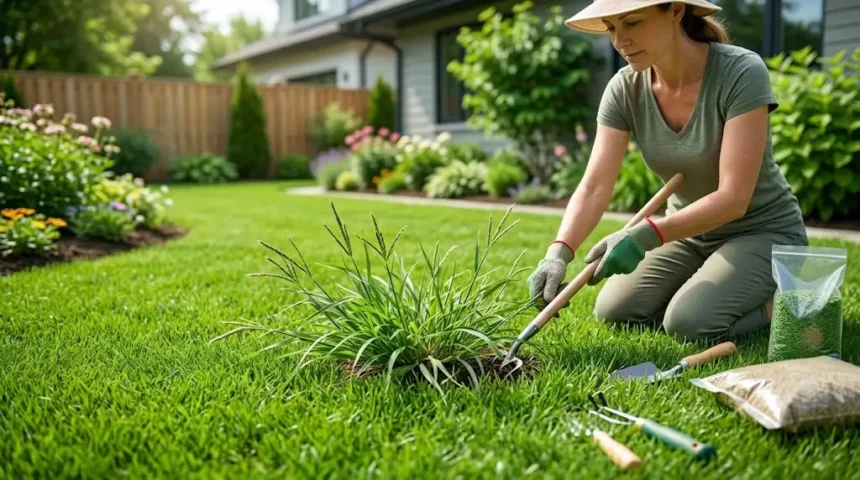
Young crabgrass plants are much easier to eliminate than mature plants. When only a few seedlings are present, hand pulling can be one of the simplest control methods. Watering the area lightly beforehand can make the soil easier to work with and help remove more of the root system. Try to disturb surrounding desirable grass as little as possible. The resulting opening should eventually be filled with healthy turf so another weed does not establish. Hand removal is especially useful for homeowners who want to limit herbicide use.
Selective post-emergent herbicides can control crabgrass in many established lawns. These products are designed to kill or suppress the weed while leaving certain labeled turf species relatively unharmed when used correctly. Effectiveness is usually highest when crabgrass is young and actively growing. Large, mature plants with multiple tillers can be considerably harder to kill and may require follow-up treatment if the label permits it. Hot weather and drought stress can also influence turf tolerance and herbicide performance. Always verify that the product is labeled for both crabgrass and the specific lawn grass being treated.
Spot treatment can reduce unnecessary herbicide exposure when crabgrass occurs in isolated patches. Rather than spraying the entire property, only affected areas can be treated according to label directions. This approach is particularly practical when most of the lawn is healthy. Accurate application still matters because excessive concentration can injure surrounding turf. Measuring equipment and following dilution instructions is better than estimating by eye. More product does not necessarily produce faster control and can increase the risk of damage.
Very mature crabgrass sometimes becomes difficult to control efficiently late in the season. In climates where frost will soon kill the annual plants naturally, it may make more sense to prevent seed production and focus on next year’s pre-emergent program. Pulling or cutting seed-producing plants before mature seed is dispersed can help reduce future pressure. However, mowing alone does not reliably prevent every seed from developing because plants can produce lower seed heads. Late-season management should therefore focus on minimizing seed return while strengthening desirable turf.
After the crabgrass dies, repair is important. Dead plants often leave open areas that can be recolonized by weeds. Raking away excessive dead material, improving the soil if necessary, and reseeding or otherwise restoring turf at the appropriate season can close those gaps. Herbicide labels may specify how long to wait before planting grass seed, so check the product used before renovation. A lawn that remains bare after weed control is only partially treated. Successful crabgrass management ends when healthy turf replaces the weed.
Best Crabgrass Killers and Treatment Options
Crabgrass control products generally fall into two broad categories: pre-emergent and post-emergent herbicides. Pre-emergents target germinating seedlings before they become visible, while post-emergents are intended for plants that have already emerged. Choosing the wrong category is one of the most common reasons homeowners are disappointed with weed control. A pre-emergent application will not usually make a large mature crabgrass plant disappear. Likewise, waiting for weeds to become obvious misses the main advantage of preventive treatment.
Different active ingredients have different strengths, restrictions, and turfgrass compatibility. Some post-emergent crabgrass herbicides work effectively on cool-season lawns but may injure certain warm-season grasses. Other products are formulated specifically for particular turf types. Combination weed killers can also contain several active ingredients designed for grassy and broadleaf weeds. The front label alone may not provide enough information to determine suitability. The full product label should always be consulted before spraying.
Nonselective herbicides kill or severely damage most green vegetation they contact, including desirable lawn grass. These products may be appropriate for isolated weeds growing in pavement cracks, renovation areas, or locations where all vegetation is intended to be removed. They are usually a poor choice for crabgrass scattered throughout a healthy lawn unless extremely precise spot treatment is possible. Accidental drift or overspray can create obvious dead patches. Selective products are generally more practical where preserving turf is the goal.
Some homeowners prefer nonchemical management. Hand pulling, improving mowing height, overseeding, repairing bare soil, and using mulch in beds can significantly reduce crabgrass without relying entirely on herbicides. Organic-labeled pre-emergent options are sometimes marketed as well, but their performance can differ from conventional products and may depend heavily on timing and application rate. No treatment should be assumed effective merely because it is described as natural. The best approach is the one that provides acceptable control while fitting the lawn’s condition and the homeowner’s preferences.
Herbicide safety extends beyond weed control. Keep people and pets away from treated areas for the period specified on the label, wear recommended protective equipment, and prevent drift onto desirable plants. Do not apply products near water or drainage areas in ways prohibited by labeling. Weather conditions such as wind and expected rain can affect application safety and performance. Local rules may also restrict certain active ingredients. Using pesticides responsibly protects the lawn, the applicator, nearby plants, and the surrounding environment.
Lawn Care Practices That Keep Crabgrass Away
Good mowing practices can dramatically influence how competitive a lawn becomes. Cutting grass at the recommended height for its species allows more leaf area for photosynthesis and generally encourages stronger roots. Avoid scalping high spots or cutting the lawn extremely short before vacations because the resulting stress can create thin patches. During periods of drought or heat, additional mowing stress can make desirable turf less competitive against warm-season weeds. Leaving the lawn slightly taller within its recommended range often improves soil shading. Regular mowing also removes many crabgrass seed heads before they fully mature.
Fertilization should strengthen desirable turf rather than encourage excessive weak growth. The right amount and timing depend on the grass species, soil fertility, climate, and season. Applying too little can leave turf thin, while excessive fertilizer can increase disease risk, mowing requirements, or environmental runoff. Soil testing can identify whether nutrients or pH genuinely need correction. Fertilizer should not be used as a substitute for addressing compaction, drainage, or poor grass selection. Balanced turf nutrition supports density, which is the real weed-control benefit.
Watering deeply enough to support established roots is generally more helpful than keeping the surface constantly wet. The exact frequency depends heavily on weather, soil texture, and grass species. Clay soil holds water differently from sandy soil, and shaded lawns lose moisture more slowly than full-sun areas. Irrigation systems should be checked for leaks, overspray, and uneven coverage. Areas that are repeatedly too wet or too dry often develop weaker turf. Correcting irrigation problems can reduce crabgrass pressure without directly treating the weed.
Aeration may help lawns suffering from significant soil compaction. Removing small cores allows better movement of air and water and can improve conditions for turf roots. Timing matters because aeration creates temporary openings where weed seeds may also germinate. For cool-season lawns, fall is often a useful renovation period in many climates because turf can recover while crabgrass pressure is declining. Warm-season lawns have different optimal renovation periods. Local recommendations should guide the timing rather than applying one schedule everywhere.
Overseeding can help thicken cool-season lawns when conditions are appropriate. New grass fills gaps before weeds can occupy them and improves the overall competitive canopy. However, many pre-emergent herbicides interfere with grass-seed germination, so overseeding and crabgrass prevention need to be coordinated carefully. Some lawns may benefit from prioritizing fall seeding and spring pre-emergent control rather than trying to do both simultaneously. Warm-season turf may be repaired through plugs, sod, or natural spreading depending on the species. The goal in every case is the same: eliminate the open space crabgrass needs.
Common Crabgrass Control Mistakes to Avoid
Waiting until midsummer to think about crabgrass prevention is one of the biggest mistakes. By the time mature weeds are obvious, much of the easiest control opportunity has already passed. Pre-emergent products work before the infestation becomes visually severe. Homeowners with a known history of crabgrass should plan control before soil temperatures enter the main germination period. This does not mean spraying unnecessarily early, but it does mean paying attention to seasonal conditions. Preventive timing typically requires less effort than fighting mature plants.
Another common mistake is mowing the lawn extremely short in an attempt to remove weeds. Crabgrass often tolerates low mowing surprisingly well because its stems can spread close to the ground. Desirable turf may be damaged more severely by scalping than the weed itself. The resulting thin canopy exposes additional soil and creates even better conditions for new crabgrass seedlings. Raising mowing height within the appropriate range is usually more effective. Healthy competition is a stronger strategy than trying to shave the weed away.
Applying too much herbicide can also cause problems. Homeowners sometimes assume that doubling a concentration will kill weeds faster, but pesticide labels are based on tested application rates. Excessive amounts can injure turf, damage nearby plants, increase runoff risk, and violate product directions. Repeated applications made too close together can create similar problems. Measuring the treatment area and calibrating sprayers or spreaders helps prevent accidental overapplication. Responsible use is both safer and more effective.
Ignoring the seed-producing stage allows infestations to continue from year to year. A homeowner may decide to tolerate mature crabgrass because frost will eventually kill it, but those plants can produce large amounts of seed before dying. Removing mature plants or preventing seed maturation can reduce future weed pressure. This is particularly valuable around driveway edges or bare areas where dense seed populations can develop. Each season’s management influences the next. Long-term improvement requires breaking the cycle of seed production and germination.
Finally, treating crabgrass without improving lawn health usually produces temporary results. A thin lawn can remain dependent on herbicides year after year because the ecological opportunity for weeds never changes. Correcting mowing, soil, irrigation, fertility, and bare spots makes the property increasingly resistant to reinvasion. Weed control should therefore be considered part of lawn management rather than a separate emergency treatment. The most successful lawn is not one that receives the most herbicide, but one where desirable grass leaves crabgrass very little room to grow.
Frequently Asked Questions About Crabgrass
What does crabgrass look like?
Crabgrass usually forms spreading clumps with broad, coarse blades growing outward from a central crown. Mature plants often develop finger-like seed heads and may appear lighter green and faster growing than the surrounding lawn.
What is the best way to prevent crabgrass?
A dense lawn combined with correctly timed pre-emergent control is one of the most effective strategies. Proper mowing, watering, fertilization, and repair of bare spots also reduce opportunities for crabgrass seedlings to establish.
Can you pull crabgrass by hand?
Yes, especially when plants are young and only a few are present. Pulling after the soil has been moistened can make removal easier, and the resulting bare spot should be repaired with desirable turf when appropriate.
Will crabgrass die in winter?
In climates with freezing winters, established crabgrass usually dies after frost because it is an annual grass. However, its seeds survive in the soil and can produce new plants when warm conditions return.
Why does crabgrass keep coming back every year?
Crabgrass produces many seeds that can remain in the soil and germinate over multiple seasons. Repeated infestations usually continue when seed production, poor pre-emergent timing, thin turf, or bare soil gives new seedlings opportunities to establish.