House Spider Guide: Identification & How to Handle Them
House spiders are among the most common creatures people encounter indoors, especially in basements, garages, attics, closets, storage rooms, and quiet corners where insects are available. Although seeing a spider indoors can be unsettling, most house-dwelling spiders are not aggressive and would rather avoid people. Many are useful predators that feed on flies, mosquitoes, moths, ants, and other small pests. The challenge is that different spiders can look surprisingly similar, making homeowners unsure whether the spider in front of them is harmless or potentially medically significant. Learning a few basic identification clues can make indoor spider encounters much easier to manage.
The phrase “house spider” does not refer to one single species. It is a broad everyday term for spiders that commonly enter homes or live around buildings. Depending on where you live, common indoor spiders may include cobweb spiders, cellar spiders, funnel weavers, jumping spiders, wolf spiders, and several other groups. Some build webs and remain in one area, while others actively roam in search of prey. Size, leg length, body shape, web style, movement, and hiding location can all provide useful clues. However, color alone is rarely enough for reliable identification because lighting, age, sex, and natural variation can change a spider’s appearance.
Handling house spiders safely is usually straightforward. In most cases, you can leave the spider alone, relocate it outdoors using a container, or reduce future encounters by sealing entry points and limiting insect prey. Crushing or spraying every spider you see is rarely necessary and can expose people and pets to pesticides without solving the underlying reason spiders are entering the home. At the same time, unfamiliar spiders should not be handled with bare hands. This guide explains how to identify common house spiders, where they hide, whether they are dangerous, what attracts them indoors, how to remove them safely, and how to prevent them from returning.
What Is a House Spider?
A house spider is any spider that commonly lives inside or around human buildings. Some species are especially well adapted to indoor environments and may spend their entire lives in homes, warehouses, sheds, or other structures. Others normally live outdoors but occasionally wander inside through doors, windows, vents, cracks, or gaps around pipes. Because homes provide shelter from weather and often contain insect prey, they can offer suitable conditions for spiders. The term is therefore based more on where a spider is found than on one specific biological classification.
Spiders belong to the class Arachnida rather than the insect group. Adult spiders have eight legs, while insects have six. Most spiders also have two main body sections: the cephalothorax at the front and the abdomen at the rear. They lack antennae and wings, which helps distinguish them from many indoor insects. Spiders produce silk through structures called spinnerets, although not every species uses silk to build a prey-catching web. Some hunting spiders rely mainly on speed, vision, or ambush behavior and use silk for egg sacs, shelter, or safety lines instead.
Indoor spiders vary considerably in size and appearance. Some are tiny enough to be overlooked, while others can appear large because of their long legs. Body color may range from pale yellow or gray to brown, black, or reddish tones. Patterns such as stripes, spots, or chevrons may appear on the abdomen or legs. Males and females of the same species can also look different, particularly in body size and leg proportions. This variation is one reason identifying spiders from a quick glance can be difficult, especially when fear makes them seem larger or more threatening than they really are.
Many house spiders are beneficial from a pest-control perspective. They feed on insects and other arthropods that enter homes, including flies, mosquitoes, moths, small beetles, cockroaches, and other spiders. A spider living quietly behind furniture may therefore be reducing the number of unwanted insects nearby. This does not mean homeowners must tolerate webs throughout living spaces, but it explains why occasional spiders are normal even in clean homes. Their presence does not necessarily indicate poor hygiene. Spiders usually follow food, shelter, and suitable environmental conditions rather than dirt itself.
Most house spiders also have little interest in interacting with people. Spiders generally bite only when trapped, pressed against skin, or directly threatened. Many species have fangs too small or venom too weak to cause significant problems in humans. Even so, bites from unidentified spiders should be monitored, especially if symptoms become severe. The safest general rule is to avoid handling unknown spiders directly. A clear container, piece of cardboard, vacuum, or professional pest-control service can usually manage indoor spiders without unnecessary contact.
How to Identify Common House Spiders
The easiest way to begin identifying a house spider is to look at its general body shape rather than focusing only on color. Long, extremely thin legs may suggest a cellar spider, while a compact body with relatively short legs and large front-facing eyes can indicate a jumping spider. A fast-moving brown spider with a more robust body may belong to a hunting group such as wolf spiders. Web-building species often have rounder abdomens and spend more time suspended in silk. These broad characteristics can narrow the possibilities before finer markings are considered.
Web style is another useful identification clue. Cobweb spiders create irregular, tangled webs in corners, under furniture, or around storage areas. Funnel weavers build flat sheet-like webs that narrow into a funnel-shaped retreat where the spider hides. Cellar spiders produce loose, messy webs in quiet indoor spaces such as basements and ceilings. Orb-weaving spiders, which are more common outdoors, create the familiar circular wheel-shaped webs. Jumping spiders and many wolf spiders do not build prey-catching webs at all. Observing the web can therefore reveal as much about the spider as looking at its body.
Movement also provides clues. Jumping spiders tend to move in short bursts and may turn toward people or objects because they rely heavily on vision. Their behavior can seem curious rather than fearful. Wolf spiders generally run quickly across floors and walls while hunting prey. Cellar spiders often remain suspended upside down in their webs and may vibrate rapidly when disturbed. Cobweb spiders usually remain close to their web and retreat when threatened. Understanding these behaviors helps homeowners distinguish between spiders that actively roam and those that stay in one location.
Location inside the home can also support identification. Cellar spiders favor damp, quiet spaces such as basements, crawl spaces, garages, and utility rooms. Common house or cobweb spiders frequently occupy corners, window frames, closets, and undisturbed storage areas. Jumping spiders are often found near windows because they hunt insects attracted to light. Wolf spiders may appear on floors after accidentally entering from outdoors. Spiders found near plumbing, exterior doors, or garage entrances may simply be temporary visitors rather than established indoor residents.
Photos can help with identification when the spider can be observed safely. A clear image taken from a reasonable distance may show leg arrangement, body proportions, markings, and other useful features. Avoid getting close enough to provoke or accidentally touch the spider. Reliable identification often depends on geographic location because many similar-looking species occur in different regions. Online image comparisons can be useful, but they can also create unnecessary fear when harmless brown spiders are mistaken for medically important species. If identification matters for health or pest-management reasons, an experienced pest professional, entomologist, or local extension service may provide a more dependable answer.
Common Types of Spiders Found in Homes
Common house spiders and related cobweb spiders are among the species most frequently encountered indoors. They usually create tangled, irregular webs in quiet corners, window frames, basements, garages, and behind furniture. Many have rounded abdomens and relatively thin legs, although appearance differs by species. These spiders usually remain close to their webs and wait for small insects to become trapped. When disturbed, they often retreat rather than attack. Their webs can become dusty and noticeable, which is usually the main reason homeowners choose to remove them.
Cellar spiders are recognizable by their extremely long, thin legs and relatively small bodies. They are sometimes casually called daddy longlegs, although that nickname is also used for harvestmen, which are different arachnids. Cellar spiders commonly live in basements, sheds, garages, ceiling corners, and other protected areas. Their webs tend to be loose and irregular rather than neat geometric structures. When threatened, a cellar spider may rapidly shake or vibrate in its web, making its body difficult to see. Despite their unusual appearance, they are generally considered low-risk to people.
Jumping spiders are compact, active hunters with excellent vision and a distinctive pair of large forward-facing eyes. Instead of waiting in a web, they stalk and jump onto small insects. Their movements can make them surprisingly noticeable around windows, walls, doors, and sunny indoor areas. Many species are small, and some have attractive patterns or metallic colors. Jumping spiders may turn to look directly at nearby movement because of their strong visual abilities. This behavior can seem aggressive, but they are generally more interested in assessing their surroundings than attacking a person.
Wolf spiders are another group of active hunters that may wander indoors, especially during weather changes or when searching for food. They are usually brown, gray, or patterned with darker markings and can appear intimidating because some species are relatively large and move quickly. Unlike web-building spiders, wolf spiders chase prey across the ground. They are most often seen on floors, in garages, basements, or near exterior entry points. Their size frequently causes alarm, but most would rather escape than bite. Repeated sightings may indicate easy access from outdoors rather than a large indoor infestation.
Funnel weavers and related grass spiders may also appear around homes. These spiders build sheet-like webs with a funnel-shaped retreat where they hide and wait for insects. Their bodies are often brown with stripes or patterns, and they can sometimes be confused with other brown spiders. Web location is an important clue because funnel webs are commonly found around foundations, window wells, shrubs, garages, or storage areas. Some species occasionally establish themselves indoors. Correct identification matters because generic labels such as “brown house spider” can refer to many unrelated species with very different levels of medical significance.
Are House Spiders Dangerous?
Most house spiders are not considered dangerous to healthy people. Nearly all spiders produce venom because they use it to subdue prey, but the presence of venom does not automatically make a species medically important. Many spider venoms are specialized for small insects and produce little more than localized discomfort if a human bite occurs. In addition, spiders generally do not seek out people to bite. Most bites happen when a spider becomes trapped against skin inside clothing, bedding, shoes, gloves, or other confined spaces. Avoiding direct handling significantly reduces the already small likelihood of being bitten.
A typical mild spider bite may cause localized redness, tenderness, itching, or minor swelling. These symptoms can resemble mosquito bites, skin irritation, ingrown hairs, or bacterial skin infections, which makes spider bites difficult to diagnose solely from appearance. Many people never actually see the spider that supposedly caused a skin lesion. As a result, unexplained red bumps are often incorrectly blamed on spiders. If a spider was clearly observed biting or trapped nearby, identification may be helpful. Otherwise, persistent or worsening skin problems should be assessed based on symptoms rather than automatically assuming a spider is responsible.
A small number of spider species can cause more significant medical effects, and their distribution varies greatly by region. Some medically important spiders produce venom that primarily affects nerves, while others can damage tissue or produce systemic symptoms. Because harmless species can resemble potentially significant ones, identifying an unfamiliar spider based on one marking is unreliable. Geographic location, body shape, eye arrangement, and other features may all matter. Homeowners who live in areas where medically significant spiders are established should learn what those local species actually look like rather than fearing every brown or dark-colored spider indoors.
Children, older adults, and people with certain health conditions may require more caution after a suspected bite, particularly if significant symptoms develop. Severe pain, spreading swelling, muscle cramps, vomiting, difficulty breathing, weakness, widespread sweating, or rapidly worsening symptoms deserve prompt medical evaluation. Serious allergic reactions are also possible after many types of bites or stings, although they are not specific to spiders. Difficulty breathing, swelling of the lips or tongue, faintness, or widespread hives can indicate a medical emergency. In such cases, emergency treatment matters more than identifying the exact spider first.
The safest approach is therefore balanced rather than fearful. Most spiders found in houses can be removed without concern, but unknown species should not be picked up with bare hands. If a medically significant spider is suspected, use a container to capture it only if this can be done safely, or photograph it from a distance. Professional pest-control assistance may be appropriate when repeated sightings occur in an area known for higher-risk species. Avoiding unnecessary contact protects both the homeowner and the spider while allowing identification or removal when needed.
Why Do Spiders Come Into the House?
Spiders enter homes primarily because buildings provide shelter and access to food. Small insects living indoors or attracted to lights can create a steady source of prey. Flies, moths, mosquitoes, ants, silverfish, small beetles, and other arthropods may support spider populations without homeowners realizing it. A house with repeated spider sightings may therefore have an underlying insect population that deserves attention. Eliminating food sources often reduces spider activity more effectively than repeatedly killing individual spiders. Spiders tend to remain where hunting is productive.
Weather can also drive spiders indoors. Changes in temperature, heavy rain, drought, or seasonal shifts may encourage outdoor spiders to search for protected areas. In some regions, people notice more wandering spiders during mating seasons because males move greater distances while looking for females. An increase in sightings does not necessarily mean spiders are multiplying inside the house. Many may simply be temporary visitors entering through small gaps. Understanding seasonal patterns can help homeowners determine whether the problem is an established indoor population or increased movement from outside.
Entry points can be remarkably small. Gaps under exterior doors, damaged window screens, cracks around foundations, openings around pipes, vents, utility lines, and poorly sealed garage doors can all provide access. Spiders may also be carried indoors on boxes, plants, firewood, outdoor furniture, or stored equipment. Because most spiders do not need large openings, completely spider-proofing a building is difficult. However, sealing obvious gaps can substantially reduce the number entering. Weather stripping and properly fitted screens can be particularly helpful in rooms where spiders appear repeatedly.
Clutter provides additional hiding places. Cardboard boxes, piles of clothing, stored papers, unused furniture, and crowded basement shelves create quiet spaces where spiders can remain undisturbed. These areas may also harbor the insects spiders feed on. Reducing clutter does not guarantee a spider-free home, but it makes hiding places easier to inspect and clean. Plastic storage containers with tight lids may be preferable to old cardboard boxes in garages, basements, and attics. Regular vacuuming around baseboards, corners, and storage areas can also remove webs, egg sacs, and insect prey.
Outdoor conditions around the house can influence indoor spider activity as well. Vegetation touching walls, piles of firewood near the foundation, outdoor lights attracting insects, and debris around entryways can create excellent spider habitat close to potential access points. Moving firewood away from the house, trimming vegetation, and reducing unnecessary nighttime lighting near doors can help. Exterior pest management should focus on modifying habitat rather than indiscriminately spraying every surface. When the environment becomes less attractive to insects and spiders, fewer are likely to enter the home in the first place.
How to Remove a House Spider Safely
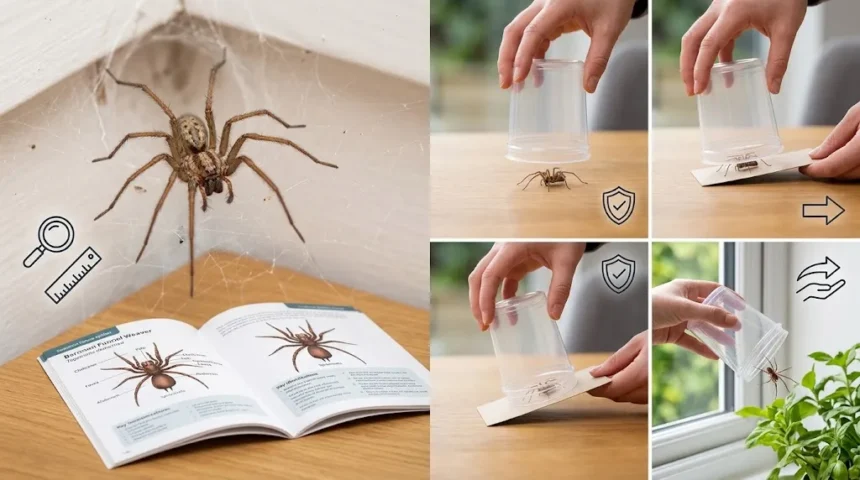
For a single spider in an accessible location, the cup-and-card method is one of the simplest removal techniques. Place a clear container over the spider, then carefully slide a stiff piece of paper or thin cardboard between the container and the surface. Once the spider is enclosed, carry the container away from busy living areas and release it in an appropriate sheltered location if local conditions allow. Wearing gloves can provide additional reassurance, especially if identification is uncertain. Move slowly rather than trying to chase the spider because sudden movements can cause it to run into a harder-to-reach area.
A vacuum can also remove spiders and webs when direct capture is impractical. This method is especially useful for high ceiling corners, basements, garages, or areas containing multiple webs. Vacuuming can remove spiders, egg sacs, and trapped insect remains simultaneously. If you use a bagless vacuum, empty the container outdoors afterward when appropriate. A vacuum is not necessarily the best choice when a medically important species is suspected and identification may be useful, because the spider can be damaged. In that situation, professional removal or safe container capture may be preferable.
Web removal is useful when spiders repeatedly occupy the same indoor locations. Use a vacuum attachment, long-handled duster, or other suitable tool to remove webs from corners, ceilings, window frames, and storage areas. Repeatedly disturbing a web-building spider’s preferred site may encourage it to relocate. Removing webs also helps homeowners see whether new activity develops after cleaning. However, web removal alone may not solve a persistent problem when abundant insect prey remains. Combining cleaning with insect management and entry-point sealing produces better long-term results.
Avoid catching unknown spiders with bare hands, even when they appear small or harmless. A spider trapped between skin and another surface is more likely to bite defensively than one left undisturbed. Children and pets should also be kept away while removal takes place. If the spider disappears behind furniture or into a wall gap, there is usually no need to dismantle the entire room unless a medically significant species is strongly suspected. Most wandering spiders will continue searching for prey or shelter and are unlikely to seek human contact deliberately.
Professional pest control may be worth considering when spiders appear frequently, egg sacs are widespread, or species with medical significance are repeatedly identified. A good pest professional should inspect the building for entry points, prey insects, moisture, clutter, and outdoor habitat rather than relying only on pesticide treatment. Chemical control may be useful in some situations, but environmental changes often provide more durable results. Ask what species is present and why a particular treatment is recommended. Understanding the cause of repeated spider activity makes it easier to prevent the same problem from returning.
How to Prevent House Spiders From Coming Back
Sealing entry points is one of the most effective prevention strategies. Inspect around exterior doors, window frames, vents, plumbing penetrations, utility cables, foundations, and garage doors for gaps. Install or repair weather stripping where doors do not close tightly. Replace damaged window screens and seal appropriate cracks using materials suited to the building surface. These steps also reduce entry by many insects, indirectly making the home less attractive to spiders. Because tiny gaps are unavoidable in most buildings, the goal is reduction rather than complete elimination.
Reducing indoor insect populations is equally important. Spiders stay where food is available, so persistent fly, moth, ant, cockroach, or other insect problems can support spider activity. Keep food stored securely, clean spills and crumbs, manage trash, and address moisture that attracts certain pests. Window and door screens can reduce flying insects entering from outdoors. If a particular pest is abundant, identify and manage that problem directly. Removing spider prey often creates an environment where fewer spiders can survive long enough to establish webs or reproduce.
Regular cleaning makes indoor spaces less suitable for web-building spiders. Vacuum corners, ceilings, behind furniture, under beds, along baseboards, and inside storage areas periodically. Pay special attention to quiet rooms that are rarely disturbed. Remove old webs even when the spider is no longer visible because egg sacs may remain nearby. Decluttering can make cleaning easier and eliminate protected hiding areas. Storage boxes with tight-fitting lids are particularly useful in attics, garages, and basements where cardboard and paper can provide shelter for spiders and insects.
Outdoor lighting can influence the number of spiders near entrances because many insects are attracted to lights at night. Those insects become prey, encouraging spiders to build webs near doors, windows, and porch fixtures. Where practical, turn off unnecessary outdoor lights or position lighting farther from frequently used entrances. Cleaning webs around exterior lights periodically may also help. Vegetation should be trimmed away from walls and windows where it creates bridges into the building. Firewood, garden materials, and debris are better stored a reasonable distance from exterior walls.
Moisture control is another useful strategy, particularly in basements, crawl spaces, bathrooms, and garages. Some insects thrive in damp environments, indirectly attracting spiders. Repair leaks, improve ventilation, and consider dehumidification where persistent humidity is a problem. Fixing moisture problems can also reduce mold and structural damage, making it beneficial beyond spider prevention. A combination of sealing, cleaning, prey control, clutter reduction, and moisture management is generally more effective than depending solely on sprays. Prevention works best when the home becomes less accessible and less rewarding for both spiders and the insects they hunt.
What to Do If You Think a Spider Bit You
If you believe a spider has bitten you, begin by washing the area gently with soap and water. A cool compress may help reduce mild pain or swelling, and keeping the affected limb elevated can sometimes limit swelling. Avoid aggressively squeezing, cutting, or attempting to suck venom from the bite. These methods do not reliably remove venom and can cause additional tissue injury or infection. If symptoms remain mild and localized, monitoring the area may be reasonable. However, significant or worsening symptoms deserve professional assessment rather than repeated home treatment.
If the spider can be photographed safely, a clear image may help with identification. Do not risk another bite trying to capture it with bare hands. If it is already contained and can be transported safely, healthcare professionals may sometimes find identification useful, depending on the region and symptoms. Remember that many skin lesions blamed on spiders have other causes, including bacterial infections, allergic reactions, insect bites, or inflammatory skin conditions. The absence of an observed spider makes diagnosis based solely on the wound particularly uncertain.
Seek prompt medical care if pain becomes severe, swelling spreads rapidly, or the person develops muscle cramps, weakness, vomiting, fever, significant sweating, or other systemic symptoms. Difficulty breathing, facial or throat swelling, fainting, or widespread hives can indicate a severe allergic reaction requiring emergency treatment. Eye exposure, bites involving very young children, or concerning symptoms in medically vulnerable individuals may also justify earlier evaluation. Medical professionals can determine whether specific treatment is needed and whether another diagnosis better explains the symptoms.
Changes in the skin over several days also deserve attention. Increasing warmth, pus, spreading redness, fever, or worsening tenderness can indicate infection. Darkening skin, blistering, or an expanding wound should not be managed solely with online images or home remedies. Several medical conditions can resemble descriptions of severe spider bites, and delaying appropriate treatment may allow them to worsen. If you draw a small line around redness to monitor spread, do not use that technique as a substitute for care when the area is clearly getting worse.
Prevention remains easier than treating a suspected bite. Shake out shoes, gloves, clothing, or bedding that has been stored in garages, sheds, basements, or other spider-prone areas. Wear gloves when moving firewood, boxes, or materials that have been undisturbed outdoors. Avoid reaching blindly into dark spaces where spiders may hide. These precautions are especially useful in regions with medically significant species. Most household spider encounters will never result in a bite, but simple awareness can reduce the already low chance of accidental contact.
When Should You Call Pest Control for House Spiders?
Seeing one or two spiders occasionally does not necessarily require professional pest control. Spiders naturally enter buildings from time to time, and a single wandering spider may have no connection to an indoor population. Simple capture, vacuuming, and inspection of entry points may be enough. If sightings occur mainly during a particular season, outdoor movement could explain them. Homeowners should look for patterns rather than assuming every spider indicates an infestation. Frequent webs, egg sacs, or repeated sightings in the same area provide stronger evidence that spiders are established indoors.
Professional help becomes more useful when large numbers of spiders keep appearing despite cleaning and exclusion efforts. This may indicate abundant insect prey, structural entry points, moisture problems, or suitable hiding locations that have not been addressed. A pest professional can inspect areas that homeowners may overlook, including crawl spaces, attics, wall voids, exterior foundations, and utility penetrations. The goal should be to identify why spiders are present rather than simply spraying visible individuals. A treatment plan based on inspection is more likely to provide lasting improvement.
Repeated identification of a medically significant spider species is another reason to seek professional assistance. The actual risk depends heavily on geographic location, so species known to occur locally should receive the most attention. A qualified pest professional can often distinguish common look-alikes from species that require more careful management. This is valuable because misidentification can lead either to unnecessary panic or to underestimating a genuine problem. Photos and specimens captured safely can sometimes assist identification before a treatment plan is developed.
Households with small children, people with mobility limitations, or individuals who may have difficulty avoiding spiders may also prefer professional management sooner. The same may apply when spiders occupy bedrooms, nurseries, frequently used closets, or other areas where accidental contact is more likely. Professional treatment should still be combined with practical steps such as reducing clutter and sealing openings. Chemical treatments alone rarely create a permanently spider-free environment if insect prey and access points remain unchanged.
Ask pest-control providers about their inspection process, target species, recommended treatment, and prevention strategy before hiring them. Good professionals should be able to explain whether pesticides are necessary and where they would be applied. Indoor pesticide use should be targeted rather than excessive, particularly in homes with children or pets. Integrated pest management combines sanitation, exclusion, habitat modification, monitoring, and carefully selected treatments when needed. This approach typically provides a more practical and sustainable solution than reacting to each individual spider after it appears.
Frequently Asked Questions About House Spiders
Are house spiders dangerous?
Most spiders commonly found inside homes are not dangerous to people and generally avoid human contact. However, a small number of medically significant species exist in certain regions, so unfamiliar spiders should not be handled with bare hands.
Why do I suddenly have spiders in my house?
A sudden increase can occur because of seasonal movement, changing weather, available insect prey, or easy entry points around doors and windows. Repeated sightings may also indicate quiet hiding places or an underlying insect problem.
Should I kill house spiders?
Killing a spider is usually unnecessary if it can be safely left alone or relocated. Many house spiders help control insects, although removal may make sense when they are in bedrooms, busy living spaces, or areas where accidental contact is likely.
What is the easiest way to remove a spider?
Place a clear container over the spider and carefully slide a stiff piece of paper or cardboard underneath it. Move the spider without touching it directly, or use a vacuum when safe capture is impractical.
How can I keep spiders out of my house?
Seal cracks and gaps, repair screens, reduce clutter, vacuum webs regularly, manage indoor insects, control moisture, and keep vegetation or stored materials away from exterior walls. Combining these measures generally works better than relying only on pesticides.