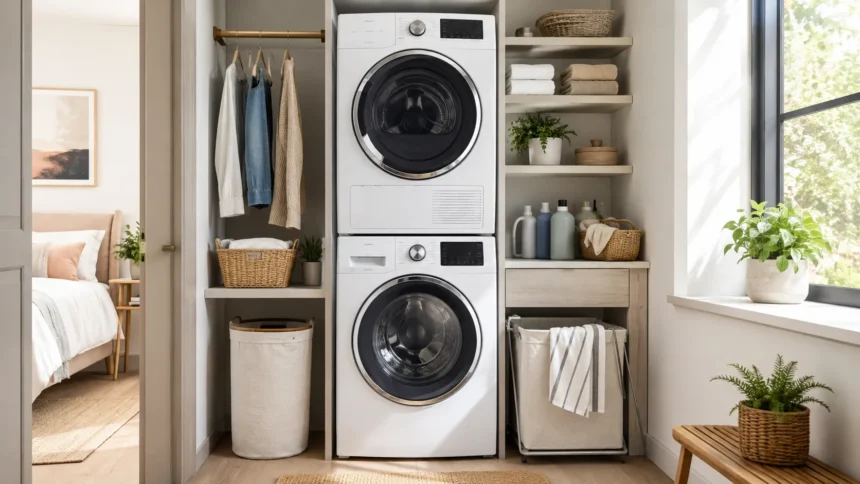
Stackable Washer and Dryer: Best Space-Saving Options
A stackable washer and dryer can turn a narrow closet, compact utility room, apartment corner, or small laundry area into a functional washing and drying space without sacrificing full-sized performance. Instead of placing two appliances side by side, the dryer sits above the washer or both machines are built into a single vertical laundry tower. This arrangement can reduce the amount of floor space required while leaving room for storage, countertops, shelving, or other household features. Modern options range from traditional 27-inch front-load pairs to compact 24-inch systems, factory-built laundry towers, and ventless heat-pump models. Some households may even save more space with a single all-in-one washer-dryer rather than a stacked pair. Choosing the right setup depends on available dimensions, ventilation, electrical connections, load size, budget, and laundry habits.
Space-saving laundry appliances have also become more flexible because ventless drying technology can reduce the need for a traditional exhaust duct. ENERGY STAR notes that heat-pump dryers operate in a closed-loop system, do not require exterior ventilation, and are available in compact formats that can be stacked with compatible washing machines. Full-size integrated towers such as the LG WashTower and Samsung Laundry Hub provide larger capacities while keeping controls easier to reach than conventional stacks. Meanwhile, all-in-one machines such as the GE Profile UltraFast combine washing and heat-pump drying within a single cabinet. The best stackable washer and dryer is therefore not simply the smallest model available. It is the configuration that uses your space efficiently while still handling the amount of laundry your household actually produces.
What Is a Stackable Washer and Dryer?
A stackable washer and dryer is a laundry setup in which two compatible appliances are installed vertically rather than next to each other. In most conventional systems, a front-loading washer sits on the floor while a compatible dryer is secured above it using a manufacturer-approved stacking kit. The arrangement usually uses approximately the floor footprint of one appliance instead of two, which can be particularly useful in apartments and narrow laundry rooms. Stackable units can still be separate machines, meaning the washer and dryer can often be repaired or replaced individually. This differs from an integrated laundry tower that arrives as one vertically designed appliance. Understanding this distinction helps shoppers compare flexibility, installation requirements, and long-term replacement costs.
Front-loading washers are usually used for stacking because their doors open from the front rather than from the top. A traditional top-load washer needs significant space above the lid, which makes placing a full-size dryer directly over it impractical. Front-load machines also tend to have relatively flat cabinet tops designed to work with specific stacking hardware. However, two appliances should never be stacked merely because their dimensions look similar. The washer and dryer need to be approved as a compatible pair, and the specified stacking kit should be installed correctly. A dryer that is simply placed on top of a washer can shift from vibration and create a serious safety hazard. Manufacturer compatibility matters as much as the physical width of the machines.
A laundry center provides another vertical approach but differs from two individually stackable appliances. Traditional laundry centers usually combine a washer below and dryer above within one factory-built frame, often with simpler controls and smaller capacities than premium front-load pairs. Newer laundry towers have modernized this idea by offering large front-load drums and centralized controls positioned around the middle of the appliance. Samsung describes its Bespoke AI Laundry Hub as a single factory-stacked appliance with a shared control panel, whereas a conventional stacked pair consists of two separate appliances joined during installation. This integrated design can make controls easier to reach and eliminate the need to choose a separate stacking kit.
Compact stacking systems are designed for spaces where even a standard 27-inch appliance is too wide or deep. These machines are commonly around 24 inches wide and may use ventless condenser or heat-pump drying technology. Compact units can be particularly useful inside closets, condos, tiny homes, accessory dwelling units, and renovated kitchens where a conventional dryer vent is unavailable. ENERGY STAR specifically notes that compact heat-pump dryers can be stacked with compact washers and installed in tighter locations because exterior ventilation is unnecessary. The tradeoff is usually smaller drum capacity, which may require more loads for large households. Compact therefore means more efficient use of physical space, not necessarily greater laundry capacity.
An all-in-one washer-dryer is technically different from a stackable set but belongs in the same space-saving conversation. Instead of separating washing and drying between two drums, a combination machine performs both stages within one cabinet. This eliminates the vertical height needed for a dryer and may allow laundry installation beneath cabinetry or in areas that cannot accommodate a tower. Modern heat-pump combinations can also operate without an exterior dryer vent, increasing placement flexibility. GE states that its Profile UltraFast Combo uses a ventless heat-pump system, operates from a dedicated 120-volt outlet, and is designed to use about half the space of a traditional separate washer-and-dryer set. The downside is that washing and drying cannot usually happen simultaneously in separate loads.
Best Space-Saving Washer and Dryer Options
A single-unit laundry tower is one of the strongest options for households that want full-size capacity with a smaller floor footprint. The LG WashTower is a current example, combining a 4.5-cubic-foot washer with a 7.4-cubic-foot dryer in a vertical cabinet measuring approximately 27 inches wide, 74⅜ inches high, and 30⅜ inches deep on selected models. Its center-mounted controls are easier to reach than controls placed at the top of a separately stacked dryer. This type of design works well for families that do regular full-size loads but have limited horizontal space. The main limitation is that the integrated structure provides less freedom to replace only one half of the system later.
A modern laundry hub offers a similar vertical footprint with a different feature set. Samsung’s current Bespoke AI Laundry Hub is sold as a factory-stacked washer and dryer with shared controls and configurations offering a 4.6- or 5.3-cubic-foot washer paired with a 7.6-cubic-foot dryer. Samsung lists common dimensions at approximately 27 inches wide, 74.4 inches high, and roughly 31.3 to 34.4 inches deep depending on model and configuration. This makes it appropriate for narrow laundry spaces where width is more limited than ceiling height. Large-capacity towers are particularly appealing when homeowners want space savings without dropping to compact drums. Always measure depth carefully because doors, hoses, ducting, and wall clearances increase the practical installation footprint.
A 24-inch compact washer with a stackable heat-pump dryer can be the better choice for apartments, closets, tiny homes, and European-style laundry spaces. These systems trade some drum volume for reduced cabinet width and depth while retaining two independent appliances. Heat-pump dryers are especially useful because they recycle warm air internally instead of venting hot humid air outdoors. ENERGY STAR states that heat-pump dryers do not require exterior ventilation and that compact models can be stacked with matching compact washers in small living spaces. Brands currently offering ENERGY STAR heat-pump options include manufacturers such as LG, Miele, Samsung, Whirlpool, Beko, Blomberg, and Asko. Compact stacks are often the best solution when a traditional vent route would be difficult or impossible to construct.
A traditional 27-inch front-load stackable pair remains one of the most flexible choices for homeowners who want independent machines and broad model selection. The washer sits beneath a matching dryer and the two cabinets are connected using the manufacturer’s stacking hardware. This configuration offers more freedom than an integrated tower because one appliance may be replaceable without discarding the other, although future compatibility needs to be checked carefully. Standard-width front-loaders can also provide larger drums than many compact systems, making them suitable for bedding, towels, and family laundry. Buyers can choose between vented electric, gas, or ventless heat-pump dryers depending on available utilities. The main disadvantage is that conventional dryer controls can become difficult for shorter users to reach once the appliance is elevated.
An all-in-one heat-pump washer-dryer offers the smallest overall appliance count and can work exceptionally well where vertical clearance is restricted. GE’s current Profile UltraFast Combo, for example, is approximately 28 inches wide, 46.7 inches high, and 32 inches deep, combining a washer and dryer within one ventless cabinet. Samsung also offers large-capacity all-in-one laundry combinations in its current lineup. These machines eliminate the need to transfer clothes between washer and dryer, which can be convenient for overnight or unattended cycles. However, the single drum becomes a bottleneck for households that frequently wash one load while drying another. They are best suited to users who value simplicity and installation flexibility more than maximum laundry throughput.
Stackable Pair vs Laundry Tower vs Washer-Dryer Combo
A separately stackable pair provides the greatest traditional flexibility because the washer and dryer remain distinct appliances. If the dryer develops a problem years before the washer, it may be possible to repair or replace only that machine rather than buying an entirely new laundry system. Separate appliances also allow one load to dry while another washes, which can significantly increase throughput on busy laundry days. Owners can often choose from multiple dryer types within the same product family, including vented electric, gas, or heat-pump configurations. The downside is installation complexity because the machines must be physically compatible and joined with the correct stacking kit. Controls may also be positioned inconveniently high on some dryer models.
An integrated laundry tower simplifies vertical installation because the washer and dryer are designed together from the beginning. This can improve ergonomics because manufacturers can place one shared control panel between the two drums. LG describes its WashTower as a single-unit vertical design intended to use half the functional floor space of a traditional side-by-side pair. Samsung similarly distinguishes its Laundry Hub from a conventional stack by describing it as one factory-stacked appliance with shared controls. These designs look clean and can provide full-size capacities in a narrow footprint. Their biggest tradeoff is reduced modularity because the washer and dryer are more closely tied together as one purchased system.
Traditional laundry centers are generally more basic than premium laundry towers. They often use a top-load washer below a smaller dryer and are designed for rental properties, apartments, closets, and straightforward everyday laundry. Because the washer lid sits beneath the elevated dryer, the machines are engineered together with sufficient opening space rather than being assembled from ordinary top-load appliances. Capacity can be smaller than that of modern front-load towers, especially in older designs. However, the simple construction can be appropriate when budget and space are more important than premium features. Shoppers should compare usable drum volume rather than assuming every vertically integrated product can handle the same load size. A narrow footprint does not guarantee equal capacity.
An all-in-one combination machine eliminates stacking entirely while still addressing the same space problem. This approach is particularly attractive when the available location is beneath a counter or when a tall tower would block cabinets, windows, or shelving. Ventless heat-pump models can also simplify dryer installation because there is no need to route an exhaust duct to the exterior. GE’s UltraFast Combo is designed around this concept and can operate on a dedicated 120-volt supply rather than the 240-volt circuit commonly required by conventional electric resistance dryers. The major compromise is sequential use of one drum. A large family doing five loads in one day may therefore finish more quickly with two separate machines.
The right choice ultimately depends on which type of space is actually limited. If floor width is the problem but ceiling height is available, a full-size laundry tower or stacked pair is usually the strongest solution. If both width and depth are extremely limited, a 24-inch compact stack may fit where a 27-inch system will not. If height is the limiting factor, an all-in-one washer-dryer may be more practical than stacking. If laundry volume is the main concern, separate washer and dryer drums provide the greatest throughput. Thinking about the specific constraint prevents shoppers from assuming that the smallest-looking machine automatically provides the best use of space.
Stackable Washer and Dryer Sizes and Measurements
Measuring width is the obvious starting point, but it should never be the only measurement taken. Standard full-size stackable machines are often around 27 inches wide, while compact systems commonly fall near the 24-inch category. Integrated towers such as current LG and Samsung models also commonly use approximately 27 inches of width. The opening should provide additional clearance rather than matching the cabinet width exactly because installation, vibration, airflow, and service access require some room. Baseboards and trim can reduce the usable width inside closets, so measurements should be taken at several heights. The narrowest point is the one that determines whether the appliances can physically enter the space.
Height becomes especially important when stacking because a pair that looks compact on a showroom floor can exceed six feet once installed. Current LG WashTower models, for example, stand approximately 74⅜ inches high, while Samsung lists its common Laundry Hub height around 74.4 inches. Separately stacked machines can reach similar or greater heights depending on cabinet dimensions and stacking hardware. Measure from the finished floor to the lowest obstruction, including shelves, water heaters, cabinets, pipes, or closet framing. Leave enough space for manufacturer-required clearances rather than planning an exact friction fit. Users should also consider whether they can comfortably reach controls, detergent dispensers, and dryer doors after installation.
Depth is often the measurement that causes installation surprises. A machine listed as 30 or 32 inches deep may require additional rear space for water hoses, the drain line, power cords, gas connections, or a dryer vent. Door clearance also matters because a front-load appliance can extend dramatically farther into a hallway or closet when open. LG lists approximately 55 inches of total depth with the WashTower door opened on some models, while GE lists 54.5 inches with the UltraFast Combo door opened 90 degrees. Measure the walking path in front of the machine, not merely the cabinet cavity. A door that cannot open fully can make loading bulky laundry frustrating even when the appliance technically fits.
Closet installations require additional attention because doors reduce usable space and airflow. A bifold or hinged closet door may strike the washer door when both are open, while a sliding door can reduce the width available for appliance access. Vented dryers also need an unobstructed exhaust path, and some installations require louvered doors or ventilation openings. Heat-pump dryers reduce venting requirements but still need the clearances specified by the manufacturer. ENERGY STAR highlights easier installation as a major advantage of heat-pump dryers because exterior ventilation is unnecessary. Nevertheless, “ventless” does not mean “zero-clearance.” Installation instructions remain the final authority for airflow, service access, and surrounding temperatures.
The delivery route should be measured just as carefully as the final laundry area. Doorways, staircases, hallway corners, elevators, and tight turns can prevent a large laundry tower from reaching a room that is otherwise spacious enough. Integrated towers can weigh several hundred pounds and cannot be separated into two lighter cabinets for moving. LG lists some WashTower configurations at more than 300 pounds, illustrating why professional handling can be valuable. All-in-one heat-pump combinations can also be unusually heavy because one cabinet contains both washing and drying systems. Shoppers should compare packaged and unpackaged dimensions before ordering. A perfect laundry-room measurement is meaningless if the appliance cannot safely travel from the entrance to the installation point.
Vented vs Ventless Dryers in a Stacked Setup
A conventional vented dryer pulls air into the appliance, heats it, moves it through damp clothing, and exhausts warm humid air through a duct leading outdoors. This technology is familiar, relatively fast, and widely available in both electric and gas configurations. The dryer vent needs to remain short, smooth, correctly sized, and free from excessive lint buildup to maintain safe performance. A poor vent route can increase drying time and create maintenance problems. Vented dryers therefore work best when the laundry area already has an appropriate exterior duct. Creating a new vent can be difficult in apartments, interior closets, concrete buildings, or spaces located far from an exterior wall.
A heat-pump dryer uses a different approach by recirculating air through a closed-loop system. Instead of repeatedly heating fresh air and exhausting it outside, the dryer removes moisture from the circulating air and reuses much of the heat. ENERGY STAR explains that this design reduces the energy needed to generate heat and eliminates the requirement for exterior ventilation. That makes heat pumps particularly appealing for compact stacks placed in closets, apartments, accessory dwelling units, and remodeled spaces. Lower-temperature drying can also be gentler on fabrics. The main tradeoffs can include longer cycle times, higher initial purchase prices, and additional filters or heat-exchanger maintenance depending on the appliance.
ENERGY STAR states that certified heat-pump dryers can reduce energy use by at least 28 percent compared with standard dryers, making energy efficiency one of the technology’s major attractions. Actual household savings depend on local electricity rates, laundry frequency, model efficiency, and what dryer is being replaced. People who run several loads every week may notice the financial benefit more quickly than occasional users. Heat-pump models can also reduce the amount of conditioned indoor air exhausted outdoors, which may matter in tightly sealed homes. Energy savings should be considered alongside installation savings when a new vent would otherwise need to be constructed. A higher purchase price can sometimes be offset by easier placement and lower operating costs.
Condenser dryers are another ventless category, although they should not be confused with heat-pump dryers. Conventional condenser models remove moisture from warm air without venting outside but can use electric resistance heating and consume more energy than heat-pump designs. They may also release more heat into the surrounding room. Heat pumps accomplish condensation while recovering and reusing heat, which generally improves efficiency. When comparing compact ventless appliances, buyers should therefore look specifically for the drying technology rather than assuming all ventless models perform identically. An ENERGY STAR certification can provide another useful efficiency reference. The word “ventless” explains the installation style, not the exact energy performance.
Gas dryers introduce additional installation considerations in stacked systems. They require an appropriate gas connection, combustion ventilation, and an exterior exhaust duct rather than operating as a fully ventless appliance. Gas models may make sense when an existing laundry area already has the correct infrastructure and local energy prices are favorable. Electric resistance dryers usually require a suitable high-voltage circuit, while some newer heat-pump and combination machines use standard 120-volt supplies. The GE Profile UltraFast Combo, for example, is specified for a dedicated 120-volt circuit. The best dryer technology is therefore partly determined by the utilities already available in the home.
Capacity and Features That Matter Most
Washer capacity should match household laundry volume rather than simply fitting into the smallest available cabinet. Compact washers are useful for one or two people but may require extra cycles when washing large bedding, towels, or family clothing. Full-size front-load washers around the 4.5- to 5-plus-cubic-foot range can handle larger loads while still fitting into a 27-inch vertical footprint. Current LG WashTower models provide approximately 4.5 cubic feet of washer capacity with 7.4 cubic feet in the dryer, while Samsung’s current Laundry Hub configurations offer washers around 4.6 or 5.3 cubic feet with 7.6-cubic-foot dryers. These examples show that space-saving vertical design does not necessarily require compact drum capacity.
Dryer capacity is typically larger than washer capacity because wet clothing needs room to tumble and expose more surface area to heated air. A small dryer paired with a relatively large washer may force users to split one washed load into two drying cycles. Manufacturers design matched pairs with this relationship in mind, which is another reason compatible washer-dryer sets can be easier to manage than randomly combining appliances. People who regularly wash comforters or bulky bedding should pay particular attention to dryer volume. A machine may technically wash a large item while still struggling to tumble it properly during drying. Capacity claims should therefore be considered alongside the types of loads actually washed at home.
Centralized controls are particularly valuable in stacked installations because a traditional dryer’s panel can end up well above eye level. Laundry towers solve this problem by placing controls between the washer and dryer doors. LG markets its Center Control arrangement as one of the WashTower’s ergonomic advantages, while Samsung’s Laundry Hub similarly uses one shared Easy Reach control panel. Separate stackable sets increasingly offer connected controls that may allow dryer settings to be accessed through the washer panel or a smartphone application. This feature can matter more than it appears during showroom shopping. A technically excellent dryer is inconvenient if the primary user cannot comfortably reach its controls.
Automatic detergent dispensing can save time and reduce excessive detergent use in households doing frequent laundry. Smart-dispense systems store enough detergent for multiple loads and meter an amount based on cycle settings or load characteristics. Wi-Fi features can also provide cycle completion alerts, remote monitoring, diagnostics, and downloadable cycles on compatible machines. These functions are helpful but should remain secondary to cleaning performance, reliability, capacity, and installation suitability. A small apartment owner may benefit more from a ventless dryer than from a touchscreen. Conversely, someone placing laundry machines on another floor may genuinely value phone notifications because they reduce unnecessary trips to check whether a cycle has finished.
Noise and vibration deserve extra attention when laundry appliances are installed near bedrooms, kitchens, or living areas. Front-load washers use high spin speeds to remove water, and an unbalanced machine can transmit considerable vibration into floors or surrounding cabinets. Proper leveling is essential, particularly when a dryer is stacked above the washer and raises the total center of mass. Modern machines may include load-balancing or vibration-control systems, but they cannot compensate for a severely uneven floor or incorrect installation. Solid flooring generally performs better than flexible surfaces that amplify movement. Buyers placing a stack in an upstairs closet should therefore consider installation quality and noise ratings alongside appearance and capacity.
Installation and Safety Considerations
The washer should almost always occupy the bottom position in a conventional stack because it is heavier and produces greater vibration during high-speed spin cycles. The dryer is lighter and is designed to be secured above the compatible washer using manufacturer-approved hardware. Reversing this arrangement would create an unstable and unsafe structure. A stacking kit usually includes brackets or hardware engineered for specific models, and generic improvisation should be avoided. Even appliances from the same brand may require different kits across product generations. Check model numbers rather than assuming visual similarity confirms compatibility. Professional installation can be particularly worthwhile when the machines are heavy or access to the laundry closet is difficult.
Water connections need to remain accessible enough for inspection and emergency shutoff. The washer requires hot and cold supply connections or the configuration specified by the manufacturer, along with a drain line installed at the correct height. Hoses should not be crushed behind the appliance or stretched tightly against fittings. Flood-protection hoses, leak sensors, and accessible shutoff valves can provide additional reassurance, especially when the laundry area is located upstairs. A drain pan may also be appropriate depending on local building requirements and installation conditions. Vertical space savings should not come at the expense of making basic plumbing impossible to inspect or service.
Dryer installation requirements vary significantly according to technology. A vented electric or gas dryer requires a properly sized exhaust duct routed outside, while a heat-pump model generally avoids that requirement. Gas dryers also need appropriate fuel connections and combustion safety considerations, making professional installation especially important. Electrical requirements can range from standard household voltage for certain heat-pump combinations to higher-voltage circuits for conventional electric dryers. The installation manual should be checked before purchasing rather than after delivery. An appliance that physically fits may still be unusable if the required outlet, vent, drain, or gas connection is absent.
Closet installations need to account for clearances and ventilation specified by the appliance manufacturer. A common mistake is measuring the washer and dryer cabinets and building a closet that leaves almost no room around them. This can make installation, hose replacement, lint maintenance, and future repairs extremely difficult. Doors may also need ventilation openings for some systems, particularly conventional vented or gas appliances. Heat-pump products offer more placement flexibility but still produce operational heat and require specified clearances. GE notes particular clearance and ventilation requirements for its UltraFast Combo installation even though the appliance itself is ventless. Always treat manufacturer instructions as the final specification rather than relying solely on general space-saving advice.
Routine maintenance remains essential after installation. Dryer lint filters should be cleaned according to manufacturer directions, and vented dryer ducts should be inspected because accumulated lint can reduce performance and create a fire risk. Heat-pump dryers may have additional filters or heat-exchanger maintenance requirements that differ from conventional models. Washer door gaskets and detergent dispensers should also be kept clean to limit residue and odors. Water hoses should be inspected periodically for cracking, bulging, or leakage. A stacked configuration can make some components harder to reach, which makes planning service access at installation particularly valuable. Saving six inches of closet space is not worthwhile if basic maintenance later requires dismantling the surrounding room.
Pros and Cons of a Stackable Washer and Dryer
The clearest advantage of stacking is floor-space efficiency. A washer and dryer that would normally occupy roughly twice the horizontal width can fit within a single vertical footprint. This can free adjacent space for cabinets, a utility sink, shelves, hanging rods, or simply more room to walk through a narrow area. Vertical layouts can also make it possible to add laundry appliances to locations that could never accommodate a side-by-side set. Apartments and condos benefit particularly from this flexibility because every square foot may matter. Space savings become even greater when ventless technology eliminates the need to reserve wall space for an awkward dryer duct route.
A second advantage is that shoppers do not necessarily have to sacrifice capacity. Modern 27-inch laundry towers and full-size front-load stacks can handle substantial household loads while using relatively little floor width. Large dryers positioned vertically can still accommodate towels and bedding, which makes a tower viable for families rather than only single occupants. Buyers can also choose premium features comparable with side-by-side machines, including steam cycles, automatic dispensing, Wi-Fi connectivity, and advanced sensing. The visual appearance can be cleaner as well because a single vertical column creates a defined laundry zone. In open-plan homes, an integrated tower can look more intentional than two unrelated appliances occupying a long wall.
Ergonomics can be either an advantage or disadvantage depending on the design. The washer door remains relatively low, which can require bending unless the entire system is designed with a raised drum. The dryer is conveniently elevated for loading, but its conventional top-mounted controls may be difficult for shorter users to reach. Integrated towers reduce this problem by placing controls in the middle. People with mobility limitations should physically test door heights and control locations before purchasing whenever possible. A configuration that saves space but creates daily accessibility problems is not truly practical. Smart-phone controls can help in some cases but should not be the only way someone can comfortably operate essential functions.
Repair flexibility can also become a disadvantage with integrated laundry towers. Two separately stackable machines remain distinct appliances, allowing one to potentially be replaced while the other stays in service. A factory-integrated tower is designed as one system, which may make future replacement decisions more complicated if one half develops a major problem. All-in-one washer-dryers concentrate even more functionality into a single cabinet, so one appliance failure can interrupt both washing and drying. On the other hand, fewer separate machines and connections can simplify the installation itself. Buyers planning to remain in a home for many years should consider service availability and warranty coverage alongside initial space savings.
Cost varies widely and should be evaluated as total installed cost rather than appliance price alone. A basic laundry center can be affordable, while premium smart towers and heat-pump combinations can cost considerably more. Yet a ventless system may avoid the expense of creating a new exterior dryer duct, upgrading some utilities, or remodeling a larger laundry room. Heat-pump dryers can also reduce electricity use over time. ENERGY STAR notes meaningful energy savings compared with standard dryers, particularly for households with frequent dryer use and higher electricity rates. The financially best option is therefore the system that balances purchase cost, installation needs, energy use, repairability, and expected years of ownership.
How to Choose the Best Stackable Washer and Dryer
Begin by deciding exactly where the appliances will go and measure that space before comparing brands. Record width, height, cabinet depth, door-clearance depth, utility locations, and the dimensions of the path leading to the installation area. Note whether an exterior dryer vent already exists and whether the electrical supply matches conventional dryer requirements. If the location lacks ventilation, a heat-pump dryer or all-in-one ventless combo may immediately become more attractive. If ceiling height is limited, a tall tower may be ruled out regardless of its excellent capacity. Space should narrow the product category before features and appearance enter the decision.
Next, estimate realistic household capacity needs. One or two people living in an apartment may find a compact 24-inch system entirely sufficient, particularly when laundry is done several times per week. A family washing sports clothing, towels, school uniforms, and bedding may benefit from a full-size 27-inch tower despite its greater depth. People who prefer to wash large batches less frequently also need more drum capacity than those who run small loads regularly. Consider the largest items washed at home, not merely average clothing loads. A machine that saves a few inches but forces every comforter to the laundromat may not provide the convenience expected from an in-home laundry system.
Then decide whether throughput or simplicity matters more. Separate washer and dryer drums allow simultaneous washing and drying, which is valuable when several loads need to be completed in one day. An all-in-one combo removes the transfer step and can occupy less space, but the next wash cannot begin until the current load has completed both stages. Integrated towers provide two drums while still simplifying controls and appearance. There is no universally superior arrangement because households use laundry equipment differently. Someone doing one overnight load may love an all-in-one machine, while a family doing six Saturday loads may find the same workflow frustrating.
Compare the actual technology instead of choosing only by brand reputation. Look at washer capacity, dryer capacity, vented versus heat-pump drying, spin speed, energy certification, noise, door configuration, cycle selection, warranty, and availability of local service. Smart features and touchscreen interfaces can be useful but should not distract from installation requirements or repair access. Heat-pump dryers deserve particular consideration where energy efficiency and ventless placement are important. ENERGY STAR’s current guidance highlights compact installation, lower-temperature fabric care, and reduced electricity use as major heat-pump advantages. Choose technology that solves a real household problem rather than paying for features that will rarely be used.
Finally, verify every specification immediately before purchasing because model dimensions, electrical requirements, stacking kits, and available configurations can change. Download the installation manual for the exact model number rather than relying only on retailer summaries. Confirm that the washer and dryer are officially stackable together and that the necessary kit is available. If buying a single tower, verify that the assembled appliance can physically pass through doors and stairs. For unusual installations, consider having a qualified installer inspect plumbing, electrical supply, gas connections, and ventilation in advance. The best stackable washer and dryer is ultimately the system that fits safely, handles your normal loads comfortably, and remains practical to operate and maintain for years.
Frequently Asked Questions About Stackable Washers and Dryers
Are stackable washers and dryers good for small spaces?
Yes. Stackable washers and dryers reduce horizontal floor space by placing the dryer above the washer, making them useful for apartments, closets, condos, narrow laundry rooms, and small homes. Compact ventless systems can provide even more installation flexibility.
What size is a typical stackable washer and dryer?
Many full-size stackable systems are approximately 27 inches wide, while compact laundry appliances are commonly around 24 inches wide. Integrated towers can stand around 74 inches tall, but exact width, depth, height, door clearance, and installation spacing should always be checked for the specific model.
Do stackable dryers need a vent?
Traditional vented dryers require an exterior exhaust duct, but heat-pump dryers are ventless and can be stacked with compatible washers. ENERGY STAR notes that this makes compact heat-pump models especially useful for tight spaces where installing a dryer vent would be difficult.
Is a laundry tower better than two separate stackable machines?
A laundry tower can provide easier-to-reach central controls and a clean integrated design, while separate stackable machines usually offer more flexibility if one appliance needs replacement later. The better choice depends on accessibility, repair preferences, capacity, and the exact installation space.
What is the most space-saving washer and dryer option?
For very limited floor and vertical space, a single all-in-one ventless washer-dryer can occupy less total room than two separate appliances. If you need to wash and dry different loads simultaneously, a compact 24-inch stack or full-size laundry tower generally provides a better balance of space savings and laundry throughput.