Lily of the Valley Meaning: Understand Its Symbolism Before You Gift It
Lily of the valley meaning is most closely connected with the return of happiness. Its small white flowers emerge during spring, giving the plant strong associations with renewal, hope, fresh beginnings and the return of joyful experiences after a difficult period. The Royal Horticultural Society also records “return of happiness” as its traditional message.
The flower is also associated with purity, humility, sweetness and gentle love. Its downward-facing bells appear delicate rather than dramatic, which helps explain why lily of the valley is often selected for intimate weddings, meaningful bouquets, memorial arrangements and personal tattoos.
The symbolism can change according to the occasion. In a bridal bouquet, the flower may communicate devotion and a happy new chapter. In a sympathy arrangement, it may express remembrance, comfort and hope after grief. As a birth flower, it can represent optimism and emotional renewal.
This guide explores lily of the valley flower meaning in relationships, weddings, spirituality, Christianity, tattoos and gifts. It also explains the plant’s botanical identity, cultural importance and toxicity, helping you appreciate its symbolism without overlooking essential safety considerations.
The Simple Meaning
The simplest lily of the valley meaning is happiness returning after sadness. It is an encouraging flower for someone beginning again after disappointment, illness, grief, separation or another difficult experience. Its message is gentle but positive rather than loud or celebratory.
The flower can also represent hope because it disappears during the colder months and returns with fresh growth in spring. This seasonal cycle makes it a natural symbol of recovery, emotional healing and confidence that difficult circumstances can eventually improve.
Its white bell-shaped flowers contribute additional associations with innocence, honesty and purity. These meanings make lily of the valley suitable for weddings, christenings, anniversaries and other events connected with a sincere new beginning.
Flower symbolism is not a universal scientific language. Meanings have developed through folklore, religion, literature and Victorian floriography, so different people may interpret the same bloom differently. The giver’s personal message therefore matters as much as the traditional definition.
Return of Happiness
“Return of happiness” is the best-known traditional meaning of lily of the valley. Victorian flower-language references used plants to communicate feelings that might have been difficult to express openly, and lily of the valley carried this reassuring message.
This symbolism makes the flower suitable for celebrating reconciliation, recovery or a fresh start. Giving it to someone who has overcome a challenging period can express the hope that peace, confidence and enjoyment are returning to their life.
The meaning may also apply to relationships. A bouquet can represent affection being renewed after distance or misunderstanding, although flowers should support honest communication rather than replace an important conversation or apology.
For personal use, the flower may serve as a reminder that emotional conditions change. A lily of the valley illustration, garden planting or piece of jewellery can symbolise the belief that joy can reappear even after a long and difficult season.
Purity and Humility
Lily of the valley is often connected with purity because its flowers are usually white. White flowers commonly appear at ceremonies involving new beginnings, sincerity and commitment, helping the plant communicate emotional clarity rather than dramatic passion.
Its small size also contributes to its association with humility. The flowers hang downward beneath broad green leaves instead of forming large upright blooms. This modest appearance has encouraged interpretations involving quiet strength, modesty and kindness without a desire for attention.
Humility does not need to mean weakness or low self-worth. In this symbolism, it can represent confidence without arrogance, service without expectation and an ability to recognise value in simple experiences.
Someone may therefore choose lily of the valley to honour a person known for gentleness, loyalty or quiet support. The flower can feel especially meaningful when the recipient prefers understated gestures rather than large, highly colourful arrangements.
Love and Relationships
In romantic settings, lily of the valley meaning usually reflects tender, faithful and sincere love. It is less strongly associated with intense passion than a red rose, making it appropriate for relationships built around trust, emotional safety and long-term companionship.
The return-of-happiness message can also symbolise finding love after loneliness or disappointment. A partner might choose the flower to communicate that the relationship has brought hope and joy back into their life.
Because the blooms grow closely together along one stem, they may be interpreted as unity or a series of shared moments. This is a modern personal interpretation rather than a fixed historical rule, but it can add meaning to anniversary gifts and relationship tattoos.
The flower should be chosen thoughtfully when a relationship is ending or experiencing conflict. Its positive symbolism may be misunderstood as a request for reconciliation, so a short written message can clarify whether the intended meaning is gratitude, healing, friendship or renewed commitment.
Lily of the Valley Wedding Meaning
Lily of the valley is a popular symbolic wedding flower because it represents happiness, purity and a new beginning. Its delicate scale works particularly well in small hand-tied bouquets, buttonholes, table arrangements and understated floral details.
Its traditional meaning can express the hope that marriage begins a joyful chapter. White flowers also coordinate naturally with bridal clothing and can provide fragrance and texture without competing with detailed fabric or jewellery.
The flower has appeared in prominent royal arrangements. Lily of the valley formed part of the late Queen Elizabeth II’s coronation bouquet and remained one of her favourite flowers, strengthening its association with elegant and important ceremonial occasions.
Fresh stems can be expensive or difficult to source outside their natural season. Couples can still use the symbolism through illustrations, embroidered flowers, stationery, artificial stems or a fragrance-inspired detail rather than requiring large quantities of the actual plant.
Spiritual Meaning
The spiritual meaning of lily of the valley often centres on renewal, inner peace and hope. Its spring appearance can represent the movement from emotional darkness toward clarity, making it meaningful for people rebuilding their lives or developing a deeper sense of purpose.
Its downward-facing blossoms may symbolise reflection and humility. Rather than reaching upward dramatically, the flowers appear quiet and contemplative, which can make them suitable symbols for prayer, meditation and private personal growth.
The bells can also be interpreted as a call toward awareness or positive change. This is a poetic interpretation rather than a formal religious teaching, but it helps explain why the flower often appears in spiritual artwork and meaningful body art.
A person may use the flower as a reminder to remain hopeful without ignoring difficult emotions. Its message is not that sadness should be avoided, but that peace and happiness may return through patience, support and gradual healing.
Biblical and Christian Meaning
The phrase “lily of the valleys” appears in the Song of Songs, and the English plant name developed from the Latin phrase lilium convallium. However, the biblical flower cannot be confidently identified as the modern botanical species Convallaria majalis. The name became attached to this particular plant later.
In later Christian symbolism, lily of the valley became associated with purity, humility and renewal. Its white flowers fit broader religious uses of white as a sign of innocence, spiritual sincerity and new life.
The plant is sometimes called “Our Lady’s tears” or “Mary’s tears,” names recorded among its traditional common names. These names have helped connect it with stories of sorrow, compassion and hope following suffering.
Readers should distinguish traditional Christian folklore from direct biblical teaching. The symbolic connections can hold personal or cultural value, but they should not be presented as proof that the Bible specifically refers to Convallaria majalis.
May Birth Flower Meaning
Lily of the valley is commonly recognised as a birth flower connected with May. Its botanical name, Convallaria majalis, also reflects its association with May flowering, and it commonly blooms during spring in suitable climates.
As a May birth flower, it represents optimism, renewed happiness and gentle strength. These qualities can make it a meaningful birthday choice for someone born during the month, especially when the gift includes an explanation of the symbolism.
A May birth flower tattoo may represent the wearer, a partner, a child, a sibling or another loved one born in May. The Royal Horticultural Society has documented examples of botanical tattoos using lily of the valley to honour a family member’s birth flower.
Birth-flower traditions can differ between lists and regions, so the symbolism should be viewed as a meaningful custom rather than an official rule. Personal significance is more important than following one exact chart.
Lily of the Valley Tattoo Meaning
A lily of the valley tattoo commonly represents the return of happiness, emotional recovery or a hopeful new beginning. It may mark the end of a difficult chapter or remind the wearer that contentment can return after loss, illness or personal change.
The flower’s association with May makes it suitable for birth-month tattoos. A person might include one stem for themselves or combine several stems with names, dates or other birth flowers representing family members.
Its small bells also work well in fine-line and botanical tattoo designs. The stem can follow the natural shape of an arm, shoulder, rib area or ankle, while the individual flowers allow the artist to create a delicate design without requiring a large area.
Tattoo meaning remains personal. The same image might represent a wedding, recovery, a deceased loved one, quiet strength or simply an appreciation of woodland plants. A design becomes more meaningful when the wearer defines the message rather than relying entirely on internet symbolism.
White and Pink Flower Meanings
White lily of the valley carries the plant’s most familiar meanings: purity, humility, innocence, renewal and returning happiness. It is the traditional colour most commonly used in wedding arrangements, symbolic illustrations and classic garden displays.
Pink lily of the valley can add associations with gentle affection, admiration and tenderness. Pink forms exist horticulturally, although they are less common than the familiar white-flowered plant.
A white bouquet may feel formal, spiritual or bridal, while a pink arrangement can feel more personal and softly romantic. The traditional meaning of renewed happiness can apply to both colours, with the colour adding an extra emotional layer.
Colour meanings are flexible rather than fixed. Packaging, accompanying flowers and the message written on a card can change how the arrangement is understood, so choose the complete presentation according to the recipient and occasion.
Grief and Remembrance
Although lily of the valley symbolises happiness, it can also appear in memorial settings. Its message may express hope that peace will return after grief or that loving memories can eventually bring comfort alongside sadness.
The plant’s seasonal disappearance and return can symbolise continuing remembrance. This makes it suitable for honouring someone whose influence remains present even though they are no longer physically part of everyday life.
Its small downward-facing bells may resemble tears, strengthening its association with mourning and compassionate remembrance. Traditional names such as “Our Lady’s tears” also connect the flower with sorrow followed by spiritual hope.
When sending it as a sympathy flower, explain the intention carefully. A message such as “May happy memories bring comfort again” connects the traditional meaning with the recipient’s grief without suggesting that they should recover quickly.
Gifting Lily of the Valley
Lily of the valley can be gifted to celebrate recovery, reconciliation, marriage, a May birthday, a new home or another positive transition. Its message works best when the occasion involves hope, emotional renewal or a quiet expression of affection.
A small arrangement may feel more appropriate than an oversized display because the flower’s appeal lies in its delicate shape and fragrance. It can also be paired with greenery or simple white flowers without losing its distinctive character.
Include a short note explaining the meaning, especially when the recipient may not know flower symbolism. Writing “Lily of the valley represents the return of happiness” turns an attractive gift into a clear and thoughtful message.
Fresh plants and cut stems require caution in homes with children or pets because lily of the valley is toxic if eaten. A print, textile design or artificial arrangement can communicate the same symbolism without introducing a poisonous plant into an unsuitable environment.
Cultural Meaning
The Victorian language of flowers helped popularise the association between lily of the valley and returning happiness. Flower dictionaries allowed bouquets to function like emotional messages, although meanings sometimes differed among books and changed according to how flowers were presented.
The flower also holds national importance in Finland, where it is recognised as the national flower. Its familiar woodland presence, fragrance and delicate appearance contribute to its place within Finnish natural identity.
Lily of the valley has appeared in royal, bridal and ceremonial settings, reinforcing associations with elegance and tradition. Its small scale demonstrates that an important symbolic flower does not need to be physically large or brightly coloured.
Cultural symbolism changes across locations and generations. When writing about the flower for a global audience, it is more accurate to describe these associations as traditions rather than claiming that every culture gives the plant exactly the same meaning.
What the Plant Looks Like
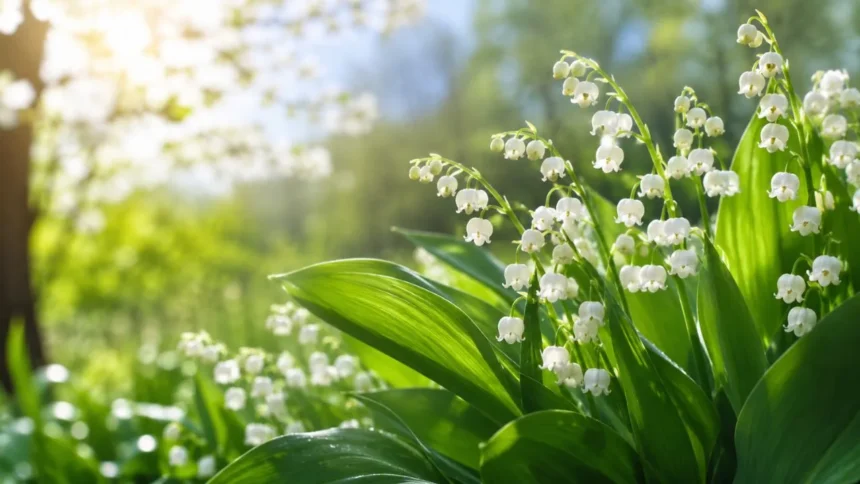
Lily of the valley has the botanical name Convallaria majalis and belongs to the Asparagaceae family. It is a rhizomatous perennial that produces broad green leaves and arching stems carrying small, fragrant, bell-shaped flowers.
The plant usually flowers during spring and may later form orange-red berries. Its white flowers often grow along one side of the stem, creating the recognisable line of hanging bells associated with the species.
It grows well in shaded woodland-style conditions and can spread rapidly through underground rhizomes. In favourable locations, it may form dense colonies and can become difficult to control or invasive, so gardeners should review local recommendations before planting it.
Lily of the valley is not a true lily from the genus Lilium. This botanical difference matters for identification and safety, although the plant remains poisonous in its own right and should never be treated as edible.
Lily of the Valley Safety
Every part of lily of the valley should be treated as poisonous if swallowed. The plant contains cardiac glycosides that can affect the heart, and exposure may cause vomiting, abnormal heart rhythm, low blood pressure, confusion, seizures or other serious symptoms.
The red berries can be especially attractive to young children. Keep plants, cut arrangements and fallen berries out of reach, and do not use the flowers or leaves to decorate food, drinks, cakes or herbal preparations.
Lily of the valley is also toxic to dogs, cats and horses. Pet owners should avoid leaving bouquets where animals can chew them and should consider safer alternatives when a pet frequently investigates household plants.
Contact a local poison centre, veterinarian or emergency medical service immediately after suspected ingestion rather than waiting for symptoms. Do not attempt to induce vomiting or administer a home remedy unless a qualified professional gives specific instructions.
Choosing the Right Symbolism
Choose lily of the valley when your message involves hope, emotional healing, sincere affection or a positive new beginning. Its symbolism is particularly strong when someone is returning to a happier period after uncertainty or hardship.
For romance, emphasise tenderness and faithful love. For a wedding, focus on shared happiness and a joyful new chapter. For remembrance, describe the flower as a symbol of comfort, enduring memory and the hope that peace will return.
For a tattoo or personal keepsake, define the meaning before choosing the final design. Decide whether the flower represents a May birthday, recovery, family connection, faith, humility or a particular person whose memory you want to preserve.
Do not worry about following every traditional definition perfectly. Flower symbolism works best as a starting point for personal expression. A clear message or story can make the bloom meaningful even when your interpretation differs from a historical flower dictionary.
Conclusion: A Symbol of Happiness Returning
Lily of the valley meaning is most widely expressed as the return of happiness. Its spring growth, white bells and sweet fragrance have also connected it with hope, renewal, purity, humility and gentle affection.
The flower is especially suitable for weddings, May birthdays, recovery gifts, meaningful tattoos and personal memorials. Its symbolism can celebrate a joyful beginning while also recognising that happiness sometimes follows a period of sadness or uncertainty.
Religious and cultural traditions add further meanings involving compassion, spiritual renewal and remembrance. These interpretations should be presented as evolving traditions rather than universal or scientifically fixed definitions.
Whether given as a bouquet, used in artwork or chosen for a tattoo, lily of the valley carries a quiet but hopeful message. Handle the real plant responsibly because of its toxicity, and accompany any gift with a few words explaining what the flower represents.
Frequently Asked Questions
What does lily of the valley symbolise?
Lily of the valley traditionally symbolises the return of happiness. It is also associated with purity, humility, hope, renewal and gentle love.
What does lily of the valley mean in love?
In love, it can represent tender affection, loyalty and happiness restored through a relationship. It is commonly chosen for understated romantic and wedding arrangements.
What is the spiritual meaning of lily of the valley?
Its spiritual meaning often involves renewal, peace, humility and hope after hardship. Some Christian traditions also connect the flower with tears, compassion and purity.
What does a lily of the valley tattoo mean?
A tattoo may represent emotional healing, a fresh start, a May birthday or remembrance of a loved one. The exact meaning depends on the wearer’s personal story.
Is lily of the valley poisonous?
Yes. All parts contain toxic cardiac glycosides and should not be eaten by people or animals. Seek professional help immediately after suspected ingestion.